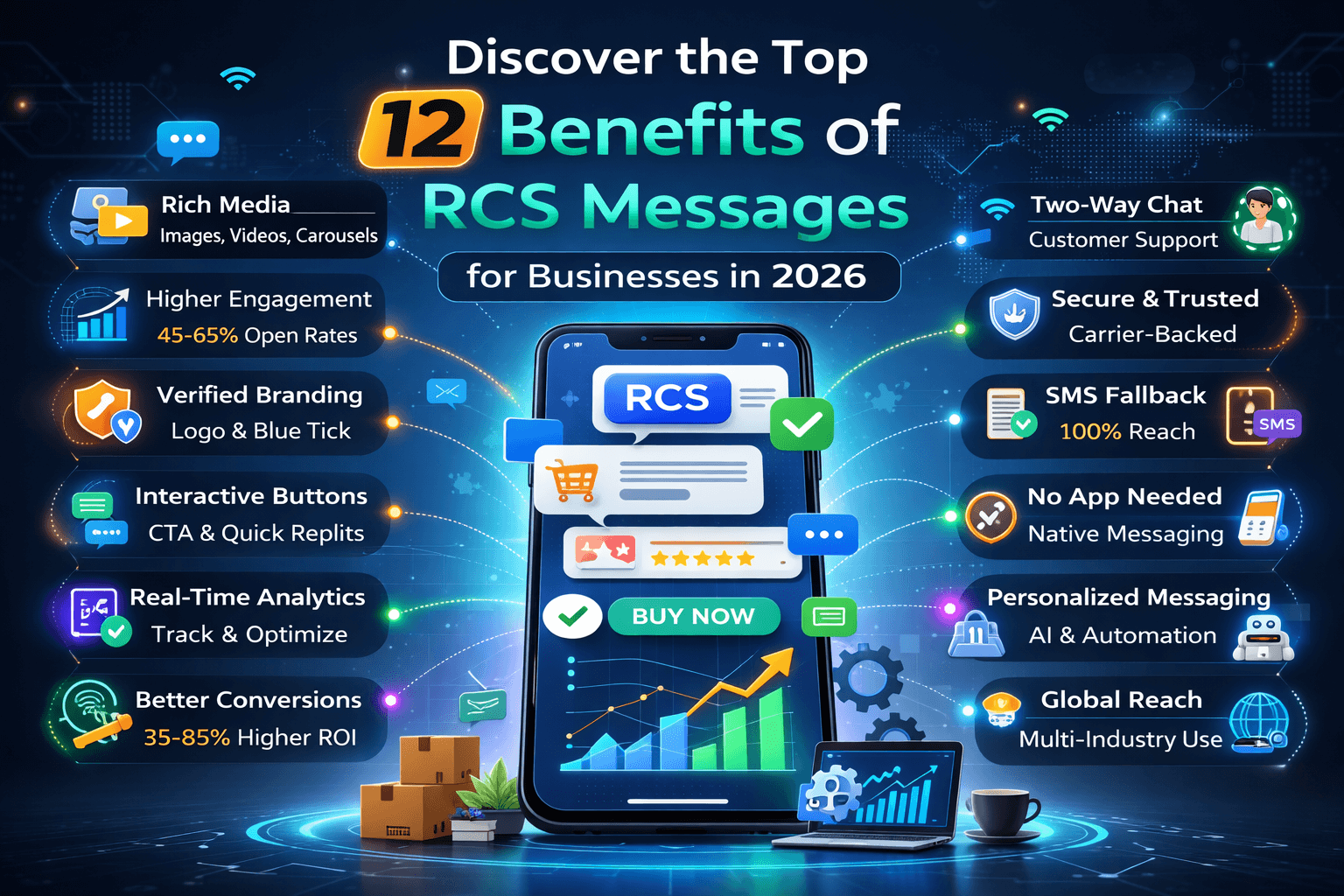
Discover the top 12 benefits of RCS messages for businesses in 2026
Discover the top benefits of RCS messaging for businesses in 2026. Learn how rich media, verified branding, and interactive messaging improve engagement, conversions, and customer experience.
Why RCSIs the Business Messaging Upgrade of 2026
Rich Communication Services (RCS) is not just a messaging format upgrade — it is a fundamental shift in the power of mobile business communication. For years, businesses have sent plain SMS messages from unrecognised short codes, with no imagery, no interactivity, no analytics beyond basic delivery confirmation, and no way to differentiate their brand from a spam sender.
RCS changes every one of those constraints simultaneously. With over 6.5 billion RCS-capable devices active globally — including every Android smartphone and every iPhone running iOS 18 or later — businesses now have access to a rich, verified, interactive messaging channel that reaches virtually every smartphone user without requiring a single app download.
This guide covers the twelve most commercially significant benefits of RCS messages for businesses in 2026, with performance data, real-world examples, and actionable context for every benefit.
|
6.5B RCS-Capable Devices Globally — End of
2025 |
45–65% RCS Open Rate vs 20–30% for Plain SMS |
3–5x Higher Click-Through Rate — RCS vs SMS |
|
35% Average Higher Engagement Rate vs Plain
SMS |
60+ Countries With Active RCS Business
Messaging |
Rs.0.01–0.05 Per-Message Cost — RCS Business
Messaging India |
RCS Business Messaging (RBM) is the commercial application of RCS infrastructure for business-to-consumer communication. It requires brand identity registration, carrier verification, and regulatory template approval — processes that produce the defining feature customers experience: every RCS message arrives with your verified business name, logo, and an official verification badge, not an unrecognised short code.
A verified sender is trusted. A trusted sender is opened. An opened, interactive message is acted upon. This chain of value is the foundation from which every benefit in this guide flows.
|
Capability |
Plain SMS |
RCS Business
Messaging |
|
Sender
identity |
Short code or unknown
number |
Verified brand name + logo
+ badge |
|
Message
format |
160 characters, plain text |
Rich text, images, video,
no char limit |
|
Interactive
content |
None |
Buttons, carousels, quick
replies |
|
Analytics |
Delivery rate only |
Open rate + clicks +
conversions |
|
Read
receipts |
Delivery confirmation only |
Delivered + read + button
clicked |
|
SMS
fallback |
It is SMS |
Automatic fallback for
unsupported devices |
|
Open rate
benchmark |
20–30% |
45–65% — up to 3x higher |
|
App
install required |
None |
None — native Messages app |
The following twelve benefits represent the full commercial case for RCS adoption. Each is supported by real performance data and positioned for immediate business application.
|
#1 ✓ TRUST |
Verified Sender Identity — The End of 'Who Sent This?' Build instant credibility with every message your
business sends Every RCS Business Message
arrives with your verified business name, official logo, and a carrier-issued
verification badge. This is not a display name that anyone can spoof — it is
a verified identity confirmed by the carrier network before any message is
delivered. The customer sees exactly who is contacting them before they read
a single word. In an environment where SMS-based phishing and
impersonation fraud is pervasive — particularly in banking, e-commerce, and
government communication — verified sender identity is not a feature, it is a
fundamental trust signal. Businesses deploying RCS consistently report that
verified identity alone drives significant lifts in open rates and customer
action, because the message is trusted before it is read. |
|
#2 🖼 RICH MEDIA |
Full-Resolution Images, Video and GIFs — Native Visual
Impact Turn every business message into a branded visual
experience RCS delivers full-resolution
images, video, and animated GIFs natively inside the Messages app — with no
link to click, no browser to open, no app to launch. Product photography
appears at full resolution. Video plays inline. Animated promotional banners
display with full motion. All of this happens within the standard messaging
interface that customers already use every day. For retail and e-commerce businesses, this is
transformative. An abandoned cart recovery message that shows the actual
product image the customer left behind — at full resolution, with the price
and a direct purchase button — drives re-engagement rates 3–4x higher than a
plain-text SMS with a URL. Visual context recreates purchase intent at the
exact moment of message delivery. |
|
#3 ▶ INTERACTIVE |
Action Buttons and Quick Replies — Zero Friction
Conversion Remove every barrier between your message and customer
action RCS messages support multiple
interactive button types: action buttons (deep-linking to specific URLs, app
screens, or payment flows), quick-reply buttons (structured response options
that return data to your system), map buttons (opening location or directions),
dial buttons (initiating a phone call), and calendar buttons (adding events
directly to the customer's calendar). All are available without any app
installation. The commercial impact of removing the click-to-URL step is
significant and consistent across industries. Customers who can complete an
action — confirm an appointment, make a payment, select a preference, book a
slot — directly from a button inside the message convert at rates 3–5x higher
than customers who must navigate a URL, wait for a page to load, and then
complete the action in a browser. |
|
Sample RCS Interactive Message — Your Brand Name Brand Logo · Verified Badge ·
Brand Name Your
appointment with Dr. Sharma is confirmed for Tomorrow at 11:00 AM City
Diagnostics · Andheri West, Mumbai [
Confirm My Appointment ] [
Reschedule ] [
Get Directions ] [
Add to Calendar ] |
|
#4 📊 ANALYTICS |
Real-Time Campaign Analytics — Measure What Actually
Matters Move from basic delivery stats to full-funnel messaging
intelligence SMS analytics ends at delivery
confirmation — you know the message was delivered to the carrier, but nothing
beyond that. RCS analytics extends to every meaningful interaction: message
delivered, message read, specific button clicked, and (when integrated with
your systems) downstream conversion completed. This is the analytics
capability that professional marketing channels deliver — applied to your
messaging channel for the first time. For campaign optimisation, the difference is
transformative. When you can see that 62% of recipients read your message but
only 8% clicked the primary CTA button, you have an actionable optimisation
brief: improve the CTA. When you can see that the secondary button
outperformed the primary by 40%, you have data to restructure your next
campaign. RCS analytics makes mobile messaging as measurable as email or paid
digital. |
|
#5 🎠 CAROUSEL |
Product Carousels — Show More, Convert More Present your full product range in a single scrollable
message RCS carousels allow businesses
to present 2–10 product or content cards in a single message — each with its
own image, title, description, and action button. The recipient scrolls
horizontally through the cards inside the message thread, selecting the option
most relevant to them. No app, no website, no separate page navigation
required. For e-commerce businesses, the carousel is the equivalent
of placing a mini-storefront inside every customer's message thread. Flash
sale campaigns showing 5–8 sale items with individual prices and Buy Now
buttons consistently achieve click-through rates 4–6x higher than
single-product SMS messages. For travel and hospitality, carousels showing
destination options, flight combinations, or room types with booking buttons
drive booking rates significantly above equivalent SMS campaigns. |
|
Sample RCS Product Carousel — Your Brand Name Brand Logo · Verified Badge ·
Brand Name Flash
Sale — Ends Tonight at Midnight! Up
to 60% off on Premium Products — Today Only ---
Scroll to browse --- Running
Shoes Rs.2,499 [ Buy Now ] Sneakers Rs.1,899 [ Buy Now ] Formal
Shoes Rs.3,299 [ Buy Now ] Sandals Rs.999 [ Buy Now ] [
View All Sale Items ] [ My Account ] |
|
#6 ↩ FALLBACK |
Automatic SMS Fallback — 100% Reach, Zero Campaign Gaps Maintain universal reach while delivering rich
experiences to RCS users Every bulk RCS campaign
automatically detects whether each recipient's device and carrier support
RCS. For recipients who can receive RCS, the full rich message is delivered.
For recipients on non-RCS devices or carriers — typically 15–20% of a modern
Indian database — the message falls back automatically to a plain SMS
version, with no action required from the sender and no gap in campaign
delivery. This automatic fallback architecture means businesses can
run a single RCS campaign that reaches 100% of their customer base —
delivering the rich interactive experience to the 80–85% on RCS-capable
devices, and a well-crafted plain SMS to the remainder. There is no need to
run parallel campaigns, manage separate contact lists, or accept any
reduction in reach when upgrading from SMS to RCS. |
|
#7 🔗 NO APP |
No App Download Required — Zero Adoption Barrier Reach every customer through the messaging app they
already use every day One of the most significant
commercial advantages of RCS over app-based messaging channels is that it
requires absolutely no customer action to receive messages. No app to
download, no account to create, no platform to join, no opt-in to a separate
ecosystem. RCS messages are delivered directly to the native Messages app —
the app that every smartphone user already has and uses daily. This zero-adoption-barrier characteristic means that the
effective reach of RCS is not limited by your customers' willingness to
install additional software. Compare this to WhatsApp Business, which
requires customers to have WhatsApp installed and to opt in explicitly — an
audience that is large but fundamentally bounded by app penetration and
consent. RCS reaches every customer, on every Android phone and every iPhone
running iOS 18, from the moment you send. |
|
#8 ⚡ SPEED |
Instant Delivery at Scale — Millions of Messages in
Minutes Match message delivery speed to the urgency of your
campaigns RCS Business Messaging
infrastructure is designed for carrier-grade throughput. Enterprise bulk RCS
platforms can deliver millions of messages in minutes — with real-time
delivery confirmation and read receipt data flowing back as recipients
engage. For time-sensitive campaigns — flash sales, limited-time offers,
emergency alerts, event reminders — the combination of instant delivery and
immediate engagement data creates a feedback loop that plain SMS cannot
match. For transactional messaging at scale — OTP delivery,
transaction alerts, order confirmations, appointment reminders — RCS
maintains the delivery speed characteristics of carrier SMS while adding the
verification, richness, and analytics capabilities that make every message
more valuable. Speed without verification and richness is table stakes. Speed
with all RCS capabilities is a competitive advantage. |
|
#9 🎯 TARGETING |
Intelligent Segmentation and Personalisation — Right
Message, Right Person Deliver individually relevant experiences to thousands
simultaneously RCS campaigns integrate with
your CRM and customer data platforms to deliver personalised content at
scale. Merge tags insert individual names, product references, account
balances, appointment times, order numbers, and any other dynamic data
directly into the message — including into image captions, carousel card
titles, and button labels. Every recipient receives a message that references
their specific context, not a generic broadcast. Segmentation capabilities allow businesses to send
different RCS message variants to different audience segments in the same
campaign — high-value customers receive a premium offer with a personal
manager's name, standard customers receive the core offer, lapsed customers
receive a re-engagement variant with an additional incentive. The
personalisation capabilities of RCS are equivalent to those of email
marketing — applied to the messaging channel with its significantly higher
open rates. |
|
#10 💰 ROI |
Higher ROI per Campaign — Better Outcomes at Comparable
Cost Achieve more conversions from the same messaging spend RCS Business Messaging in
India is priced at Rs.0.01 to Rs.0.05 per message — comparable to or modestly
above premium SMS. But the correct commercial comparison is cost-per-outcome,
not cost-per-message. When RCS delivers 2–3x more message opens, 3–5x higher
button click rates, and 2–4x higher conversion rates compared to equivalent
SMS campaigns, the cost-per-conversion is consistently lower for RCS even at
a higher per-message rate. For a business sending 100,000 promotional messages at
Rs.0.04 per RCS message (Rs.4,000 total) achieving a 10% conversion rate,
versus 100,000 SMS messages at Rs.0.02 per message (Rs.2,000 total) achieving
a 2.5% conversion rate — the RCS campaign generates 10,000 conversions at
Rs.0.40 cost-per-conversion, while the SMS campaign generates 2,500
conversions at Rs.0.80 cost-per-conversion. RCS delivers 4x the conversions
at half the cost-per-outcome. |
|
Metric |
Plain SMS |
RCS Business
Messaging |
RCS
Advantage |
|
Open rate |
20–30% |
45–65% |
2–3x higher |
|
Click-through
rate |
1–3% |
5–15% |
3–5x higher |
|
Conversion
rate |
Baseline |
2–4x baseline |
Significantly higher |
|
Cost per
message |
Rs.0.01–0.03 |
Rs.0.01–0.05 |
Comparable |
|
Cost per
conversion |
Higher |
Lower |
RCS wins on outcomes |
|
#11 🛡 COMPLIANCE |
Built-In Compliance Infrastructure — Regulatory-Ready
by Design Send at scale with the compliance confidence that SMS
campaigns require RCS Business Messaging
operates within the same TRAI DLT regulatory framework as commercial SMS in
India — entity registration, sender ID verification, and template
pre-approval are required before any messages are sent. This is not a
limitation: it is the compliance infrastructure that produces the verified
sender identity that makes RCS trustworthy. The same framework that protects
consumers from spam also protects businesses from impersonation. For businesses already operating under the TRAI DLT
framework for SMS, extending compliance to RCS requires registering your RCS
brand name as a sender ID (3–7 business days) and getting your RCS message
templates approved under the same Transactional, Service, or Promotional
categorisation system. The compliance pathway is well-established, and
experienced RCS aggregators can guide the full process from entity
registration to first live send. |
|
#12 🔮 FUTURE |
Future-Proof Channel Investment — Built for the Next
Decade Invest in the messaging channel that carriers,
platforms and regulators have aligned behind RCS is not an emerging
experiment — it is the global carrier industry's agreed standard for
next-generation business messaging, backed by Google, Apple, and every major
mobile carrier. Apple's addition of RCS support in iOS 18 in 2024 completed
the universal device coverage picture. GSMA reports RCS active device counts
growing by hundreds of millions quarterly. The regulatory and carrier
infrastructure for RCS is mature and stable. Businesses building their RCS communication capability in
2026 are not early adopters accepting technology risk — they are adopting a
commercially proven, carrier-backed, regulator-compliant upgrade to the
messaging channel they already use. The competitive advantage available to
early RCS adopters — higher engagement while competitors remain on SMS — will
compress as adoption becomes universal. The businesses acting now are
capturing the performance differential while it is at its maximum. |
Benefits
Quick-Reference Matrix
Use this matrix to identify which RCS benefits are most immediately relevant to your business context and starting point.
|
Verified Sender Identity Trust-building, fraud
prevention, higher open rates for banking, finance, and government |
Rich Media — Images & Video Product showcasing, visual
campaigns for retail, fashion, food, real estate |
|
Action Buttons & Quick Reply Appointment confirmation,
payments, bookings — any use case requiring customer action |
Real-Time Analytics Campaign optimisation, A/B
testing, ROI measurement — all industries |
|
Product Carousels Multi-product promotions,
holiday offers, catalogue browsing — retail, travel, auto |
Automatic SMS Fallback Universal reach maintenance
— critical for large databases with device diversity |
|
No App Download Required Maximum reach advantage —
especially versus WhatsApp for less app-engaged segments |
Instant Bulk Delivery Flash sales, time-sensitive
alerts, OTP and transaction messaging — all industries |
|
Segmentation & Personalisation CRM-integrated campaigns,
loyalty programmes, lifecycle messaging |
Higher ROI per Campaign Cost-per-conversion
optimisation — measurable for every campaign type |
|
Built-In Compliance TRAI DLT-ready for all
Indian businesses — essential for financial and healthcare sectors |
Future-Proof Investment Long-term channel strategy —
building capability before category-wide adoption |
|
1 |
Audit Your Current SMS Performance Baseline Before deploying RCS, document your current SMS metrics:
open rates, click rates, conversion rates, and cost-per-conversion for your
highest-volume campaign types. This baseline is essential for measuring the
benefit uplift RCS delivers — and for building the internal business case for
expanding RCS investment after your first campaign. |
|
2 |
Register Your Brand on the TRAI DLT Platform For Indian businesses, complete entity registration on the
TRAI DLT platform and register your RCS sender ID (brand name). For
businesses already registered for SMS DLT, this is an extension of existing
registration. Work with an experienced RCS aggregator who provides guided DLT
compliance support to minimise delays. |
|
3 |
Choose Your Highest-ROI Starting Use Case Select the single use case where the gap between your
current SMS performance and RCS potential is greatest. For most businesses,
this is their highest-volume campaign type — promotional campaigns,
appointment reminders, or transactional alerts — because performance
improvements across high volume generate the largest absolute impact. |
|
4 |
Design Your First RCS Campaign in Parallel with SMS Deploy your first RCS campaign to a 50% split of your
target audience, running your existing SMS campaign to the other 50%. This
parallel test generates direct RCS-vs-SMS performance comparison data under
identical conditions — the most compelling evidence for subsequent RCS
investment decisions. |
|
5 |
After your first RCS campaign, compare open rates, click
rates, conversion rates, and cost-per-outcome against your SMS baseline. Use
the RCS analytics data to identify optimisation opportunities — CTA button
copy, image selection, message length, send timing. Scale your
best-performing RCS template across your full audience and expand to
additional use cases. |
The three dominant B2C mobile messaging channels serve different communication objectives and reach different audience segments most effectively. Understanding the channel mix is as important as understanding any individual channel's benefits.
|
Factor |
Plain SMS |
RCS |
WhatsApp
Business |
|
Cost per
message |
Rs.0.01–0.03 |
Rs.0.01–0.05 |
Rs.0.10–0.70/conv |
|
Open rate |
20–30% |
45–65% |
98% (opted-in) |
|
Click-through
rate |
1–3% |
5–15% |
15–40% |
|
Opt-in
required |
Not required |
Not required |
Yes — explicit |
|
App
install required |
None |
None |
Yes — WhatsApp |
|
Rich media |
No |
Yes |
Yes |
|
Verified
sender |
No |
Yes |
Yes — green tick |
|
Interactive
buttons |
No |
Yes |
Yes |
|
SMS
fallback |
It is SMS |
Automatic |
None |
|
DLT
required India |
Yes |
Yes |
No — Meta framework |
|
Best for |
Universal reach |
High-vol branded |
Conversational |
Top
Industry Applications — Where RCS Benefits Translate Directly to Revenue
|
Industry |
Top RCS
Benefit |
Primary Use
Cases |
Typical
Uplift vs SMS |
|
Retail
& E-Commerce |
Rich media + carousels |
Flash sales, abandoned
cart, order tracking |
3–5x CTR |
|
Banking
& Finance |
Verified sender identity |
Transaction alerts, loan
offers, pre-approved |
2–3x opens |
|
Healthcare
& Pharma |
Interactive buttons |
Appointment confirm, refill
reminders, lab reports |
40–60% fewer no-shows |
|
Logistics
& Delivery |
Real-time tracking buttons |
Dispatch alerts, delivery
windows, exceptions |
40–60% fewer support calls |
|
Hospitality
& Travel |
Image carousels + booking |
Confirmation, pre-arrival,
check-in, review |
2–3x conversion |
|
Real
Estate |
Property image carousels |
Project launch, lead
nurture, site visit booking |
3–4x site visit bookings |
|
Automotive |
Visual product showcase |
Test drive, service
reminder, model launch |
Significant uplift in
bookings |
|
Insurance |
Compliance + verified trust |
Renewal, claims status,
FNOL workflow |
Higher renewal rates |
|
Telecom
& Internet |
Personalised upgrades |
Data alerts, plan upgrades,
bill payment |
Measurable churn reduction |
|
Government
& Public |
Verified sender identity |
Bill reminders,
appointments, health drives |
Trust + action rates |
Q: What is the single most important benefit of RCS messages for businesses?
A: Verified sender identity delivers the most immediate and universal benefit across all industries and use cases. Every other RCS benefit — rich media, interactive buttons, analytics, carousels — depends on the message being opened. Verified sender identity is the primary driver of higher open rates because it answers the customer's first question — is this message from who it claims to be — before they read a single word. For industries where trust is the primary conversion barrier (banking, finance, healthcare, government), verified identity alone justifies the migration from SMS to RCS.
Q: How
quickly do businesses see the benefits of RCS after going live?
A: The performance benefits of RCS are visible from the first
campaign. Open rates, click-through rates, and conversion metrics are all
measurable in real time as your first RCS campaign delivers. Most businesses
running parallel RCS and SMS tests see statistically significant performance
differences within the first 24–48 hours of campaign delivery. The compounding
benefits — improved sender reputation, refined creative optimisation, expanded
use case deployment — build over subsequent campaigns.
Q: Are the benefits of RCS available to small and medium businesses, or only enterprises?
A: The benefits of RCS are available to businesses of any
size. Many RCS aggregators offer self-service platforms with no minimum volume
commitment, pay-as-you-go pricing, and no-code message builders that make
campaign creation accessible without technical resources. The DLT registration
process applies equally to all business sizes. Small businesses with
high-quality, relevant messaging consistently achieve the same percentage
performance improvements as enterprise senders.
A: No. Apple added native RCS support in iOS 18, released in
September 2024. This means that customers on iPhones running iOS 18 or later
can receive RCS Business Messages in their native Messages app alongside
Android users. For customers on older iOS versions or non-RCS-capable Android
devices, messages are automatically delivered as SMS fallback — ensuring 100%
reach with no campaign gaps.
A: RCS and WhatsApp Business deliver similar types of rich,
interactive messaging capabilities, but serve different audience segments and
communication objectives. RCS reaches your full customer base without opt-in
requirements, at carrier-grade scale, with automatic SMS fallback for non-RCS
devices. WhatsApp reaches a large but bounded opted-in audience at higher
per-message cost, with superior conversational capabilities. For maximum
benefit, businesses should use both channels strategically — RCS for broad
reach transactional and promotional messaging, WhatsApp for conversational
opted-in engagement.
A: Three things are required: TRAI DLT entity registration and
RCS sender ID approval (extension of existing SMS DLT registration for most
businesses), selection of an RCS-capable aggregator platform with DLT
compliance support, and RCS message template registration and approval. For
businesses already operating under SMS DLT compliance, the additional
requirements are minimal. An experienced aggregator can guide the full process
from initial registration to first live campaign in three to four weeks.
The twelve benefits covered in this guide are not theoretical future capabilities — they are available today, on the devices your customers already carry, through the regulatory infrastructure your business already operates within. Verified sender identity, rich media, interactive buttons, product carousels, real-time analytics, automatic SMS fallback, zero adoption barrier, instant bulk delivery, intelligent segmentation, higher ROI, built-in compliance, and future-proof channel investment are all live and deployable in 2026.
The businesses that capture the RCS advantage in 2026 are those that act before RCS performance uplift becomes the baseline expectation in their category — because as RCS adoption becomes universal, the competitive advantage available to early movers compresses. The brands deploying RCS today are achieving 3–5x higher click-through rates against competitors still sending plain SMS. That performance gap will not persist forever.
Start with your highest-volume use case. Register your brand. Design one campaign. Run the parallel test. Measure the performance gap. The data from your first RCS campaign will make the case for every campaign that follows.