How to Send Bulk RCS Messages Instantly: 2026 Business Guide
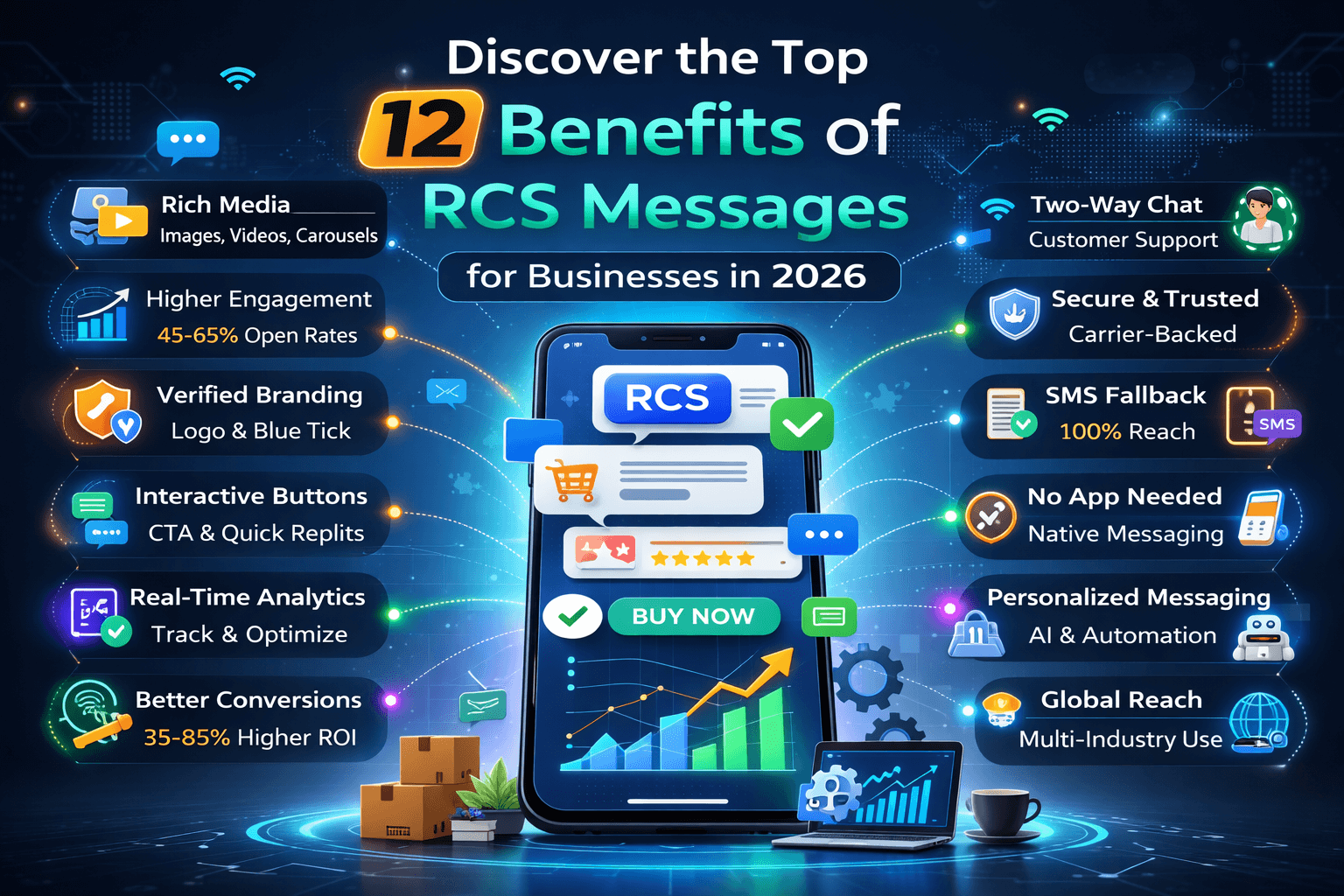
Bulk RCS messaging allows businesses to send rich, interactive messages to large contact lists simultaneously. Unlike traditional SMS, bulk RCS supports verified business branding, interactive buttons, rich media (images, videos, carousels), and deep engagement tracking — all delivered in one-to-one message threads that feel personal at scale
Rich Communication Services (RCS) is the carrier-grade upgrade to SMS that transforms plain text business messages into branded, interactive, data-rich conversations. Where SMS delivers 160 characters from an unrecognised short code, RCS delivers a verified brand name with logo, full-resolution images and video, interactive reply and action buttons, real-time read receipts, and campaign analytics — all inside the recipient's native Messages app, with no app download required.
In 2026, with over 6.5 billion RCS-capable devices globally, near-universal Android coverage in India, and Apple's full RCS support in iOS 18, the question for most businesses is no longer whether to adopt RCS — it is how to send bulk RCS messages effectively and at scale. This guide covers everything: from platform selection and brand registration to message design, compliance, and optimisation.
|
6.5B RCS-Capable Devices Globally — End of
2025 |
45–65% RCS Open Rate vs 20–30% for Plain SMS |
3–5× Higher Click-Through Rate — RCS vs SMS |
|
35% Average Higher Engagement vs Plain SMS |
60+ Countries With Active RCS Business
Messaging |
₹0.01–0.05 Per-Message Cost — RCS Business
Messaging India |
RCS SMS service — formally called RCS Business Messaging (RBM) — is the commercial use of RCS infrastructure for business-to-consumer communication at scale. It uses a separate, registered, verified business sender pathway requiring brand identity registration, carrier verification, and regulatory template approval before any commercial messages can be sent.
Sending bulk RCS messages means dispatching verified, rich,
interactive messages to thousands or millions of recipients simultaneously —
through a platform that handles carrier routing, fallback delivery, real-time
analytics, and compliance in the background.
|
Capability |
Plain SMS |
RCS Bulk
Messaging |
|
Sender
identity |
Short code / unknown number |
Verified brand name + logo
+ badge |
|
Message
format |
Plain text, 160 chars max |
Rich text, images, no
character limit |
|
Images and
video |
None |
Full-resolution, native
display |
|
Product
carousels |
Not possible |
Horizontal scrollable card
sets |
|
Interactive
buttons |
None |
Reply, action, deep-link
buttons |
|
Read
receipts |
Delivery only |
Delivered + read + clicked |
|
Campaign
analytics |
Delivery rate only |
Open + click + conversion
data |
|
Open rate
benchmark |
20–30% |
45–65% — up to 3× higher |
|
SMS
fallback |
It is SMS |
Auto-fallback if device
unsupported |
|
App
install required |
None |
None — native Messages app |
|
DLT
compliance India |
Required |
Required — same TRAI DLT
framework |
The 7Steps to Sending Bulk RCS Messages Instantly
The following seven steps represent the complete deployment
pathway — from first registration to live campaign. Each step is presented with
the specific actions required and common pitfalls to avoid.
|
1 |
Get RCS Business Messaging (RBM) Approval Before sending at scale,
your brand must be verified as an RCS Business Messaging sender. Submit your
logo, business name, website, and contact details to Google's RBM platform or
your chosen aggregator for verification. Approval typically takes 3–7 business
days with an established provider. Many enterprise platforms handle this on
your behalf, cutting setup time significantly. |
|
2 |
Choose a Bulk RCS Messaging Platform You need a platform that
supports RCS at scale. Look for: high-volume sending infrastructure with
carrier-grade reliability, a drag-and-drop RCS message builder, audience
segmentation and contact management, real-time delivery and engagement
analytics, automatic SMS fallback for non-RCS devices, and API access for
automated or triggered messaging. Top platforms in 2026 include Sinch,
Infobip, Twilio, Kaleyra, and MessageBird. |
|
3 |
Build and Segment Your Contact List A bulk campaign is only as
good as its list. Use double opt-in to ensure compliance and quality. Segment
by behaviour, purchase history, location, or device type. Remove inactive
contacts regularly to protect sender reputation. Verify RCS capability for each
number before sending — most platforms do this automatically and fall back to
SMS for non-RCS devices. |
|
4 |
A great bulk RCS message
includes: a strong hero image or video (1200×628px recommended), a concise
headline of 6–10 action-driven words, a clear body message of 2–3 sentences,
1–3 CTA buttons (e.g. 'Shop Now', 'Get Offer', 'Learn More'), and an optional
carousel of 2–5 product cards. The average RCS message is scanned in under 3
seconds — your offer must be immediately obvious. |
|
5 |
Configure Your Sending Schedule Timing matters enormously
in mobile messaging. Send Tuesday–Thursday for highest open rates. Target
10:00 AM–12:00 PM or 5:00 PM–7:00 PM in the recipient's local time zone.
Avoid early mornings, late nights, and major holidays unless
campaign-relevant. Use time-zone intelligent delivery if your platform
supports it. |
|
6 |
Not every recipient will
have an RCS-capable device. A smart bulk RCS platform automatically detects
device compatibility and delivers a plain SMS version for users who cannot
receive RCS. Configure clear, complete, and actionable SMS fallback content
for every RCS template — approximately 15–20% of recipients in a typical
database will receive the SMS version. |
|
7 |
Once your campaign goes
live, track delivery rate, read rate, CTA click-through rate, conversion
rate, and opt-out rate in real time. Use A/B testing to refine headlines,
images, and CTA copy across subsequent sends. A well-measured first campaign
creates the data and business momentum needed to scale confidently. |
|
Pro Tip: Always run your first RCS
campaign in parallel with your existing SMS campaign — not as a replacement.
Split the same audience 50/50, send identical content adapted for each
format, and measure the performance gap directly. This parallel test
generates the most compelling internal business case data. |
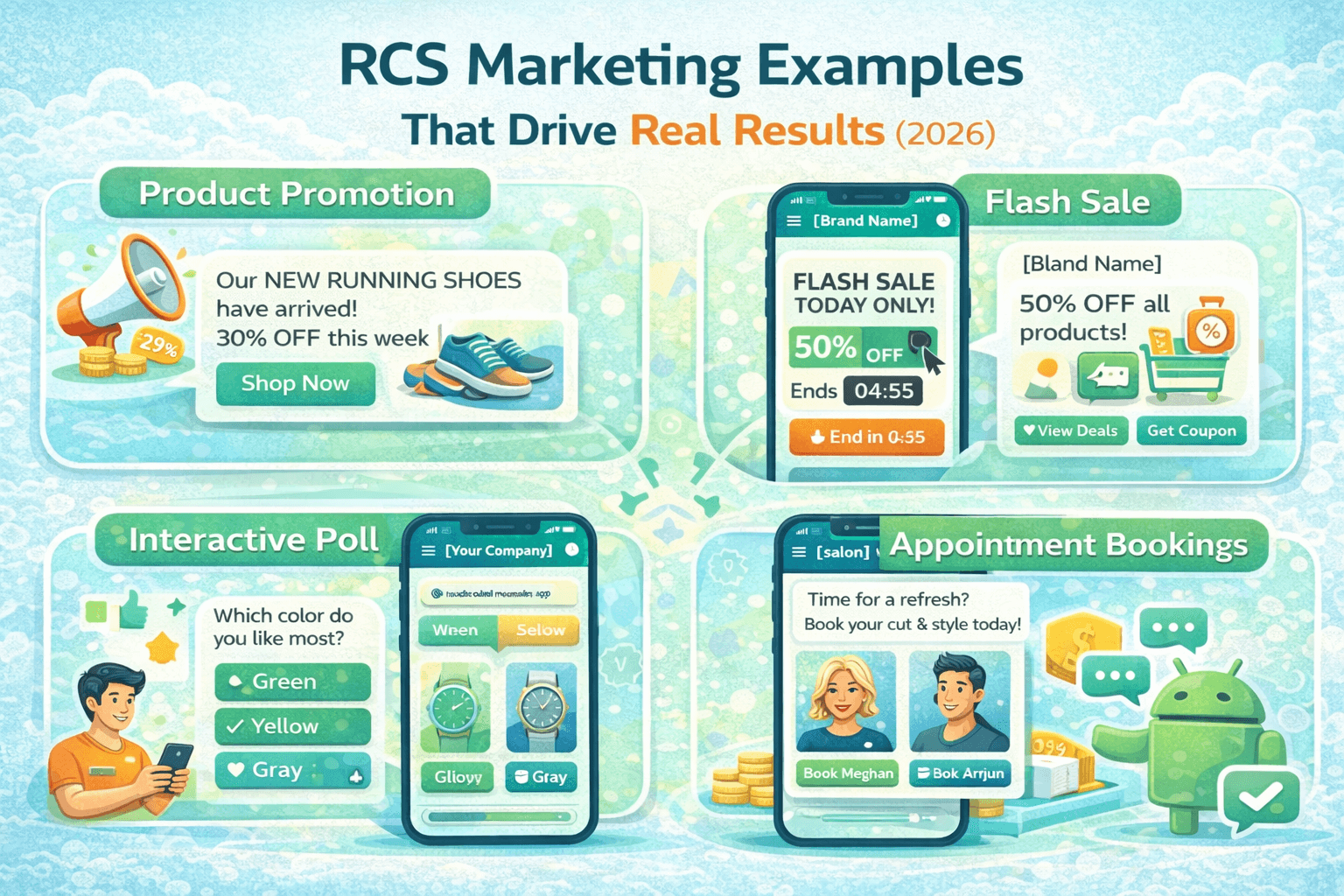
Sample
RCS Message Templates
Use these templates as starting points for your first bulk RCS campaigns. Each is designed for maximum visual impact and clear call to action.
Flash
Sale Campaign
|
Sample RCS Flash Sale — Your Brand Name Brand Logo · Verified Badge ·
Brand Name Flash
Sale — Ends Tonight at Midnight! Up
to 60% off on Premium Products — Today Only Product
Carousel: Item A ₹2,499 · Item B ₹1,899 ·
Item C ₹3,299 [
Shop the Sale Now ] [
View All Offers ] [
Get My Exclusive Member Discount ] |
Appointment
Reminder
|
Sample RCS Appointment Reminder — Your Brand Name Brand Logo · Verified Badge ·
Brand Name Your
appointment is confirmed for Tomorrow, 11:00 AM Dr.
Sharma · City Diagnostics · Andheri West, Mumbai [
✓ Confirm My Appointment ] [
Reschedule ] [
Get Directions ] |
Order
Tracking Update
|
Sample RCS Order Update — Your Brand Name Brand Logo · Verified Badge ·
Brand Name Your
order #ORD-892341 is out for delivery today Expected
between 2:00 PM – 4:00 PM [
Track My Order Live ] [
Contact Delivery Agent ] [
Delivery Instructions ] |
RCS vs
SMS vs WhatsApp Business — The 2026 Channel Comparison
Understanding how the three channels complement rather than
compete with each other is essential for building a coherent multi-channel
strategy for 2026.
|
Metric |
Plain SMS |
RCS |
WhatsApp
Business |
|
Cost per
message |
₹0.01–0.03 |
₹0.01–0.05 |
₹0.10–0.70/conv |
|
Open rate |
20–30% |
45–65% |
98% (opted-in) |
|
Click-through
rate |
1–3% |
5–15% |
15–40% |
|
Opt-in
required |
Not required |
Not required |
Yes — explicit |
|
App
install required |
None |
None |
Yes — WhatsApp |
|
Rich media |
No |
Yes |
Yes |
|
Verified
sender |
No |
Yes |
Yes — green tick |
|
Interactive
buttons |
No |
Yes |
Yes |
|
SMS
fallback |
It is SMS |
Automatic |
None |
|
DLT
required India |
Yes |
Yes |
No — Meta framework |
|
Best for |
Universal reach |
High-vol branded campaigns |
Conversational engagement |
|
Strategic Insight: RCS excels at high-volume,
carrier-delivered transactional and promotional messaging to your full
customer base without opt-in. WhatsApp excels at conversational, opted-in
engagement. SMS serves as the universal fallback. Businesses using all three
channels strategically consistently outperform those relying on any single
channel alone. |
Best Practices for High-Performance Bulk RCS Campaigns
•
Personalise at scale — use merge tags to include the
recipient's name, product, or account detail
•
Keep messages short and scannable — RCS is not email;
brevity and visual clarity win
•
Use branded sender IDs — recipients are far more likely
to trust and engage with verified brands
•
Don't over-send — 2 to 4 campaigns per month is a
healthy cadence for most brands
•
Always honour opt-outs immediately — compliance is
non-negotiable and delays damage sender reputation
•
Test across devices — preview your message on multiple
Android versions and iOS 18 before launching
•
Write actionable CTA button labels — 'Shop the Sale
Now' outperforms 'Click Here' every time
•
Use urgency and specificity in headlines — 'Ends
Tonight at Midnight' beats 'Limited Time Offer'
• Set up conversion tracking — connect your RCS deep links to your analytics platform to measure end-to-end ROI
RCS
Compliance and Legal Considerations
Bulk RCS messaging is subject to the same regulatory frameworks as SMS marketing, with additional requirements specific to RCS Business Messaging registration. Key requirements include:
•
Express written consent — recipients must have opted in
before receiving marketing messages
•
Clear opt-out mechanism — every message must include an
easy, frictionless unsubscribe path
•
Sender identification — your verified brand name must
be prominently visible in every message
•
TCPA compliance (US), GDPR compliance (EU), CASL
compliance (Canada) — know your regional rules
• TRAI DLT compliance (India) — entity registration, sender ID, and template approval required for all commercial RCS
Bulk RCS
Messaging in India — Market Context and DLT Compliance
Why
India Is One of the World's Most Important RCS Markets
India's smartphone market profile is uniquely favourable for RCS. With over 95% of Indian smartphones running Android and Jio, Airtel, and Vi all supporting RCS Business Messaging on their networks, the technical infrastructure is available to the overwhelming majority of Indian business messaging audiences. The scale of the Indian market — over 700 million smartphone users — makes it one of the highest-priority markets for global RCS platform development.
TRAI DLT
Compliance — The Non-Negotiable Starting Point
All commercial RCS messaging in India requires compliance with TCCCPR 2018, administered through the TRAI DLT platform. For businesses already sending commercial SMS under the DLT framework, the path to RCS compliance is an extension of existing registration across three steps:
•
Entity registration — confirm your Principal Entity
(PE) ID on the DLT portal
•
Sender ID registration — register your RCS brand name
(3–7 business days)
• Template registration — get approval for every message template, categorised as Transactional, Service, or Promotional
Frequently Asked Questions — Bulk RCS Messaging for Businesses
Q: What
is the difference between bulk RCS and regular SMS for businesses?
A: Bulk RCS delivers verified brand identity, rich media, interactive buttons, real-time read receipts, and campaign analytics — all within the native Messages app with no app download required. Plain SMS delivers 160 characters from an unrecognised short code with no visual content, no interactivity, and only basic delivery confirmation. RCS achieves open rates of 45–65% versus 20–30% for SMS, and click-through rates 3–5 times higher.
Q: How
much does bulk RCS messaging cost compared to plain SMS in India?
A: RCS Business Messaging in India is typically priced at
₹0.01 to ₹0.05 per message — comparable to or modestly above premium SMS at
₹0.01–₹0.03. The correct comparison is cost-per-outcome rather than
cost-per-message. Because RCS delivers 2–3 times more opens and 3–5 times more
clicks per message than SMS, the cost-per-outcome is typically lower for most
conversion-oriented use cases.
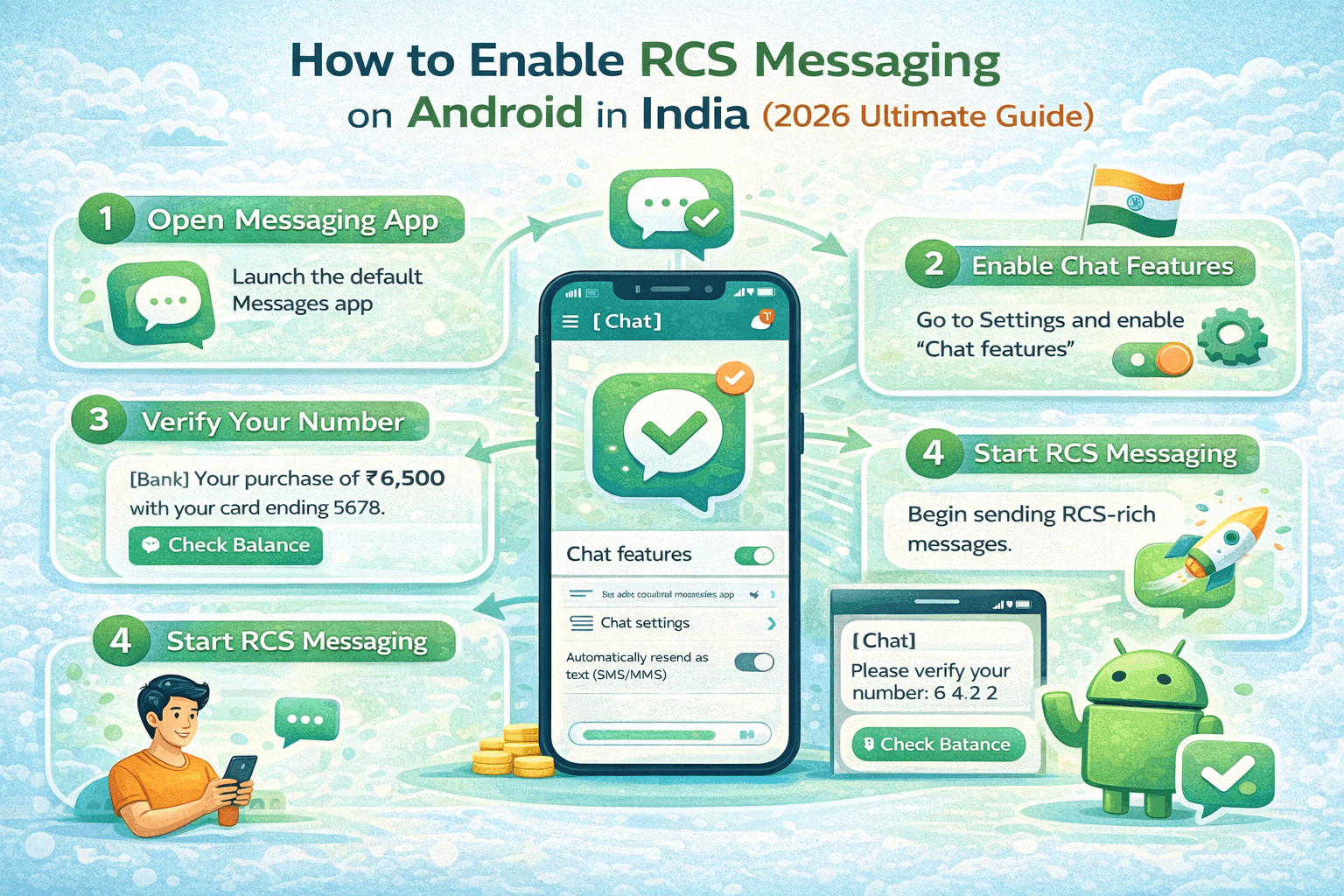
A: No. Customers do not need to download any app, create any account, opt in to any platform, or change any settings. RCS messages are delivered to the native Messages app on every Android smartphone and every iPhone running iOS 18 or later. For customers whose devices or carriers do not support RCS, messages are automatically delivered as SMS fallback — ensuring 100% reach with zero adoption barrier.
Q: How
long does it take to go live with bulk RCS in India?
A: For businesses with existing TRAI DLT registration for SMS, the typical timeline is 3–4 weeks: DLT sender ID registration 3–7 days, brand profile verification 3–7 days, template registration and approval 2–5 days per batch, and technical integration with your aggregator 1–2 weeks. Businesses without DLT registration should add 7–10 days for entity registration.
Q: Can I
send bulk RCS alongside WhatsApp Business API?
A: Yes — and for most businesses, using both channels is the optimal strategy. RCS handles high-volume carrier-delivered transactional and promotional messaging to your full customer base without opt-in requirements. WhatsApp handles conversational opted-in engagement for customers who are active WhatsApp users. The two channels serve different communication objectives most effectively.
Q: What
happens to customers who cannot receive RCS messages?
A: If a recipient's device or carrier does not support RCS, the message is automatically delivered as SMS fallback — a plain text version delivered through carrier SMS infrastructure. This fallback is automatic and requires no action from the sender. Always configure clear, complete, and actionable SMS fallback content for every RCS template, as approximately 15–20% of recipients in a typical Indian database will receive the SMS version.
What
Does Bulk RCS Messaging Cost?
RCS pricing varies by provider and volume. Here is a general benchmark for 2026:
|
Volume Tier |
Estimated
Cost per Message |
Typical Use
Cases |
|
Under
10,000 messages/month |
₹0.03–₹0.08 |
SMBs, pilot campaigns |
|
10,000–100,000/month |
₹0.015–₹0.04 |
Growing brands, regular
campaigns |
|
100,000–1M/month |
₹0.005–₹0.02 |
Enterprise marketing,
transactional alerts |
|
1M+/month |
Negotiated pricing |
Telcos, large enterprises,
aggregators |
Most businesses find that the higher engagement rates of RCS make it more cost-effective than SMS even at a higher per-message rate — because the cost-per-outcome (cost per click, cost per conversion) is consistently lower.
Conclusion
— 2026 Is the Year to Go Live With Bulk RCS
The steps in this guide cover the complete deployment pathway — but the common thread is simple: bulk RCS takes the communication investment businesses already make in SMS and makes it work harder. Verified identity builds trust. Visual content captures attention. Interactive buttons remove friction. Analytics prove what works.
In India, the infrastructure readiness, regulatory clarity, and device coverage for bulk RCS messaging in 2026 is the best it has ever been. The businesses building their RCS communication infrastructure now are not early adopters taking a risk — they are adopting a commercially proven, carrier-backed, regulator-compliant upgrade to the messaging channel they already use.
Start with one use case — the one where the gap between your current SMS performance and what RCS makes possible is largest. Measure the improvement. Build from there. The compounding advantage of better open rates, higher click-through, and more engaged customers starts the moment your first RCS campaign goes live.