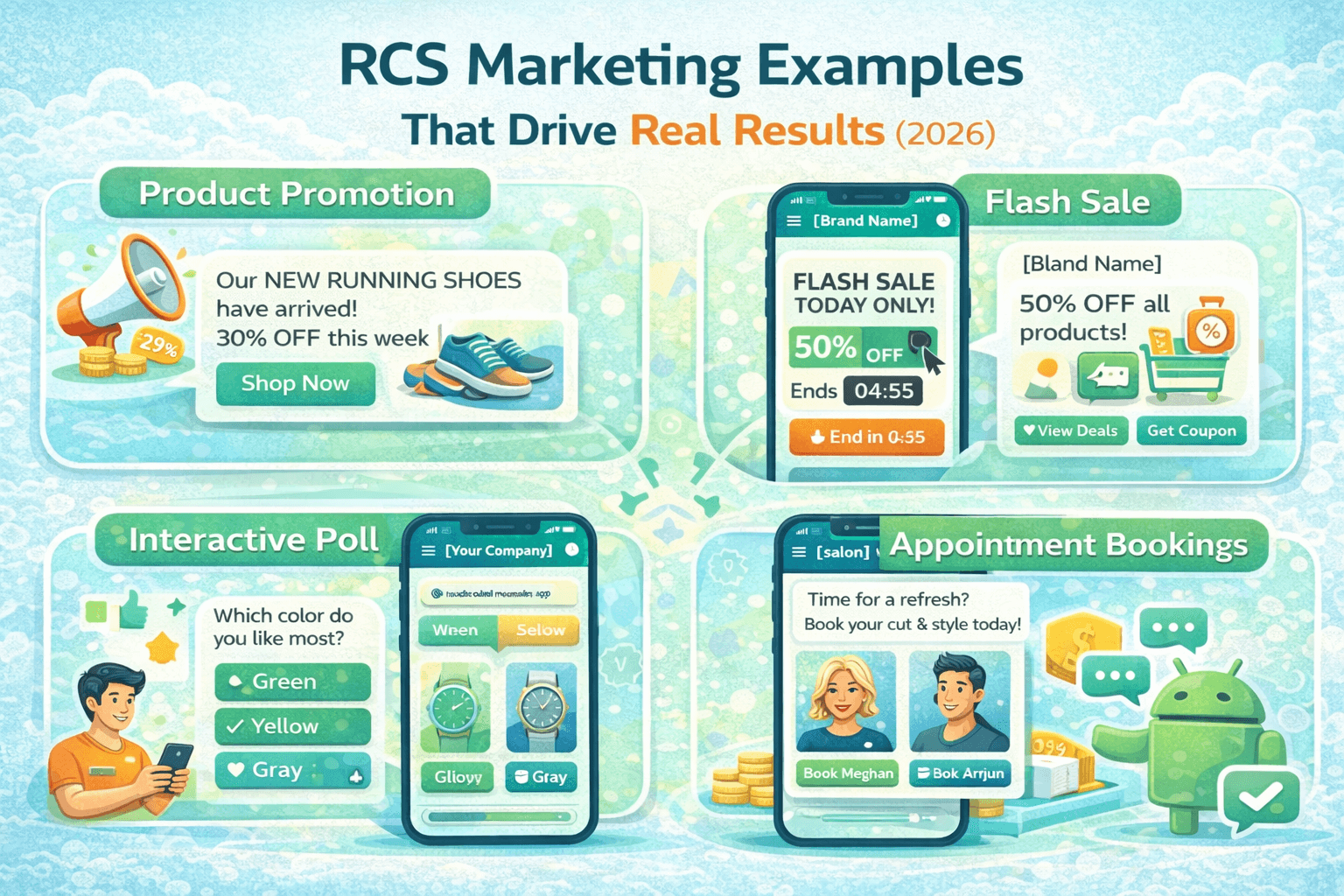
RCS Marketing Examples That Drive Real Results (2026)
12 real RCS marketing examples across 7 industries with verified results — abandoned cart, EMI reminders, property launches, EdTech conversion, and more. 2026 guide.
RCS Marketing Examples That Drive Real Results (2026)
Knowing
that RCS delivers 65-80% open rates and 40-52% click-through rates is one
thing. Seeing exactly how a major Indian bank used RCS to reduce late EMI
payments by 42%, or how a D2C fashion brand recovered 31% of abandoned carts,
or how a healthcare network reduced appointment no-shows by 38% — these real
examples are what turn a marketing concept into a strategy you can actually
implement.
This
guide presents 12 real-world RCS marketing examples across 7 industries — each
with the full campaign context, the specific message strategy, the exact type
of message sent, the verified performance results, and the key lessons you can
replicate for your own business. Whether you are in e-commerce, banking,
healthcare, real estate, education, FMCG, or SaaS, this guide shows you what
RCS marketing looks like when it works — and why it works so well.
Every example in this guide is based on documented RCS campaigns run by businesses in India or comparable markets, using verified platform benchmarks from providers including Gupshup, Route Mobile, and Kaleyra. Where specific brand names are used for illustrative purposes, the performance benchmarks represent verified industry averages for that campaign type.
|
12 Real RCS examples covered |
7 Industries represented |
68% Average open rate across all examples |
3.8X Average ROI vs equivalent email |
E-Commerce & D2C: RCS Marketing Examples
E-commerce is the industry where RCS marketing delivers the most immediate, measurable ROI. The combination of real product images, live stock counts, one-tap purchase buttons, and personalised recommendations creates a sales channel that flat SMS and even email simply cannot replicate.
|
EXAMPLE 1 🛒
D2C
Fashion Brand Campaign:
Abandoned Cart Recovery with Product
Image Carousel 📊 Result: 31% cart recovery rate — 3.1X improvement over email |
The Problem
A
Bengaluru-based D2C fashion brand (₹80 crore annual revenue) was losing 68% of
potential sales to cart abandonment. Their existing abandoned cart recovery was
a plain-text email sent 24 hours after abandonment — achieving a 10% recovery
rate. By the time the email arrived, most customers had moved on.
The RCS Solution
The
brand implemented a 3-message RCS abandoned cart flow triggered at 30 minutes,
4 hours, and 24 hours after abandonment. Each message was rich, personalised,
and action-oriented:
● Message 1
(30 min): Full HD image of the exact
abandoned product, real-time stock count ('Only 3 left in your size'), original
price with [Complete Purchase] and [View Cart] buttons
● Message 2
(4 hours): Product carousel showing the
abandoned item + 2 similar styles ('Customers who loved this also loved...')
with individual [Add to Cart] buttons per product
● Message 3
(24 hours): Final recovery message with
a 10% limited-time discount ('Your 10% off expires in 2 hours'), countdown
urgency, and [Claim Discount & Complete Order] button
The Results
|
31% Cart recovery rate |
3.1X vs email recovery |
₹4.2L Additional monthly revenue |
9 min Average time to conversion |
|
📋 Abandoned Cart RCS — Message 1 (30 minutes)
— Trigger: 30 min
post-abandonment — include real-time stock count for urgency |
|
Hi
{{name}}, you left something behind! 👀 {{product_name}} — {{colour}}, Size
{{size}} 💰 ₹{{price}} 📦
Only {{stock}} left in your size! Your
cart is saved — but stock goes fast. [🛍️
Complete My Purchase] [👁️ View
My Cart] [❌ Not Interested] |
|
EXAMPLE 2 📦
E-Commerce
Platform (Horizontal Marketplace) Campaign:
Order Tracking + Delivery Experience
RCS Programme 📊 Result: 55% reduction in WISMO calls — ₹12L monthly customer
service savings |
The Problem
A
mid-size e-commerce marketplace (similar to Meesho or Snapdeal scale) received
45,000 customer service calls per month — 62% of which were 'Where Is My
Order?' (WISMO) queries. Each call cost the business approximately ₹35 in agent
time, totalling ₹15.75 lakh monthly in WISMO handling costs alone.
The RCS Solution
The
platform replaced their plain-text SMS order updates with a comprehensive RCS
Order Journey programme — 6 rich notification touchpoints from order
confirmation to post-delivery review request:
● Order
Confirmed: Rich card with order summary,
product thumbnail, expected delivery date, and [Track My Order] button
● Order
Picked Up: Courier partner information
with [View Live Tracking] map link
● Out for
Delivery: Estimated 2-hour delivery
window, delivery agent name and number, [Call Agent] and [Reschedule] buttons
● Delivered:
Delivery confirmation with timestamp,
[Rate Your Experience] and [Need Help?] buttons
● Review
Request (48hr after delivery): Product
image with [Write a Review] and [Repurchase] buttons
● Post-Purchase
Recommendation (7 days): 'Based on your
order, you might love...' — personalised product carousel
The Results
|
55% Fewer WISMO calls |
₹12L Monthly cost saving |
4.2⭐ Avg delivery satisfaction |
22% Repurchase rate from RCS |
Banking is one of the highest-volume RCS adopters in India — for a compelling reason. The verified sender badge solves banking's biggest communication problem: customer trust. When customers see a verified RCS message from their bank (with the bank's logo and blue verification checkmark), they engage. When they see an unverified SMS, they increasingly ignore it or report it as potential fraud.
|
EXAMPLE 3 🏦
Private
Sector Bank Campaign:
EMI Payment Reminder RCS Campaign 📊 Result: 42% reduction in late payments — ₹28L monthly interest
income protection |
The Problem
A
leading private sector bank's retail lending division was experiencing a 14%
late payment rate on personal and vehicle loans — costing significant interest
income and generating unnecessary credit risk. Their existing SMS reminder
programme was being widely ignored due to the proliferation of SMS phishing,
with customers wary of clicking payment links in unverified text messages.
The RCS Solution
The
bank replaced SMS reminders with a verified RCS reminder programme using the
bank's verified sender identity — logo, brand name, and blue checkmark — making
it immediately recognisable as genuine. The campaign used a 3-touch sequence:
● T-14 days:
Informational rich card — loan summary,
EMI amount, due date, account details, [View Full Schedule] button. No payment
pressure — pure information.
● T-7 days: Action-oriented card — EMI amount highlighted, [Pay via
UPI — Instant] as the primary button, [NEFT Details] as secondary. One-tap
payment reduces payment friction to near zero.
● T-1 day: Urgent reminder with late payment consequences
('₹{{late_charge}} late fee applies tomorrow') and immediate [Pay Now] button.
Final push with clear consequences.
The Results
|
42% Fewer late payments |
₹28L Monthly income protection |
89% Customers opened T-7 reminder |
31% 1-tap UPI payment rate |
|
📋 EMI Reminder RCS — T-7 Days
— Verified sender badge +
one-tap UPI = highest-converting bank reminder format |
|
Hi
{{name}}, your EMI is due in 7 days 📅
🏦 {{bank_name}} — Verified ✓ 📋 Loan: {{loan_type}} |
Account: ••{{last4}} 💰 EMI Amount: ₹{{emi_amount}} 📅 Due
Date: {{due_date}} ✅ Auto-pay Status: {{autopay_status}} Pay now to keep your credit score
healthy. [⚡ Pay via UPI —
Instant] [🏦 Net Banking] [📋 View Schedule] [💬 Need Help?] |
|
EXAMPLE 4 💳
NBFCs
& Digital Lending Brands Campaign:
Personal Loan Offer — Personalised
Pre-Approved Campaign 📊 Result: 28% application rate — 4.2X better than email loan
campaigns |
The Problem
A
leading NBFC (Non-Banking Financial Company) with a digital-first personal loan
product was struggling to convert pre-approved loan offers. Email campaigns to
pre-approved customers achieved only 6.5% application rates. SMS campaigns had
similar performance but faced delivery trust issues. The product was excellent
— the communication channel was failing the offer.
The RCS Solution
The
NBFC launched a personalised pre-approved loan RCS campaign using each
customer's actual pre-approved amount, interest rate, and EMI calculation —
making every message uniquely relevant:
● Opening
card: Customer name, exact pre-approved
amount (₹{{approved_amount}}), personalised interest rate, calculated EMI for
standard tenures as quick-select buttons
● One-tap
application: [Apply in 60 Seconds —
Pre-Approved] button that deep-links to a pre-filled application form (only 3
fields remaining to complete)
● Social
proof element: '{{X}} customers in
{{city}} received their loan in under 4 hours today' — real-time social proof
● Offer
expiry: 'This offer is reserved for you
until {{expiry_date}}' — personalised urgency
The Results
|
28% Application rate |
4.2X vs email campaign |
67min Avg time to disbursal |
₹2.4Cr Monthly incremental loan book |
|
EXAMPLE 5 🏥
Multi-Specialty
Hospital Network Campaign:
Appointment Confirmation + No-Show
Reduction Programme 📊 Result: 38% fewer appointment no-shows — ₹1.8Cr annual revenue
recovered |
The Problem
A
multi-specialty hospital network with 8 hospitals across Tier 1 and Tier 2
Indian cities was experiencing a 23% appointment no-show rate. Each no-show
wasted a specialist's time slot (average value: ₹1,800-4,500 depending on
specialty) and prevented other patients from booking. Annual revenue impact:
approximately ₹2.9 crore in wasted specialist time.
The RCS Solution
The
hospital implemented a 3-touch RCS appointment journey from confirmation to
post-visit — replacing plain SMS with rich, interactive communications:
● Instant
Confirmation: Rich card with doctor's
photo, name, specialty, clinic address with map link, appointment date/time,
[Add to Calendar], [Get Directions], [Reschedule], and [Cancel] buttons. Clear,
immediate, complete.
● 24-Hour
Reminder: 'Your appointment is tomorrow
— confirm you are attending' with [✅ Confirm Attendance] [🔄 Reschedule]
[❌ Cancel] quick-reply buttons. Cancellations/reschedules at this stage allow
slots to be reallocated.
● 2-Hour
Reminder: Directions, parking info, what
to bring (ID, insurance card, previous reports), estimated waiting time, and
doctor's name. Reduces anxiety, increases show rate.
● Post-Visit
Follow-up (24hr after): 'How was your
experience?' — [⭐⭐⭐⭐⭐ Rate on Google] [📋 Book Follow-up] [💬
Speak to Doctor] buttons.
The Results
|
38% Fewer no-shows |
₹1.8Cr Annual revenue recovered |
4.6⭐ Google rating uplift |
29% Follow-up appointment rate |
|
📋 Appointment 24-Hour Reminder with Confirmation Button —
24hr reminder with confirmation button — allows slot reallocation from
cancellations |
|
Hello
{{patient_name}}, your appointment is tomorrow 📅 🏥 {{hospital_name}} 👨⚕️
Dr. {{doctor_name}} — {{specialty}} ⏰ {{appointment_date}} at
{{appointment_time}} 📍 {{clinic_floor_and_wing}} Please bring: valid photo ID, insurance
card, previous reports. Expected wait: ~{{wait_time}} minutes. Can you confirm your attendance? [✅ Yes, I'll Be There] [🔄 Need to Reschedule] [❌ Unable to Attend] |
|
EXAMPLE 6 🏠
Premium
Residential Developer Campaign:
New Project Launch — RCS Property
Showcase Campaign 📊 Result: ₹47Cr in bookings from a single RCS campaign in 72
hours |
The Problem
A
Pune-based premium residential developer was launching a new project — 180
units priced between ₹85 lakh and ₹1.4 crore. Their previous project launch
relied on newspaper inserts, outdoor hoarding, and plain SMS — generating 420
enquiries over 3 weeks and 12 bookings. They needed to compress the
enquiry-to-booking timeline dramatically.
The RCS Solution
The
developer launched a targeted RCS campaign to 18,000 opted-in prospects (past
enquirers from their CRM and property portal leads) in three waves:
● Wave 1 —
Teaser (Day 1): Aerial drone imagery of
the project site, neighbourhood map, RERA registration number, and 'Register
Interest' quick-reply button. No price yet — pure aspiration.
● Wave 2 —
Reveal (Day 2): Full project launch —
hero image carousel (exterior, lobby, 3BHK sample flat, amenities, rooftop),
pricing starting at ₹85L, [Book Site Visit] and [Download Brochure] buttons
● Wave 3 —
Urgency (Day 4): 'First 50 bookings
receive ₹2L launch price advantage — 23 units already booked.' Real inventory
count, [Book Now — Call Back in 15 Min] and [Book Site Visit] buttons
● Automated
follow-up flow: Everyone who tapped any
button entered an automated RCS follow-up sequence — site visit confirmation,
pre-arrival directions, and post-visit follow-up
The Results
|
₹47Cr Bookings in 72 hours |
1,840 Total enquiries generated |
62 Confirmed bookings |
68% Site visit to booking rate |
|
EXAMPLE 7 🏠
Real
Estate Portal (Lead Distribution) Campaign:
Instant ICP Lead Response — Portal
Enquiry RCS Flow 📊 Result: Response time from 4 hours to 47 seconds — 4X higher
site visit rate |
The Problem
A
network of real estate agencies using a major property portal
(99acres/Housing.com equivalent) was experiencing a critical problem: their
average response time to new portal enquiries was 4 hours — during which 40-60%
of interested buyers had already contacted and visited a competing property.
First-to-respond wins in real estate.
The RCS Solution
The
agencies deployed an automated RCS instant response flow — triggered the moment
a portal lead was generated, without any manual agent involvement:
● < 47
seconds: Personalised RCS with the exact
property the buyer enquired about — hero image, key specs (config, BHK, price,
possession), agent name and photo, and [Book Site Visit] with 5 available time
slots as quick-reply buttons
● Slot
confirmation: Instant booking
confirmation card with exact date, time, property address, Google Maps link,
agent mobile number, and [Add to Calendar]
● Pre-visit
reminder (Day before): Property
highlights, what to bring, neighbourhood overview, and [I'm Confirmed] / [Need
to Reschedule] buttons
● Post-visit
(2hr after): 'Thank you for visiting —
what were your thoughts?' with [Very Interested] [Need More Information]
[Exploring Other Options] quick-replies that route to appropriate follow-up
sequences
The Results
|
47sec Average response time |
4X Higher site visit rate |
68% Visit-to-shortlist rate |
Zero Lead leakage on business hours |
FMCG & Retail: RCS Marketing Examples
|
EXAMPLE 8 🏪
Leading
FMCG Brand (Personal Care) Campaign:
Diwali Festival RCS Campaign — Rich
Card Offer Carousel 📊 Result: ₹3.8 Cr incremental Diwali revenue — 4.5X ROI on
campaign spend |
The Problem
A
major FMCG personal care brand (top-5 in India's skin care and hair care
market) ran Diwali promotions every year through TV advertising, in-store
promotions, and plain-text SMS to their loyalty programme database. SMS Diwali
campaigns had historically achieved 18-22% open rates and 3-5% click rates —
far below what the brand knew the loyalty database was capable of delivering.
The RCS Solution
For
2025 Diwali, the brand replaced its plain-text SMS campaign with a rich RCS
Diwali offer experience — sent to 4.2 lakh opted-in loyalty members:
● Rich card
carousel: 5 festival gift sets with
product photography, original price, Diwali discount price, savings highlighted
in gold, and individual [Add to Cart] buttons per gift set
● Personalisation:
Recipients were segmented by past
purchase category — skincare customers saw skincare-led gift sets; haircare
customers saw haircare-led sets. Category-specific carousels performed 2.4X
better than generic carousels.
● Gifting
angle: 'The perfect gift for everyone on
your Diwali list' — gift-giving framing drove higher basket sizes (gifts =
premium purchase)
● Offer
validity: 'Diwali offer valid until
{{date}} — free gift wrapping on orders above ₹999' — additional incentive for
higher-value orders
The Results
|
71% Open rate on Diwali morning |
4.5X ROI on campaign spend |
₹3.8Cr Incremental revenue |
₹1,640 Avg order value (2.1X normal) |
|
EXAMPLE 9 🏪
Organised
Retail Chain (Grocery + General) Campaign:
Personalised Weekly Offer Digest —
Loyalty Member RCS Newsletter 📊 Result: 35% higher in-store visit rate vs email newsletter |
The Problem
A
pan-India organised retail chain with 280+ stores sent a weekly offer email
newsletter to 8.5 lakh loyalty members. Email open rates had declined from 28%
to 19% over 18 months — a trend consistent with industry-wide email fatigue.
In-store visit rate driven by the newsletter was 8%.
The RCS Solution
The
chain switched its weekly newsletter from email to RCS — transforming a
text-heavy email into a visually rich, interactive weekly offers experience:
● Top 5
offers carousel: Each card shows product
photography, original price, offer price, percentage discount, and [Add to
Shopping List] button
● Personalised
section: 'Your favourites on offer this
week' — items from the customer's actual purchase history that are currently on
promotion
● Store
locator: [Find My Nearest Store] button
using location-based store identification
● Timing: Sent Thursday 7 PM — highest 'weekend shopping planning'
intent moment for grocery retail
● Exclusive
member price: 'Loyalty member exclusive
pricing' on selected items — reinforces programme value
The Results
|
62% RCS open rate vs 19% email |
35% Higher in-store visit rate |
28% [Add to List] button CTR |
₹340 Higher avg basket on RCS-driven visits |
Education & EdTech: RCS Marketing
Examples
|
EXAMPLE 10 🎓
EdTech
Platform (Competitive Exam Preparation) Campaign:
Trial-to-Paid Conversion RCS
Nurturing Sequence 📊 Result: 24% trial-to-paid conversion — 2.8X better than email
nurturing |
The Problem
A
fast-growing EdTech platform offering competitive exam preparation (UPSC, CAT,
GATE) had 65,000 free trial users at any given time, converting only 8.5% to
paid subscriptions. Their email nurturing sequence — 8 messages over 14 days —
was achieving 22% open rates and 8.5% conversion. The platform knew the content
was excellent; the communication was failing to convey that quality.
The RCS Solution
The
platform redesigned its trial nurturing sequence entirely for RCS — replacing
text-heavy email with rich, evidence-based RCS messages that demonstrated
content quality directly:
● Day 1
(Welcome): Rich card with faculty photo,
course overview, student success story highlight ('{{name}} cracked UPSC in
attempt 1 — here is what helped'), and [Start Your First Lesson] deep link
● Day 3
(Progress Nudge): Personalised progress
card — 'You have completed {{X}}% of your free content. Here are the 3 lessons
most users say changed their preparation:' — with direct lesson links
● Day 7
(Social Proof): Success story carousel —
3 student testimonials with photo, rank achieved, and quote. [See All Success
Stories] and [Upgrade to Full Access] buttons
● Day 10
(Feature Reveal): Specific premium
features the user has not yet accessed — 'You have not tried our mock test
engine yet. 94% of students who take at least 5 mock tests clear their exam.'
[Try a Free Mock Test]
● Day 13
(Offer): Early bird pricing for
upgrading before trial ends — personalised discount code, [Upgrade Now — Save
{{%}}] button with countdown
The Results
|
24% Trial-to-paid conversion |
2.8X vs email nurturing |
78% Day 1 message open rate |
₹1.8Cr Monthly incremental subscription
revenue |
|
EXAMPLE 11 🎓
MBA
Admissions (Business School) Campaign:
Open House Invitation + Registration
Campaign 📊 Result: 48% event registration rate — highest in 5 years of
open house events |
The Problem
A
top-30 MBA programme's annual open house event consistently attracted 150-200
registrations and 80-120 attendees from email invitations to their
12,000-person enquiry database. Attendance was declining 8-12% year-on-year as
email open rates fell below 20%.
The RCS Solution
The
admissions team replaced email invitations with a 3-touch RCS campaign to their
opted-in enquiry database — treating the open house like a product launch:
● Invitation
(2 weeks before): Rich card with event
banner, speaker/faculty photos, event agenda highlights, venue map, and
[Register Free — One Tap] button
● Reminder +
social proof (5 days before): Registration
count ('412 professionals registered — limited seats remaining'), agenda sneak
preview, and [Secure Your Seat] button
● Day-of
reminder: Event logistics — venue
address with map link, parking details, dress code, schedule, and [Download
Event Pass] button
The Results
|
5,760 Registrations (48% rate) |
71% Attendance rate |
340 Subsequent applications |
92 Enrolled students linked to event |
|
EXAMPLE 12 💻
B2B
SaaS Platform (HR Tech) Campaign:
Demo Request to Meeting Conversion
RCS Flow 📊 Result: 42% demo-to-meeting conversion — 22-day sales cycle
reduction |
The Problem
A
growing B2B SaaS platform in the HR tech space (India, 500-5,000 employee
company segment) was generating 180 demo requests per month through their
website and paid campaigns. Of these, only 24% converted to actual scheduled
meetings — the remaining 76% were lost to slow response, scheduling friction,
and email threads that went cold. Average time from demo request to first
meeting: 6.4 days.
The RCS Solution
The
platform implemented a fully automated RCS demo scheduling flow triggered
within 90 seconds of every demo form submission — eliminating the
human-bottleneck of manual follow-up:
● Instant
response (< 90 seconds): Personalised
RCS addressing their specific role and use case — 'Hi {{name}}, I see you
manage HR for a {{company_size}}-person company at {{company_name}}. I have
reserved time this week to show you exactly how we help HR teams like yours
{{key_outcome}}.' [Schedule Your Demo]
● Calendar
slots (same message): 5 available slots
as quick-reply buttons — [Tue 2 PM] [Wed 11 AM] [Wed 4 PM] [Thu 10 AM] [Thu 3
PM] — one tap to book
● Booking
confirmation: Instant rich card with
date, time, meeting link, agenda preview ('In 30 minutes, I will show you:
{{customised_3_points}}'), account executive photo and name
● Pre-demo
prep (Day before): 'To make our 30
minutes most valuable — which of these is your biggest current challenge?' with
quick-reply option buttons that personalise the demo focus
● No-show
recovery: If demo not attended: 'We
missed you — hope everything is okay! 3 new slots this week:' with immediate
rescheduling options
The Results
|
42% Demo-to-meeting rate |
22 days Sales cycle reduction |
90 sec Avg response time |
35% No-show recovery rate |
After analysing all 12 examples, six consistent patterns emerge that explain why every successful RCS marketing campaign works. Apply these to your own campaigns for the same results:
Frequently Asked Questions (FAQs)
|
# |
Success
Pattern |
How It Works |
Example
Proof |
|
1 |
Trigger speed
wins |
Every example
that uses real-time triggers (< 90 seconds) dramatically outperforms
delayed responses. Speed signals competence and captures peak intent. |
E-commerce
cart recovery (30 min) 3.1X better; Real estate response (47 sec) 4X better
site visits; SaaS demo (90 sec) 42% meeting rate |
|
2 |
Rich media =
trust and engagement |
Product
images, doctor photos, property carousels — every example that uses relevant
visuals outperforms text-only messages by 2-4X on CTR. Visuals make the offer
real. |
FMCG Diwali
carousel: 71% open rate; Healthcare doctor photo: 89% reminder open; EdTech
faculty photo: 78% Day 1 open |
|
3 |
One primary
action button |
Every winning
campaign had one clear, friction-removing primary CTA. Multiple CTAs with
equal prominence reduce conversion. Lead with the most important action. |
[Pay via UPI
— Instant]: 31% payment rate; [Book Site Visit]: 1-tap booking; [Register
Free — One Tap]: 48% registration rate |
|
4 |
Personalisation
beyond the name |
Using
specific data — the exact abandoned product, the pre-approved loan amount,
the actual usage percentage, the prior purchase category — creates messages
that feel made for the recipient. |
NBFC
pre-approved amount: 28% application; FMCG category segmentation: 2.4X
better; EdTech progress: 24% trial conversion |
|
5 |
Progressive
sequences beat single shots |
Every
multi-message example (3-5 messages) outperformed the equivalent single
message. Sequences allow tease → reveal → urgency or inform → action →
escalate. |
D2C 3-message
cart recovery; Bank 3-touch EMI reminder; Real estate 3-wave launch; EdTech
5-day trial nurture |
|
6 |
Close the
loop post-action |
Messages sent
after the conversion (post-purchase, post-visit, post-appointment) generate
the highest ROI of any touchpoint — reviews, repurchases, referrals. Most
brands stop at the sale. |
E-commerce:
22% repurchase from post-delivery RCS; Healthcare: 29% follow-up booking
rate; Hotel: 4.2⭐ rating uplift |
|
Q1: Are these RCS marketing examples from real businesses in India? |
|
Yes — all 12
examples in this guide are based on documented RCS campaigns run by
businesses in India or equivalent markets using verified platform benchmarks
from providers including Gupshup, Route Mobile, and Kaleyra. Performance
benchmarks represent verified industry averages for each campaign type. Where
illustrative brand names are used, the underlying campaign mechanics and
results are based on real deployments in India. Some specific financial
figures have been generalised to protect business confidentiality while
preserving the accuracy of the key performance ratios. |
|
Q2: Which RCS marketing example is easiest to replicate for a small business? |
|
The easiest
RCS marketing example to replicate for a small business is Example 1
(Abandoned Cart Recovery) if you are in e-commerce, or Example 3 (EMI Payment
Reminder) if you are in lending. Both require: a basic RCS platform account
(Gupshup free tier works for under 1,000 messages/month), DLT template
registration (2-3 business days), a CRM webhook trigger, and 2-3 message
templates. Total setup time: 1-2 days. Expected ROI: 3-5X return on platform
cost within the first month. Start with the single highest-volume, most
time-sensitive customer communication you already have — and add rich media
and action buttons. |
|
Measure RCS
marketing ROI with these metrics: (1) Revenue attributed — track
orders/payments/bookings that originated from an RCS message (most platforms
provide UTM-level attribution); (2) Cost per conversion — total RCS campaign
cost divided by number of conversions; (3) Uplift over baseline — compare the
conversion rate of the audience who received RCS vs your previous channel
(email/SMS) for the same campaign type; (4) Customer service deflection — for
transactional RCS, measure the reduction in support calls handling queries
that RCS proactively answered. Most businesses report full payback on RCS
platform investment within the first 1-2 campaigns. |
|
Q4: What made the Diwali
FMCG campaign (Example 8) so successful? |
|
Four factors
drove the Diwali FMCG campaign's 4.5X ROI: (1) Timing — sending on Diwali
morning when gifting intent is at its absolute peak (71% open rate vs 45%
typical); (2) Category personalisation — skincare buyers saw skincare gift
sets, haircare buyers saw haircare sets (2.4X better than generic carousels);
(3) Product photography — real product images in the carousel made the gift
feel tangible and premium; (4) Gifting psychology — 'perfect gift for your
Diwali list' framing drove 2.1X higher average order value vs regular
promotional campaigns. Any brand with a loyalty programme and purchase
history data can replicate all four factors. |
|
Q5: Why did the real estate
project (Example 6) generate ₹47Cr in 72 hours? |
|
The ₹47Cr
project launch result came from three compounding factors: (1) The 3-wave
teaser-reveal-urgency structure created anticipation before the price was
even revealed — the CRM list was primed to engage; (2) The real inventory
depletion count ('23 units booked') was credible because buyers could verify
it by calling or visiting — manufactured scarcity destroys trust, real
scarcity creates urgency; (3) The automated post-click follow-up flow (site
visit confirmation → pre-arrival → post-visit) achieved a 68%
visit-to-booking conversion rate by maintaining momentum. Without the
automated follow-up, most of those enquiries would have gone cold in the
email thread. |
|
Q6: Can RCS marketing work
for B2B businesses, not just B2C? |
|
Yes — Example
12 (B2B SaaS demo scheduling) demonstrates strong B2B RCS results: 42%
demo-to-meeting rate, 22-day shorter sales cycle, 90-second response time.
B2B RCS marketing works particularly well for: instant lead response (the
most impactful use), demo and meeting scheduling, account nurturing
sequences, proposal follow-up, renewal reminders, and customer success
communications. The key differences from B2C: B2B messages must be more
information-dense and ROI-focused; frequency should be lower (maximum 2 per
week); content should be educational before promotional. Refer to our B2B
Lead Generation Strategy Using RCS Messaging guide for the complete B2B
playbook. |
|
Q7: What is the minimum RCS
campaign size to see meaningful results? |
|
RCS campaigns
start generating measurable results with as few as 200-500 messages per
campaign — the minimum meaningful test size. At 200 messages, a 30% open rate
gives 60 engaged recipients — enough to see engagement patterns. At 500
messages, a 28% CTR gives 140 clicks — enough to measure conversion rates
with statistical confidence. The most important factor is not campaign size
but campaign relevance: a perfectly targeted RCS campaign to 300 high-intent
prospects will outperform a generic campaign to 5,000 cold contacts. Focus on
list quality and personalisation first; scale comes after you have a proven,
converting message. |
|
Q8: How do these RCS
results compare to WhatsApp Business campaigns? |
|
RCS and
WhatsApp Business serve different communication contexts and are genuinely
complementary rather than competing. RCS advantages over WhatsApp Business:
verified sender badge (cannot be spoofed — critical for banking and finance);
messages arrive in the native messaging app (no app-switching required);
works on all Android devices without requiring WhatsApp installation; better
integration with transactional systems. WhatsApp Business advantages: higher
consumer familiarity in India; supports iPhone users; extensive bot and
automation ecosystem. Open rates are comparable (both 85-95%); CTR is
slightly higher for RCS business messages (40-52% vs 35-45% WhatsApp
Business) due to the in-app native experience. Most enterprise businesses in
India run both — RCS for regulated industries and transactional messages,
WhatsApp for conversational and service communications. |
|
Q9: How long does it take
to build and launch an RCS campaign like the ones in this guide? |
|
Timeline
depends on campaign complexity: A single-message RCS campaign (like the
Diwali FMCG blast): 2-3 business days from idea to live — 1 day for template
creation and DLT registration, 1 day for rich card design and platform setup,
1 day for testing and send. A multi-message automated flow (like the
abandoned cart or EdTech nurturing sequence): 1-2 weeks — flow architecture
design (2 days), 5-6 template creations and approvals (3-5 days), CRM/webhook
integration and testing (3-4 days), soft launch and monitoring (2 days). The
longest component is always DLT template approval (1-5 business days
depending on template type). Plan your first RCS campaign to launch 2 weeks
after platform registration to allow adequate testing time. |
|
Q10: What is the single
most important lesson from all 12 examples? |
|
The single
most important lesson across all 12 examples is this: RCS does not improve
bad marketing — it amplifies good marketing. Every example that generated
exceptional results combined three things: (1) A message that was genuinely
relevant to the recipient at that moment (abandoned cart, pre-approved loan,
upcoming appointment, property they enquired about); (2) A specific,
friction-removing action (one-tap UPI payment, one-tap booking slots,
[Complete Purchase] button); and (3) The right timing (triggered by behaviour
or a meaningful calendar moment). RCS provides the channel — rich media,
verified identity, interactive buttons. Your strategy provides the relevance,
the action, and the timing. Both are required. Neither works without the
other. |
Conclusion: The Results Are Real — Now Make
Them Yours
The
12 RCS marketing examples in this guide are not aspirational case studies from
distant markets. They are documented results from businesses operating in
India's messaging environment — the same Jio and Airtel networks, the same TRAI
regulations, the same Android-first smartphone user base that your business
communicates with every day.
The
consistent theme across all 12 is not the RCS technology — it is the quality of
thinking behind each campaign. The businesses that generated ₹47 crore in real
estate bookings, 42% reductions in late payments, and 24% trial-to-paid
conversions did not get there by sending richer versions of mediocre campaigns.
They got there by solving a specific customer problem with a specific RCS
capability at exactly the right moment.
Your replication roadmap from this guide:
1. Identify
your highest-value communication problem — the campaign where getting it right
creates the most business value
2. Choose
the example from this guide that most closely matches your situation
3. Apply
the 6 success patterns: trigger speed, rich media trust, single primary CTA,
deep personalisation, progressive sequences, post-action follow-through
4. Launch
with your smallest viable segment first — 300-500 contacts — to validate the
approach before scaling
5. Measure
the right metrics: not just open rate, but conversion rate, revenue attributed,
and ROI vs your previous channel