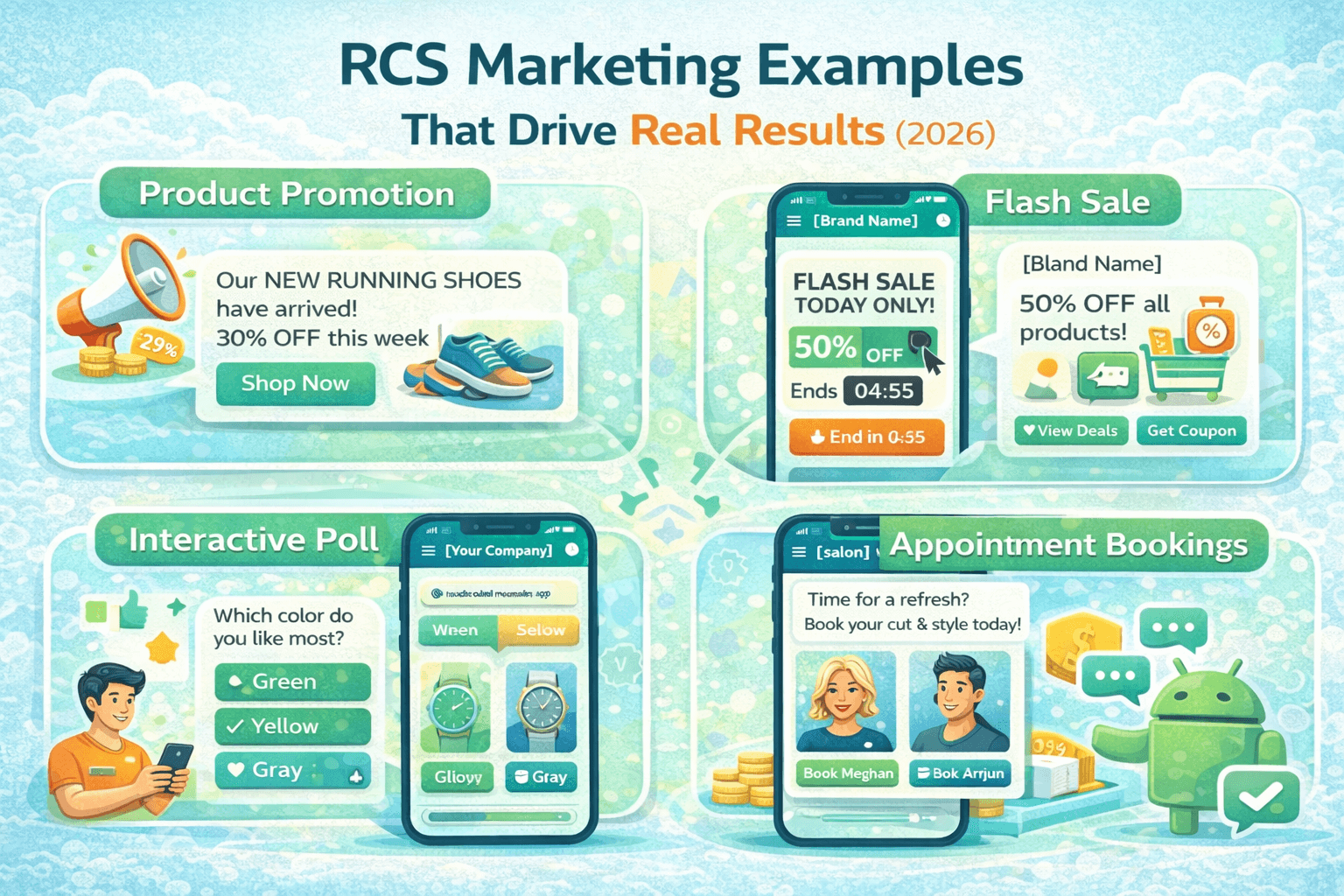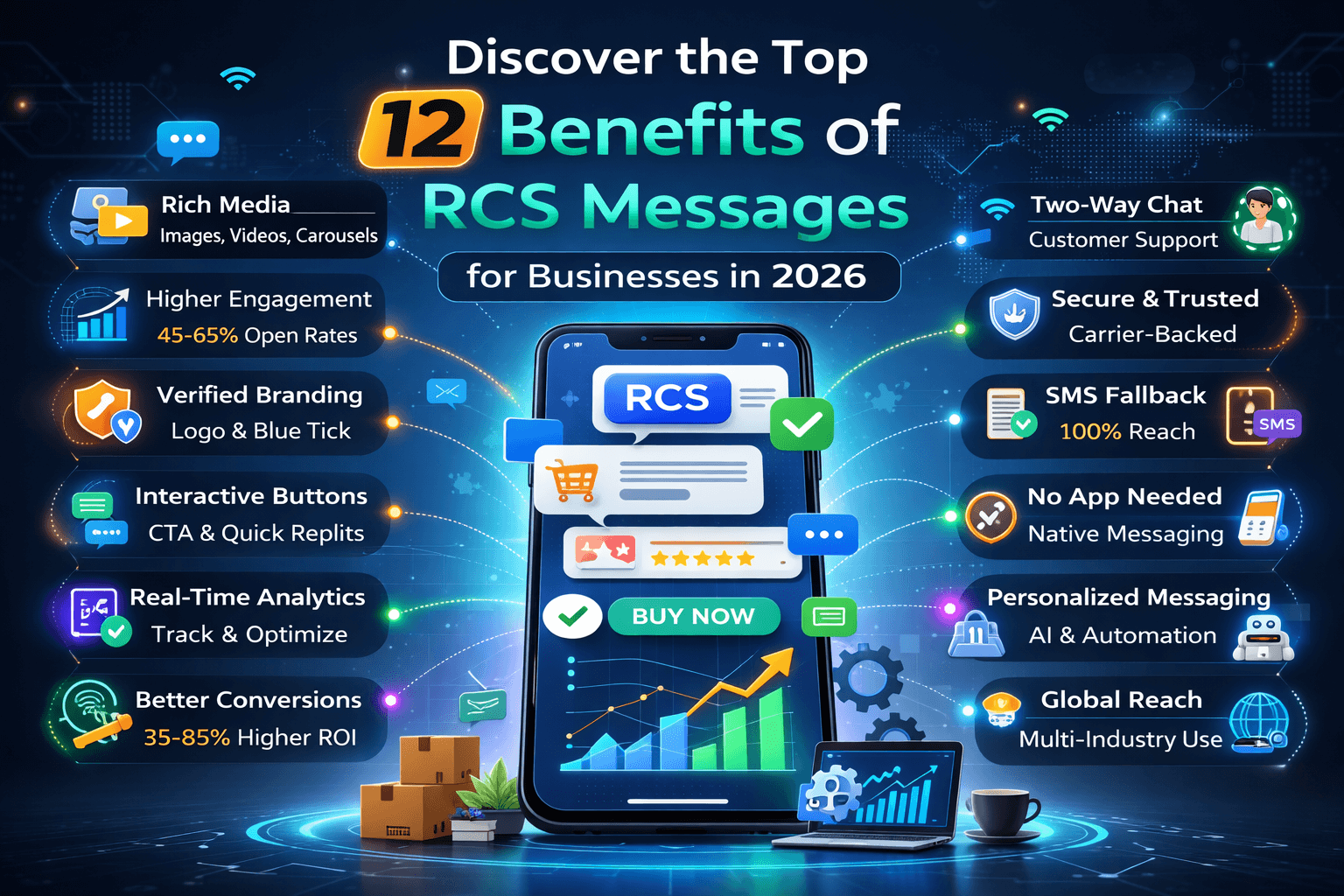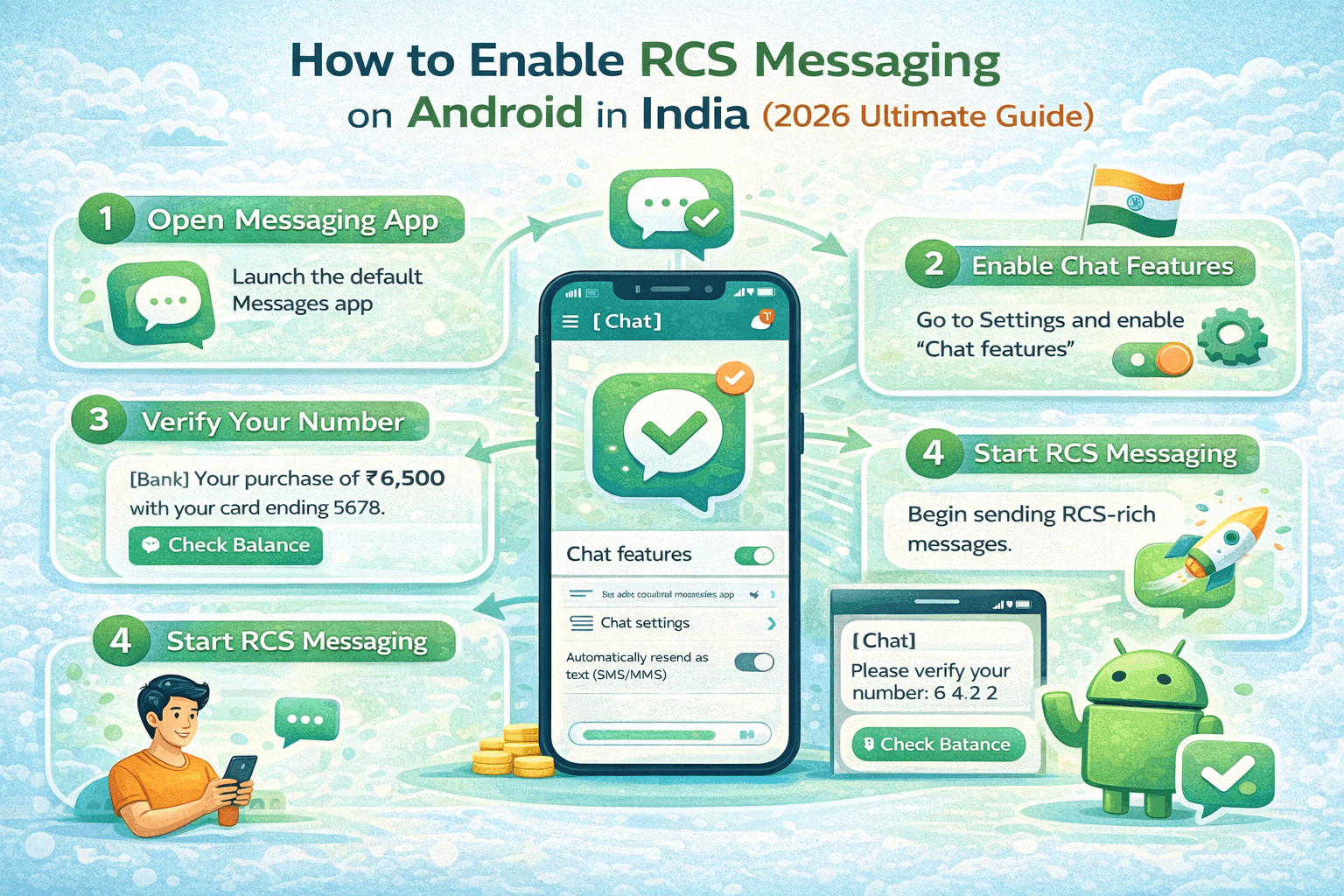
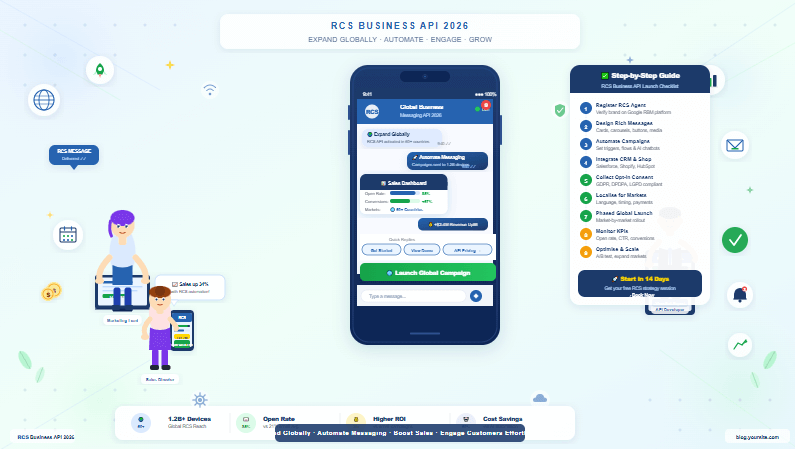
Expand globally with RCS Business API in 2026. Automate messaging, boost sales, and engage international customers effortlessly.
Expand globally with RCS Business API in 2026 and transform the way your brand connects with international customers. RCS (Rich Communication Services) enables businesses to send interactive, branded, and media-rich messages directly to users’ native messaging apps — without requiring additional downloads
Introduction: RCS Business API Is the New Engine of Global Brand Growth
The world's most ambitious brands share a common challenge: how do you reach customers in Lagos, London, Mumbai, and São Paulo — in a way that feels local, personal, and instant — without building a separate infrastructure for every market? In 2026, the answer is the RCS Business API.
Rich Communication Services (RCS) is the most significant evolution in mobile messaging in two decades. As the universal successor to SMS, RCS is now active on over 1.2 billion devices worldwide and is the default messaging standard on Android — which powers more than 72% of the world's smartphones. With Apple's full RCS adoption on iOS 18, the global addressable audience for RCS Business API campaigns reached critical mass in 2025 and continues to grow rapidly into 2026.
For brands with global ambitions, this is not a future opportunity. It is a present one. This guide covers everything you need to know about using the RCS Business API to automate messaging, drive international sales, and engage customers across every market — with the full SEO framework your website blog needs to rank and convert.
What Is the RCS Business API? (2026 Edition)
The RCS Business API — officially called the RBM (RCS Business Messaging) API — is the enterprise interface through which businesses send and receive RCS messages programmatically at scale. It is the backbone of every branded RCS campaign, automated notification flow, and conversational chatbot running on the RCS channel.
Through the RCS Business API, brands can create a verified business agent — a digital identity with a display name, logo, description, and contact information — that appears to customers in their native messaging app as a trusted, verified sender. All messages sent through the API carry this verified identity, replacing anonymous phone numbers with recognisable brand names.
RCS Business API vs. Traditional SMS API: The Key Differences
Why the RCS Business API Is the #1 Tool for Global Expansion in 2026
Expanding globally used to mean expensive localised infrastructure, fragmented tech stacks, and inconsistent customer experiences across markets. The RCS Business API changes this equation entirely. Here is why it has become the global engagement channel of choice for international brands in 2026.
|
1.2B+ RCS-Active Devices across 60+ countries |
85% Average Open Rate vs 21% for email |
45% Average CTR vs 3.2% for email |
60% Lower Support Costs via RCS chatbot automation |
1. One API, Truly Global Reach
The RCS
Business API operates across all major mobile networks in 60+ countries through
Google's RBM platform and certified aggregator partners. A single API
integration gives your brand a verified, consistent presence on the messaging
channel used by the majority of the world's Android users — and now iOS users —
without needing separate integrations or local partnerships for each market.
This is the fundamental shift that makes RCS the scalable global channel that
SMS never quite managed to become, despite its ubiquity.
2. Verified Brand Identity Builds Instant International Trust
When a customer
in Indonesia, Germany, or Colombia receives a message from your brand via the
RCS Business API, they see your company name, your logo, your brand colour, and
a verification badge that confirms the message is genuinely from you. In
markets where SMS fraud and phishing are significant consumer concerns — which
is most markets — this verified identity is a genuine commercial
differentiator. It is the difference between a message that gets opened and
acted upon, and one that gets ignored or reported as spam.
3. Rich Media and Interactivity Drive Dramatically Higher Engagement
RCS Business
API messages are not limited to text. Every message your brand sends through
the API can include high-resolution images, product carousels, video
thumbnails, action buttons, suggested reply chips, and map integrations. In
2026, brands running RCS Business API campaigns consistently report
click-through rates of 15–45% — compared to 2–4% for equivalent SMS campaigns
and 3–6% for email. The interactive format meets modern consumers' expectations
in every global market.
4. Automation at Scale Across Every Market Simultaneously
The RCS
Business API is designed for automation. Connect it to your CRM, e-commerce
platform, or customer data platform, and trigger personalised RCS messages at
every stage of the customer journey — automatically, across every market,
simultaneously. Welcome journeys, order confirmations, shipping updates,
abandoned cart recoveries, appointment reminders, payment requests, and
re-engagement campaigns can all be fully automated through the API, with
market-specific localisation applied dynamically at send time.
5. Conversational AI Turns Messaging Into a Revenue Channel
The most
advanced brands deploying the RCS Business API in 2026 are not using it for
one-way notifications. They are using it as a two-way conversational commerce
channel, powered by AI chatbots that can handle product discovery, FAQ
resolution, booking and reservations, payment processing, and post-sale support
— all within the native messaging thread. A customer who asks 'What sizes do
you have?' via RCS can complete a purchase within the same conversation,
without visiting a website or downloading an app.
6. Lower Cost Per Engagement Than Any Alternative Channel
When you factor in delivery rates, open rates, and conversion rates, the RCS Business API delivers a lower effective cost per engaged customer than email, paid social, SMS, or app push notifications in virtually every market where it has been deployed at scale. Brands consistently report 5–15x ROI on RCS Business API campaigns versus equivalent SMS or email campaigns, driven by the combination of verified delivery, rich media engagement, and automated conversation flows that remove friction from every conversion step.
How to Automate Messaging With the RCS Business API: Key Use Cases
Automation is where the RCS Business API delivers its most transformative value for global brands. Here are the highest-impact automation use cases that leading international businesses are running in 2026.
Automated Sales & Marketing Campaigns
•
Personalised product
recommendation campaigns triggered by browse or purchase history — sent as RCS
rich card carousels with one-tap add-to-cart buttons
•
Abandoned cart recovery
sequences — a 3-message automated flow with product image, social proof, and a
time-limited offer driving an average 25–35% cart recovery rate
•
Flash sale and
limited-stock alerts to opted-in customer segments — with countdown timer
images and direct purchase buttons
•
Post-purchase upsell and
cross-sell flows triggered by order confirmation — presenting related products
as interactive carousels
•
Win-back campaigns for
lapsed customers — personalised, triggered at 30/60/90 day intervals with
dynamic incentive escalation
• Seasonal and promotional campaign automation — schedule global campaigns with market-specific timing and language variants from a single workflow
Automated Customer Service & Support
•
First-response automation —
instant RCS acknowledgement with estimated response time and self-service
options when a customer initiates a support conversation
•
Order status and delivery
tracking — proactive updates triggered at each shipping milestone, reducing
inbound 'where is my order?' enquiries by up to 70%
•
Returns and refund
processing — fully automated RCS flow guiding customers through the returns
process, collecting required information, and issuing return labels
•
FAQ chatbot — AI-powered
instant answers to the top 50–100 customer queries, handling 60–80% of tier-1
support volume without human intervention
•
Appointment booking and
reminders — two-way scheduling flows with automated confirmation, 24-hour
reminder, and rescheduling option
• Escalation to live agent — intelligent handoff when the chatbot reaches its confidence threshold, with full conversation context passed to the human agent
Automated Transactional Notifications
•
Payment confirmations and
receipts with itemised breakdown as a rich card
•
Subscription renewal
reminders with one-tap renewal button and account summary
•
Security alerts — login
notifications, password change confirmations, suspicious activity warnings
•
Document and e-signature
requests — send contracts, onboarding forms, and policy documents via RCS with
a tap-to-sign action button
•
KYC and verification flows
— collect required identity documents via automated RCS conversation in
regulated industries
• Loyalty programme updates — points balance notifications, tier upgrade alerts, and reward redemption prompts
Boost Sales Globally: RCS Business API Commerce Strategies for 2026
The RCS Business API is not just a communication tool — it is a sales channel. In 2026, the most commercially advanced brands are treating their RCS Business API deployment as a revenue line, not just an engagement metric. Here are the strategies driving the strongest sales results globally.
Strategy 1: The RCS Commerce Funnel
The most
powerful RCS sales strategy is the end-to-end commerce funnel — a connected
sequence of automated RCS touchpoints that takes a customer from initial brand
awareness to completed purchase without ever leaving the messaging thread. A
customer clicks a 'Message Us' button on a social ad, receives a personalised
RCS greeting, browses a product carousel, asks a question answered by the
chatbot, selects a product, and completes payment — all in RCS. Brands running
this full-funnel RCS commerce flow are reporting conversion rates of 18–35% —
dramatically above any other digital channel.
Strategy 2: Conversational Selling With AI Chatbots
Traditional
e-commerce treats customers as transactions. The RCS Business API enables
conversational selling — an approach where an AI-powered chatbot acts as a
knowledgeable, always-available sales assistant, asking the right questions to
understand what the customer needs and presenting the most relevant options in
an interactive, engaging format. A customer who receives a generic email blast
converts at 1–3%. A customer who has a personalised RCS conversation with an AI
sales assistant converts at 15–30%. The data is unambiguous.
Strategy 3: RCS Advertising Click-to-Message Campaigns
In 2026,
Google's integration of RCS into its advertising ecosystem means brands can run
Search and Display ads with a 'Message Us' call-to-action that opens a branded
RCS conversation instantly. This click-to-RCS ad format is generating
significantly lower cost-per-lead than equivalent click-to-website campaigns in
multiple verticals — because the low-friction, high-trust entry point of a
branded RCS conversation converts better than a cold landing page arrival.
Strategy 4: RCS Loyalty and Re-Engagement Programmes
Customer
retention is where RCS Business API delivers some of its most consistent
commercial value. Automated loyalty programme communications via RCS — points
balance updates, tier upgrade notifications, personalised reward
recommendations, and exclusive member offers — drive significantly higher
engagement and redemption rates than equivalent email communications. Brands
running RCS-based loyalty programmes in 2026 are reporting 2.4x higher
programme participation rates versus email-only programmes.
Strategy 5: Market-Specific Sales Campaigns at Global Scale
The RCS Business API enables brands to run genuinely localised sales campaigns at global scale — with market-specific timing, language, offers, payment methods, and creative — all managed from a single platform. A global fashion brand can run simultaneous campaigns timed to local peak engagement windows in the UK, India, Brazil, Germany, and Singapore, each with localised language and culturally relevant creative, all triggered and managed through a single RCS Business API workflow. This was previously possible only for brands with large localisation teams. In 2026, it is achievable with a single well-configured RCS automation platform.
How to Set Up the RCS Business API: Step-by-Step Guide
Setting up the RCS Business API for global deployment involves several distinct stages. Here is the complete process, whether you are going through Google's RBM platform directly or via a certified aggregator partner.
|
1 |
Choose Your Access Route: Google RBM Direct or
Aggregator Partner You
can access the RCS Business API directly through Google's RBM (RCS Business
Messaging) Developer Portal at business.messages.google.com, or through a
certified RCS aggregator partner — such as Sinch, Infobip, Twilio, Vonage, or
a regional telco partner. Direct access gives maximum control and is best for
teams with strong development resources. Aggregator partners provide
pre-built platforms, no-code flow builders, and managed onboarding — making
them the preferred route for most businesses. Aggregators also handle the
multi-operator relationships required for true global reach across different
mobile networks. |
|
2 |
Create and Register Your RCS Business Agent Your
RCS Business Agent is the verified digital identity from which all your RCS
messages are sent. Create your agent by providing your legal business name,
display name (what customers see), brand description, logo (PNG, minimum
1024x1024px), hero banner image (recommended 1440x448px), brand colour,
website URL, privacy policy URL, and contact information. The agent profile
is reviewed and approved by Google or your aggregator partner before
activation. Ensure all details are accurate and match your public-facing
brand identity — inconsistencies will delay approval. |
|
3 |
Configure Your Verified Sender Identity for Each Market For
true global reach, you may need to configure market-specific sender
identities or ensure your primary agent is approved for multi-country
delivery. Work with your aggregator partner to confirm network coverage in
each of your target markets. Some markets require local operator agreements
or in-country phone number registration. In 2026, Google's RBM platform
supports direct delivery to most major markets without separate local
registration, but operator-specific coverage gaps still exist — verify coverage
before committing to a market launch timeline. |
|
4 |
Design and Test Your Message Templates and Rich Cards Build
your core message templates: welcome/greeting messages, transactional
notification templates, marketing campaign templates, and chatbot response
templates. Use your platform's rich card builder to create product carousels,
standalone cards, and interactive button messages. Test every template on
both Android (Google Messages) and iOS (Messages app) to verify that all
media, buttons, and interactive elements render correctly. Pay particular
attention to image aspect ratios (Google recommends 16:9 for hero images in
rich cards) and button label character limits (max 25 characters). |
|
5 |
Build Your Automation Flows and Chatbot Logic Design
the automated conversation flows that will power your RCS messaging. Start
with the highest-volume use cases: welcome/greeting sequences, order
confirmations, FAQ handling, and abandoned cart recovery. Use your platform's
flow builder to map decision trees, define intent triggers (for AI-powered
flows), set escalation rules, and configure business hours behaviour. In
2026, most leading platforms offer LLM-powered chatbot integration — enabling
natural language understanding that goes far beyond keyword matching. Define
clear handoff protocols to human agents for complex or sensitive queries. |
|
6 |
Integrate With Your CRM, E-commerce, and Data Systems Connect
the RCS Business API to your existing technology stack. Essential
integrations include your CRM (Salesforce, HubSpot, Microsoft Dynamics) for
customer data and conversation history, your e-commerce platform (Shopify,
Magento, Salesforce Commerce Cloud) for order and product data, your customer
data platform for segmentation and personalisation, and your analytics
platform for attribution and reporting. These integrations are what transform
the RCS Business API from a messaging channel into a personalised,
data-driven revenue engine. |
|
7 |
Implement Opt-In Collection and Compliance Framework Before
sending any proactive RCS messages, ensure you have a compliant opt-in
framework in place for every market you operate in. Opt-in consent must be
explicit, channel-specific (general SMS or email consent is not sufficient),
and documented. Build opt-in collection into your website, checkout flows,
loyalty programme registration, and app onboarding. Implement a clear and
easy opt-out mechanism. Configure your platform to suppress opted-out
contacts instantly. Ensure your data processing is documented in your Records
of Processing Activities to comply with GDPR, CCPA, India's DPDPA, Brazil's
LGPD, and other applicable regulations. |
|
8 |
Launch With a Market-by-Market Phased Rollout Do
not attempt to launch globally on day one. Start with your primary market,
run for 4–6 weeks, gather performance data, identify optimisation
opportunities, and refine before expanding. A phased rollout reduces risk,
allows your team to build operational expertise, and generates
market-specific data that improves localisation quality in subsequent
markets. Define clear KPIs for each market launch: delivery rate (target
>98%), open rate (target >70%), reply rate (target >20%), and
conversion rate (varies by campaign type). |
|
9 |
Measure, Optimise, and Scale Establish
a continuous improvement cycle from day one. Weekly: review delivery rates,
open rates, and opt-out rates. Monthly: analyse campaign conversion rates,
chatbot resolution rates, and cost-per-conversion. Quarterly: A/B test
message templates, chatbot flows, and send timing. Annually: audit your
global rollout against market expansion targets and re-evaluate your
BSP/aggregator partnership. The brands that achieve the highest long-term ROI
from the RCS Business API are those that treat it as a living programme — not
a set-and-forget deployment. |
Engage International Customers Effortlessly: Market-by-Market RCS Strategy
Deploying the RCS Business API globally is not the same as deploying it in one market and translating the messages. Truly effective international RCS engagement requires thoughtful localisation across language, tone, timing, content format, payment integration, and compliance. Here is how to approach the world's most important markets.
|
Market |
RCS Penetration |
Top Use Cases |
Peak Send Time |
Key Language Note |
Payment Tip |
|
India |
Very High |
Commerce,
Banking, OTP |
7–9pm IST |
Formal Hindi
or English |
UPI
integration essential |
|
United
Kingdom |
High |
Retail,
Finance, Health |
10am–12pm GMT |
Friendly,
concise tone |
Stripe / Open
Banking |
|
Brazil |
Very High |
Retail,
F&B, Services |
Sat mornings / eves |
Casual
Brazilian Portuguese |
Pix payment
integration |
|
Germany |
Medium-High |
B2B, Finance,
Utility |
Tue–Thu 9–11am CET |
Formal Sie
form |
SEPA / PayPal |
|
USA |
High |
Retail,
Healthcare |
Tue–Wed 10am EST |
Casual,
emoji-friendly |
Stripe /
Apple Pay |
|
Nigeria |
Growing |
Fintech,
FMCG, Telco |
Evenings 6–9pm WAT |
English —
warm, energetic |
Paystack /
Flutterwave |
|
UAE / KSA |
High |
Luxury,
Travel, Finance |
Sun–Thu 8–10pm GST |
Arabic +
English dual lang |
Network Int'l
/ Telr |
|
Indonesia |
High |
E-commerce,
F&B |
Lunch + 8–10pm WIB |
Bahasa
Indonesia preferred |
GoPay / OVO /
DANA |
|
Mexico |
Medium-High |
Retail,
Banking |
Weekdays 6–8pm CST |
Warm,
informal Spanish |
OXXO / SPEI |
|
Singapore |
Very High |
Finance,
Travel, B2B |
Weekdays 12–2pm SGT |
English —
professional |
PayNow / Grab
Pay |
Universal Principles for International RCS Engagement
•
Always use a local phone
number or country-specific sender identity where operator relationships permit
— local numbers see 12–18% higher open rates than international numbers in most
markets
•
Localise not just language
but tone — formality levels, emoji usage, and directness vary significantly
between cultures and affect engagement rates substantially
•
Respect local communication
norms — in many markets, messaging outside of business hours is considered
intrusive; in others, evening and weekend engagement peaks are the norm
•
Integrate local payment
methods — a checkout button that does not offer the preferred local payment
method is a conversion killer in every market without exception
•
Comply with local data
protection law from day one — retroactive compliance is far more costly and
disruptive than building it in from the outset
• Test message rendering on local carrier networks before launch — RCS feature support can vary between operators in the same market
Top RCS Business API Platforms for Global Brands in 2026
Choosing the right platform to access and manage your RCS Business API is one of the most consequential decisions in your global messaging strategy. Here is how the leading platforms compare for international deployments.
|
Platform |
Best For |
No-Code Builder |
AI Chatbot |
Global Markets |
Pricing Model |
|
Google RBM
(Direct) |
Developers |
API-first |
Dialogflow |
60+ countries |
Per-message |
|
Sinch |
SMB to
Enterprise |
Yes — Engage |
Built-in AI |
150+ countries |
Per message / custom |
|
Infobip |
Enterprise /
Telco |
Yes — Answers |
Advanced NLP |
180+ countries |
Custom contract |
|
Twilio |
Developers |
Studio flows |
Flex + AI |
60+ countries |
Pay-as-you-go |
|
Vonage
(Ericsson) |
Mid to
Enterprise |
Dashboard |
AI Studio |
100+ countries |
Custom |
|
Messagebird
/ Bird |
Mid to
Enterprise |
Yes — Flows |
ML-powered |
170+ countries |
Custom |
|
Tyntec |
Telco / B2B |
Moderate |
API
integration |
50+ countries |
Custom |
|
Kaleyra |
SMB /
Emerging Mkt |
Yes — Studio |
NLP-based |
100+ countries |
Monthly plans |
Frequently Asked Questions: RCS Business API 2026
These FAQs target Google's People Also Ask feature and FAQPage rich snippets. Add FAQPage JSON-LD schema to your published post using these exact Q&A pairs.
|
Q: What is the RCS Business
API and how does it work? |
|
A:
The RCS Business API (also called the RBM API or RCS Business Messaging API)
is an enterprise messaging interface that allows businesses to send rich,
interactive, verified messages to customers through their device's native
messaging app. It works by connecting your business systems — CRM, e-commerce
platform, or messaging platform — to Google's RBM infrastructure (or a
certified aggregator network) via REST API. When your system triggers a
message send, the API routes the message through the mobile network to the
customer's device as an RCS message, displayed with your brand name, logo,
and rich media content. Two-way conversations are enabled by receiving
customer replies through the same API webhook. |
|
Q: How much does the RCS
Business API cost in 2026? |
|
A:
RCS Business API pricing is typically per-message or per-conversation,
varying by provider, market, and volume. Direct Google RBM access charges per
RCS message sent. Aggregator platforms may charge per message, per
conversation, or via monthly platform fees. Indicative per-message costs
range from $0.01 to $0.08 depending on market and message type. At high
volumes, most aggregators offer tiered pricing that significantly reduces the
per-message cost. Some platforms also offer monthly flat-rate plans for
predictable volume. Request a custom quote from your chosen platform based on
your target markets and projected monthly message volume. |
|
Q: Which countries support
the RCS Business API? |
|
A:
As of 2026, the RCS Business API is supported in over 60 countries through
Google's RBM platform, with additional markets covered by regional aggregator
networks. Key markets include the UK, USA, India, Brazil, Germany, France,
Australia, Japan, South Korea, UAE, Saudi Arabia, Mexico, Indonesia, Nigeria,
and Singapore. Coverage continues to expand as operator agreements are
finalised. For the most current market coverage, check Google's official RBM
documentation or consult your aggregator partner, who will have up-to-date
operator coverage maps for your target markets. |
|
Q: Can the RCS Business API
work on iPhones? |
|
A:
Yes. Since Apple's adoption of RCS in iOS 18 (released September 2024), the
RCS Business API now delivers messages to iPhone users as well as Android
users. RCS Business Messages are displayed in the iPhone's native Messages
app with rich media and interactive elements, subject to iOS's current RCS
feature support level. As of 2026, iOS supports the core RCS Business
Messaging feature set including rich cards, suggested replies, and action
buttons. Some advanced RCS features may have different rendering between
Android and iOS — always test on both platforms before campaign launch. |
|
Q: How do I get my RCS
Business Agent verified? |
|
A:
RCS Business Agent verification is managed by Google (for direct RBM access)
or by your aggregator partner. The process involves submitting your business
details including legal business name, display name, logo, website, privacy
policy, and contact information. Google reviews submissions for authenticity,
brand consistency, and compliance with RBM usage policies. Approval typically
takes 3–10 business days. Businesses in regulated categories (financial
services, healthcare, gambling) may face additional review requirements. Once
approved, your agent displays your brand identity in every message sent
through the API. |
|
Q: What is the difference
between RCS and WhatsApp Business API for global messaging? |
|
A:
Both RCS and WhatsApp Business API enable rich, interactive business
messaging, but they differ in key ways. RCS works through the native
messaging app on Android and iOS without any app download — it is built into
the device's default SMS/messaging app. WhatsApp requires customers to have
the WhatsApp app installed, but has a larger active user base (2 billion vs
1.2 billion for RCS) and stronger penetration in specific markets like India
and Brazil. RCS is generally more cost-effective at scale and does not
require a separate app, making it the lower-friction channel. Many global
brands run both channels simultaneously, using RCS for markets with strong
native penetration and WhatsApp where it is the dominant messaging platform. |
|
Q: Do I need technical
development skills to use the RCS Business API? |
|
A:
It depends on your chosen access route. Direct Google RBM API integration
requires REST API development skills and the ability to build and maintain
webhook infrastructure. However, most businesses access the RCS Business API
through aggregator platforms that provide no-code or low-code interfaces —
visual flow builders, drag-and-drop chatbot designers, and pre-built
integrations with popular CRM and e-commerce platforms. These platforms make
it possible for marketing and CX teams to build, launch, and manage RCS
Business API campaigns with minimal or no coding required. |
Conclusion: The Global Opportunity Is Live — Your Brand Should Be Too
The RCS Business API in 2026 is not an emerging technology to keep on the roadmap. It is a proven, commercially deployed, globally scalable channel that is already driving measurable revenue and engagement uplift for the brands that have moved first.
The fundamentals are compelling: 1.2 billion RCS-active devices and growing. Open rates that dwarf every other digital channel. A verified, trusted brand identity in every message. Full automation capability across every stage of the customer journey. And a global infrastructure that allows a single brand to engage customers in London, Lagos, Mumbai, and São Paulo — consistently, personally, and at scale — from one platform.
Expanding globally with the RCS Business API is no longer a strategic option reserved for the world's largest corporations. In 2026, the platform infrastructure, the aggregator ecosystem, and the operator coverage have matured to the point where any ambitious brand — from a scaling e-commerce business to a mid-size financial services firm — can deploy, automate, and optimise a global RCS messaging strategy within weeks.
Your
international customers are already on RCS. The only question is whether your
brand is talking to them there. Make sure it is.