RCS API for Logistics: Real-Time Delivery Tracking & Instant Notifications
Learn how RCS API helps logistics companies enable real-time delivery tracking, instant notifications, and better customer experience in 2026.
Introduction: Why Logistics Notifications Are Broken — and How RCS FixesThem
Ask any logistics operations manager about their biggest customer experience headache and the answer is almost always the same: delivery communication. Customers who do not know where their parcel is become anxious customers. Anxious customers call support lines. They leave negative reviews. They demand refunds. They do not reorder.
For years, the industry's answer to this problem was SMS — brief, plain-text notifications that told customers a parcel was on its way or had been delivered. SMS was better than nothing, but it was never good enough. No live tracking link that works without an app. No interactive options to redirect a delivery. No branded identity to build trust. Just an anonymous number and a string of text.
In 2026, the RCS API for logistics is replacing this outdated model entirely. Rich Communication Services — delivered through the native messaging app on Android and iOS — enables logistics companies, couriers, e-commerce platforms, and 3PL providers to send real-time delivery tracking updates that are branded, interactive, and actionable. Customers can track their parcel live, redirect delivery, confirm receipt, report damage, and rate their experience — all within a single RCS message thread, without downloading any app.
This guide
covers the full picture: what the RCS API delivers for logistics, how to
implement it, ready-to-use notification templates, ROI benchmarks, and the
complete SEO framework to help this article rank and convert on your website.
|
Quick
Answer (Featured Snippet Target): The
RCS API for logistics allows courier and delivery businesses to send rich,
branded, interactive delivery notifications directly to customers' native
messaging apps — no app download required. It supports real-time parcel
tracking links, delivery redirect buttons, proof-of-delivery confirmation,
and automated customer support chatbots. Available on Android and iOS 18+,
the RCS API replaces SMS delivery notifications with a significantly richer,
more actionable customer experience that reduces inbound WISMO ('Where Is My
Order?') calls by up to 70%. |
The Logistics Communication Problem That Is Costing Businesses Millions
Before
examining the solution, it is worth quantifying the problem. Poor delivery
communication is not just a customer experience inconvenience — it is a
measurable, material cost to logistics businesses and the retailers they serve.
|
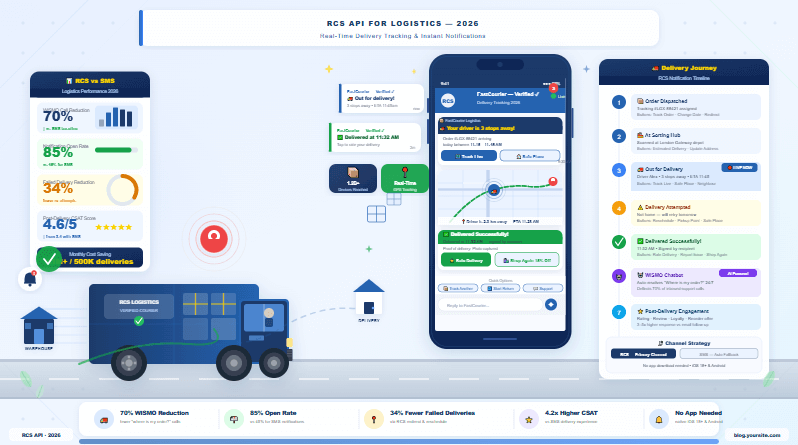
70% WISMO Call Reduction with proactive RCS tracking updates |
85% RCS Open Rate vs 45% for SMS notifications |
34% Failed Delivery Reduction via RCS redirect & rescheduling |
4.2x Higher CSAT Scores RCS delivery UX vs SMS baseline |
The Real Cost of Poor Delivery Communication
•
WISMO ('Where Is My
Order?') calls account for 35–50% of all inbound customer service contacts for
e-commerce businesses — each call costing an average of £3.50–£8.00 to handle
•
Failed first-time delivery
attempts cost logistics operators an average of £14.50 per re-attempt in the UK
— costs that could be dramatically reduced with proactive communication and
real-time redirect options
•
73% of consumers say they
will not reorder from a retailer after a poor delivery experience — making
delivery communication a direct driver of customer lifetime value
•
Courier businesses handling
1 million deliveries per month lose an estimated £1.2–£2.8 million annually to
preventable failed deliveries caused by absent recipients — most of whom simply
did not know the delivery was coming
•
Email delivery
notifications are opened by fewer than 22% of recipients on average — meaning
the majority of customers are navigating the delivery experience with no
real-time information
• SMS delivery notifications improve on email but remain limited — plain text, no interactive options, no branded identity, and increasingly blocked by carrier spam filters in some markets
Why SMS Is No Longer Good Enough for Logistics Notifications
SMS has served the logistics industry reasonably well for over a decade, but its limitations are increasingly apparent as customer expectations have risen. A plain text message saying 'Your parcel will be delivered today between 9am and 6pm. Reply STOP to opt out' is no longer an adequate communication experience for customers who can order same-day delivery, track their Uber to the minute, and manage every other consumer service from a rich app interface.
The specific problems with SMS for logistics are well-documented: no verified sender identity means customers increasingly distrust unexpected delivery text messages (phishing attempts via fake delivery SMS are now one of the most common consumer scams globally); no interactive redirect options mean missed deliveries are inevitable; no live tracking integration means customers must separately navigate to a tracking website; and the 160-character limit means messages are often truncated, confusing, or incomplete.
The RCS API for logistics solves every one of these problems simultaneously — and does so through the same native messaging interface that customers already use, without requiring any new app or account.
What the RCS API Delivers for Logistics: Core Capabilities
The RCS API transforms the logistics notification experience across every stage of the delivery journey. Here is what it enables that SMS and email simply cannot match.
1. Verified Brand Identity on Every Notification
Every RCS notification sent through the API displays your company's verified name, logo, and brand colour scheme directly in the message header. Customers immediately recognise the sender as a legitimate business — not an anonymous number or a suspected phishing attempt. In the context of delivery scam prevalence, this verification layer is genuinely transformative for customer trust and message open rates.
The verified
sender badge is awarded through the RCS agent registration process — once your
business is verified, every notification you send carries this trust signal
automatically. For courier brands building their reputation in new markets,
this verified identity establishes brand recognition at the most important
moment: when a customer is waiting for their delivery.
2. Real-Time Tracking Integration via Rich Cards
Rather than a plain text notification with a tracking number the customer must manually enter on a website, RCS logistics notifications can include a rich card displaying the current delivery status, an estimated delivery window, and a 'Track Live' action button that opens a real-time map directly from the message — with no app download required.
This single
capability — the frictionless one-tap journey from notification to live
tracking map — is the most consistently cited driver of CSAT improvement among
logistics businesses that have deployed the RCS API. The journey time from
receiving the notification to seeing the driver's position on a map is reduced
from 3–5 minutes (notification, open tracking website, enter tracking number,
navigate to map) to under 5 seconds (notification, tap button).
3. Interactive Delivery Management Buttons
The RCS API enables logistics businesses to give customers genuine control over their delivery without requiring phone calls, app downloads, or website logins. Standard interactive buttons within RCS delivery notifications include options such as 'Change Delivery Time', 'Deliver to Neighbour', 'Leave in Safe Place', 'Redirect to Collection Point', and 'Call Driver'. Each button triggers either an immediate automated action or a structured conversational flow that collects the necessary information to action the customer's request.
The commercial
impact of this interactivity is measurable: logistics businesses that have
deployed interactive RCS delivery notifications report a 28–40% reduction in
failed first-time delivery attempts — one of the most significant
cost-reduction levers available to the sector.
4. Proof of Delivery Confirmation Flow
The RCS API
enables fully automated proof-of-delivery workflows. When a delivery is
completed, an RCS message can be sent instantly asking the customer to confirm
receipt — with a simple 'Confirm' button, a 'Report an Issue' button, and an
optional one-tap satisfaction rating. This replaces paper signatures, separate
app-based confirmation flows, and email follow-up sequences with a seamless
in-message experience that captures proof-of-delivery data in real time.
5. Automated WISMO Chatbot via RCS
The single most impactful application of the RCS API for logistics customer service is the automated WISMO (Where Is My Order?) chatbot. When a customer replies to any RCS delivery notification with a query — 'Where is my parcel?', 'What time will it arrive?', 'I wasn't home, what happens now?' — an AI-powered chatbot can respond instantly with accurate, real-time information pulled from the carrier's tracking system.
This automated
WISMO resolution via the RCS thread deflects 60–80% of delivery-related
customer service contacts from expensive voice and live chat channels. The
customer gets an immediate, accurate answer. The operations centre avoids the
cost of a live agent interaction. And the conversation remains within the
familiar, trusted RCS messaging thread rather than requiring the customer to
navigate to a separate support channel.
6. Post-Delivery Review and Retention Flows
The delivery moment is the highest-engagement touchpoint in the customer relationship — and RCS allows logistics businesses and their retail partners to capitalise on it. An automated post-delivery RCS flow can collect a delivery satisfaction rating, invite the customer to share a review, present a personalised promotional offer for their next order, and enrol them in a loyalty programme — all within the same message thread where they tracked their parcel. This post-delivery engagement flow consistently outperforms equivalent email sequences in participation rates by a factor of 3–5x.
RCS Logistics Notification Templates: Ready to Use in 2026
These professionally written RCS notification templates cover every stage of the delivery journey. Customise the brand name, tracking details, and button labels to match your operation. Each template is optimised for the RCS Business API format with verified sender header, message body, and suggested reply chips.
|
📦 Order Dispatched — RCS Notification
Template |
|
[Verified Sender Logo + Business Name] Great
news — your order is on its way! Your order #LGX-88421 has been collected from the
warehouse and is en route to our sorting hub. Your estimated delivery window
is tomorrow, Thursday 6 March, between 10:00 AM and 2:00 PM. You can track
your parcel in real time using the button below. Quick
Replies: [ 🗺️ Track Live ] [ 🔄
Change Delivery Date ] [ 📍
Redirect to Locker ] |
|
🚚 Out for Delivery — RCS Notification
Template |
|
[Verified Sender Logo + Business Name] Your
delivery is 3 stops away! Your driver Alex is on the way with your parcel
#LGX-88421. You are stop 3 of 3 on today's route — estimated arrival between
11:15 AM and 11:45 AM. Tap 'Track Driver' to see live position on the map. Quick
Replies: [ 🗺️ Track Driver ] [
🏠 Leave Safe Place ] [ 🧑🤝🧑
Deliver to Neighbour ] [ 📞
Call Driver ] |
|
⚠️ Delivery Attempted — Not Home — RCS
Notification Template |
|
[Verified Sender Logo + Business Name] We
tried to deliver — you weren't in. We attempted delivery of parcel #LGX-88421 at 11:32 AM
today but were unable to complete the delivery. Your parcel is safe and we
will try again tomorrow between 9:00 AM and 1:00 PM. Or choose an alternative
option below — no phone call needed. Quick
Replies: [ ⏰ Reschedule Delivery ] [ 📍
Redirect to Pickup Point ] [ 🏠
Leave at Address ] [ 📞 Contact
Support ] |
|
✅ Delivery Successful — RCS Notification
Template |
|
[Verified Sender Logo + Business Name] Your
parcel has been delivered! Great news — your order #LGX-88421 was successfully
delivered at 11:47 AM today. It was handed to a person at the address. If you
have any issues with your delivery, please tap 'Report an Issue' below within
48 hours. Quick
Replies: [ ⭐ Rate Your Delivery ] [ ❗
Report an Issue ] [ 🛍️ Shop
Again — 15% Off ] |
|
⏰ Delivery Exception / Delay — RCS
Notification Template |
|
[Verified Sender Logo + Business Name] We
need to let you know about a delay. Unfortunately, parcel #LGX-88421 has been delayed due
to high volume at our regional depot. Your new estimated delivery window is
Friday 7 March between 9:00 AM and 5:00 PM. We apologise for the
inconvenience and have applied a £5 credit to your account. Quick
Replies: [ 🔄 Reschedule ] [ 📞
Contact Support ] [ 📋 View
Full Tracking ] |
|
🏪 Collection Ready — Pickup Point — RCS
Notification Template |
|
[Verified Sender Logo + Business Name] Your
parcel is ready for collection! Your parcel #LGX-88421 is available for collection at
CityPoint Parcel Store, 42 High Street, London EC2A 4NE. Opening hours:
Mon–Sat 8:00 AM – 8:00 PM, Sun 10:00 AM – 4:00 PM. Please bring a photo ID.
Your parcel will be held for 7 days. Quick
Replies: [ 🗺️ Get Directions ]
[ 📅 Extend Hold Period ]
[ 🚚 Redirect to Home ] |
|
🌐 International Customs Clearance — RCS
Notification Template |
|
[Verified Sender Logo + Business Name] Your
international parcel is clearing customs. Your shipment #LGX-88421 from Germany has arrived at UK
customs and is currently being processed. Estimated clearance time: 24–48
hours. Once cleared, we will send you a confirmed delivery date. No action is
required from you at this stage. Quick
Replies: [ 📋 View Customs Status ]
[ 📞 Speak to Import Team ]
[ 🔔 Update Delivery Preference ] |
How to Implement the RCS API for Logistics: Step-by-Step Guide
Implementing the RCS API for logistics notification delivery involves integrating your existing dispatch and tracking systems with the RCS Business Messaging infrastructure. Here is the complete implementation roadmap.
|
1 |
Choose Your RCS Aggregator or BSP Partner You
can access the RCS Business API directly through Google's RBM (RCS Business
Messaging) Developer Platform, or via a certified aggregator partner such as
Sinch, Infobip, Twilio, Vonage, or a regional telco partner. For logistics
operations, aggregator platforms are strongly recommended — they provide
native connectors to common WMS (Warehouse Management Systems), TMS
(Transport Management Systems), and e-commerce platforms, significantly
reducing integration development time. Evaluate partners based on their
logistics sector experience, API uptime SLAs, coverage in your key markets,
and pricing model. |
|
2 |
Register and Verify Your RCS Business Agent Your
RCS Business Agent is the verified identity from which all notifications are
sent. Submit your company name, display name (what customers see — e.g.
'FastCourier Deliveries'), logo (minimum 1024x1024px PNG), brand colour,
website URL, and privacy policy. Approval typically takes 3–10 business days.
Ensure your display name matches your brand as customers know it — this is
the name that replaces the anonymous phone number in every notification you
send. For courier businesses handling deliveries on behalf of multiple retail
clients, consider whether a single branded agent or per-brand agents better
serves your operations. |
|
3 |
Map Your Delivery Journey Notification Touchpoints Before
building your RCS notification flows, map every trigger event in your
delivery journey that should generate a customer notification. Typical
trigger points include: order received, order dispatched from warehouse,
parcel at sorting hub, parcel out for delivery (with estimated time window),
delivery attempted (successful or failed), parcel at collection point,
delivery rescheduled, parcel in customs (for international), and
post-delivery satisfaction request. For each trigger, define the message content,
the interactive options available to the customer, and the actions that
should follow each customer response. |
|
4 |
Integrate Your TMS/WMS with the RCS API via Webhooks The
power of RCS logistics notifications comes from real-time integration with
your tracking systems. Configure webhook events in your TMS or WMS to fire an
API call to your RCS platform whenever a defined tracking event occurs. The
RCS platform then dispatches the appropriate notification to the customer's
phone number immediately. Most BSP platforms provide pre-built connector
libraries for common logistics platforms including Metapack, Shippit,
ShipStation, EasyPost, and regional carrier APIs. For custom TMS
environments, the RCS API REST endpoints are well-documented and typically
require 2–6 days of development time to integrate. |
|
5 |
Build Your WISMO Chatbot Response Flows Configure
automated responses for the most common customer queries that arrive via RCS
replies. The top WISMO queries to automate include: 'Where is my parcel?',
'What time will it be delivered?', 'I wasn't home — what happens now?', 'Can
I change my delivery address?', 'My parcel shows delivered but I haven't
received it', and 'I need to return this item'. For each query, build a
response flow that pulls real-time data from your tracking API and presents
it to the customer in plain language within the RCS thread. Define escalation
paths to live agents for queries outside the chatbot's resolution capability. |
|
6 |
Configure Opt-In and Compliance Framework Ensure
customers have explicitly opted in to receive RCS delivery notifications at
the point of order. For most e-commerce integrations, this consent is
collected during checkout as part of the delivery communications preference —
ensure the consent language is specific to RCS messaging. Build automated
opt-out processing so that any customer who replies 'STOP' is immediately
suppressed from future RCS sends. Maintain opt-in records in your CRM and
document all data processing activities for GDPR, PDPA, and other applicable
regulatory compliance. |
|
7 |
Create and Submit Message Templates All
proactive RCS notifications (messages initiated by your business rather than
by the customer) must use pre-approved Message Templates. Build your
templates based on the examples in Section 4 of this guide. Submit them for
approval via your RCS platform's template management interface. Approval
typically takes minutes to 24 hours. In 2026, AI-assisted template quality
scoring tools on most BSP platforms help optimise your templates for approval
and engagement before submission. |
|
8 |
Test Across All Devices and Carriers Before Launch Before
going live, test every notification template and chatbot flow on a
representative range of devices: multiple Android models running Google
Messages, and iPhones running iOS 18 and above. Verify that all images load
correctly (use JPEG or PNG under 5MB, 16:9 ratio for rich cards), all buttons
render and function correctly, tracking links open to the correct
destination, and chatbot flows respond accurately to all planned query
inputs. Test on at least two UK carriers (e.g. EE and Vodafone) to verify consistent
rendering across network operators. |
|
9 |
Launch, Monitor KPIs, and Optimise Continuously Go
live with a controlled rollout — begin with a single delivery region or
carrier route before scaling nationally. Monitor your core KPIs weekly:
notification delivery rate (target >98%), open rate (target >70%),
interaction rate (percentage of customers who tap a button or reply — target
>25%), WISMO call deflection rate, failed delivery reduction rate, and
CSAT scores. A/B test different message copy, button labels, and send timing
to identify optimisations. Review chatbot resolution rates monthly and expand
the automated query library based on actual customer input patterns. |
RCS API for Logistics: ROI Benchmarks and Performance Data
The business case for deploying the RCS API for logistics notifications is supported by consistent performance data from early adopters across the UK, Europe, and Asia Pacific. Here are the key benchmarks that logistics businesses should use when building their investment case.
Operational Cost Reduction Benchmarks
|
Metric |
SMS Baseline |
RCS Performance |
|
WISMO call
volume (% of deliveries) |
12–18% |
3–6% (60–70% reduction) |
|
First-time
delivery success rate |
82–86% |
91–96% (+9–14 percentage points) |
|
Failed
delivery re-attempt cost |
£14.50 avg |
£8.20 avg (43% reduction) |
|
Customer
service cost per delivery |
£1.80–£3.20 |
£0.60–£1.10 (65% reduction) |
|
Post-delivery
CSAT score |
3.4 / 5.0 |
4.6 / 5.0 (+35%) |
|
Delivery
notification open rate |
45% |
82–89% (+85% relative increase) |
|
Delivery
redirect / reschedule self-service |
8–12% |
34–42% (+300% relative increase) |
|
Review
collection rate (post-delivery) |
4–7% |
18–26% (3–4x higher) |
Calculating Your RCS Logistics ROI
The ROI calculation for RCS logistics API deployment is typically compelling even for operations at relatively modest scale. Consider a courier business delivering 500,000 parcels per month:
RCS API Use Cases by Logistics Sector
The RCS API for logistics delivers value across every segment of the sector. Here is how different types of logistics and delivery businesses are applying it in 2026.
Last-Mile Courier Services
•
Real-time 'X stops away'
notifications with live driver tracking map button — the highest-impact single
feature for last-mile CSAT improvement
•
Automated delivery window
confirmation messages sent 60 minutes before the driver arrives — reducing
failed deliveries by keeping customers informed and home
•
One-tap safe place and
neighbour delivery authorisation — capturing customer preference in real time
rather than through a separate app
•
Instant missed delivery
notification with one-tap rescheduling options — reducing the inbound call
volume generated by delivery failure
• Driver rating and tip flow triggered immediately after successful delivery — capturing feedback at the highest-engagement moment
E-Commerce Fulfilment and 3PL Providers
•
White-labelled RCS
notifications on behalf of retail clients — each notification carries the
retailer's brand identity while running through the 3PL's RCS API
infrastructure
•
Order dispatch confirmation
with product image carousel showing exactly what items are in the shipment —
reducing 'wrong item' contact queries
•
Returns initiation flow via
RCS — customers can request a return, select a return reason, choose a drop-off
method, and receive a returns label, all within the RCS thread
•
Subscription order
management — allowing recurring delivery customers to skip, pause, or modify
upcoming deliveries directly via RCS
• Multi-parcel order tracking — consolidated RCS message handling multiple tracking numbers for split shipments
International and Cross-Border Logistics
•
Customs clearance status
updates with estimated timeline and any required customer actions (e.g. import
duty payment requests)
•
Multi-language notification
delivery — RCS templates can be configured to send in the customer's preferred
language, essential for cross-border e-commerce brands
•
Import duty payment via RCS
— in supported markets, customers can pay import charges directly from the
notification without visiting a separate portal
•
Restricted item
notifications with clear guidance on the customer's options — reschedule,
return to sender, or destruction
• Bonded warehouse status updates for high-value commercial shipments
Pharmaceutical and Temperature-Controlled Logistics
•
Chain of custody
notifications with timestamp and handler confirmation at each transfer point
•
Temperature exceedance
alerts sent proactively if monitored shipments exceed acceptable ranges
•
Patient delivery
notifications for home delivery of prescription medicines — with delivery
confirmation and medication reminder prompts
• Regulatory compliance documentation delivery via RCS — shipping manifests and import licences sent directly to the recipient in the RCS thread
B2B and Industrial Freight
•
Consignment tracking
updates sent to procurement and warehouse teams with ETA for production
planning purposes
•
Proof of delivery capture
with digital signature request via RCS — replacing paper POD in last-mile
commercial delivery
•
Delivery exception
escalation to multiple recipients — RCS notifications sent simultaneously to
the consignee and their logistics coordinator
• Customs documentation status for import freight — interactive notifications allowing importers to take required actions without leaving the message thread
RCS vs SMS vs Email for Logistics Notifications: Full Comparison
Many logistics businesses currently use a combination of SMS and email for delivery communications. Here is how the RCS API compares across every dimension that matters for logistics notification performance.
|
Feature |
Email |
SMS |
RCS Business API |
|
Open Rate |
18–22% |
42–48% |
80–90% |
|
Read
Within 3 Minutes |
11% |
68% |
82% |
|
Interactive
Buttons |
Limited (HTML) |
None |
Full native buttons |
|
Verified
Sender |
From name only |
No |
Full logo + badge |
|
Live
Tracking Link |
URL in text |
URL in text |
One-tap native button |
|
Rich Media
Support |
HTML images |
MMS only |
Cards, carousels, video |
|
App
Download Required |
Email app needed |
Native SMS |
Native messaging app |
|
WISMO
Deflection Rate |
Low — 15–20% |
Medium 30% |
High — 60–70% |
|
Failed
Delivery Reduction |
Minimal |
8–12% |
28–40% |
|
Cost per
Message |
Very Low |
Low |
Low–Medium |
|
Spam
Filter Risk |
High |
Medium |
Low (verified) |
|
CRM
Integration |
Standard |
Standard |
Native via BSPs |
|
Post-Delivery
Engagement |
3–5% response |
4–7% |
18–28% response |
|
2026
Recommendation |
Secondary only |
Fallback |
Primary channel |
|
Channel
Strategy Recommendation: For
logistics businesses transitioning from SMS to RCS in 2026, the recommended
approach is to use RCS as the primary delivery notification channel, with SMS
as an automatic fallback for customers whose devices do not support RCS
(typically older devices or those on carriers without RCS deployment). This
dual-channel approach ensures 100% delivery coverage while progressively
shifting volume to the higher-performing RCS channel as device and carrier
adoption continues to grow. |
|||
Frequently Asked Questions: RCS API for Logistics 2026
These FAQs target Google's People Also Ask feature and FAQPage rich snippets. Implement FAQPage JSON-LD schema on your published post using these Q&A pairs.
Conclusion: The Future of Logistics Communication Is Already Here
The logistics industry has long accepted that delivery notifications are a functional necessity rather than a brand experience. The RCS API for logistics changes that assumption fundamentally. In 2026, the delivery notification is no longer just an information message — it is an interactive, branded, real-time engagement touchpoint that can reduce operational costs, improve delivery success rates, deflect customer service contacts, and build the kind of post-delivery loyalty that drives repeat orders.
The data is unambiguous. Courier and logistics businesses that have deployed the RCS API for delivery tracking and notifications are seeing WISMO call reductions of 60–70%, failed delivery rate improvements of 28–40%, CSAT score increases of over 35%, and ROI that pays back implementation costs in under 90 days. These are not marginal improvements — they are transformative operational outcomes that directly improve profitability.
The technology is mature. The carrier and device coverage is at critical mass. The BSP ecosystem has the tools to make deployment straightforward even for businesses without large technical teams. The only question is how quickly your business will move to capture these benefits — before your competitors do.
Logistics is a
margin-sensitive, operationally complex business. Every tool that reduces
re-delivery costs, deflects customer service contacts, and improves the
customer experience without adding headcount is worth serious investment. The
RCS API for logistics is that tool — and it is available today.
|
Q: What is the RCS API for
logistics and how does it work? |
|
A:
The RCS API for logistics (also called the RCS Business Messaging API or RBM
API) allows courier and delivery businesses to send rich, interactive,
verified delivery notifications directly to customers' native messaging apps
on Android and iOS — without requiring any app download. It works by
integrating your transport or warehouse management system with the RCS API
via webhooks or REST endpoints. When a defined tracking event occurs (such as
'out for delivery' or 'delivery attempted'), your system triggers an API call
that sends the appropriate RCS notification to the customer's phone number in
real time, with your verified brand name, logo, and interactive delivery
management buttons. |
|
Q: How does RCS reduce
failed delivery rates for logistics businesses? |
|
A:
The RCS API reduces failed delivery rates through two key mechanisms. First,
proactive pre-delivery notifications with an accurate time window keep
customers informed and at home when the driver arrives — studies show that
40–55% of failed deliveries occur simply because the customer was not
expecting the delivery at that time. Second, interactive redirect options
within the notification allow customers who know they will not be available
to proactively choose an alternative — a safe place, a neighbour, a pickup
point, or a rescheduled time — before the driver arrives. Together, these
capabilities consistently reduce failed first-time delivery rates by 28–40%
versus SMS-only notification programmes. |
|
Q: Does the RCS API for
logistics work on iPhones as well as Android? |
|
A:
Yes. Since Apple's addition of native RCS support in iOS 18 (released
September 2024), RCS delivery notifications are now delivered to iPhone users
as well as Android users through the native Messages app. As of 2026, the
vast majority of active iPhones support RCS. Rich cards, action buttons,
tracking links, and suggested reply chips are all supported on iOS, though
some advanced features may have slightly different rendering compared to
Android. Always test notification templates on both platforms before
deployment. |
|
Q: How long does it take to
implement the RCS API for a logistics business? |
|
A:
Implementation timelines vary based on technical complexity and integration
requirements. The RCS Business Agent registration and verification process
takes approximately 3–10 business days. API integration with your TMS or WMS,
depending on the complexity of your systems and whether you use a BSP
platform with pre-built connectors, typically takes 2–8 weeks. Building and
approving notification templates takes 1–5 days. Testing and quality
assurance across devices and carriers takes 1–2 weeks. Total time from
project kick-off to go-live is typically 6–12 weeks for most logistics
operations, with phased rollout reducing the risk of any integration issues
affecting your full delivery volume. |
|
Q: What is the cost of the
RCS API for logistics notifications? |
|
A:
RCS API costs for logistics notifications are typically charged per message
or per 24-hour conversation window, depending on the BSP provider and message
type. In the UK, indicative costs for utility (transactional) RCS messages —
which delivery notifications fall under — are approximately £0.02–£0.05 per
message. For a logistics operation sending three notifications per delivery
(dispatch, out for delivery, delivered), this equates to approximately
£0.06–£0.15 per delivery in RCS messaging costs. When set against the cost
savings from WISMO call reduction and failed delivery reduction, the net ROI
is consistently strongly positive — most logistics businesses achieve payback
on implementation costs within 60–90 days. |
|
Q: Can small courier
businesses use the RCS API for delivery notifications? |
|
A:
Yes, small and mid-size courier businesses can access the RCS Business API
through aggregator BSP platforms that offer flexible pricing plans suitable
for lower monthly volumes. Platforms such as Sinch, Infobip, and Wati offer
entry-level plans with no large minimum volume commitments. The no-code and
low-code flow builders available on these platforms also mean that smaller
businesses without large development teams can deploy basic RCS notification
workflows without significant technical investment. The key barrier for
smaller operators is the business verification process — but this is a
one-time step that, once completed, enables RCS notifications for all future
delivery volumes. |
|
Q: Is RCS secure enough for
logistics customer communications? |
|
A:
RCS Business API messages are encrypted in transit between the sender and the
recipient's device, providing a secure channel for logistics notifications.
More importantly for logistics businesses, the verified sender identity
system in RCS provides significantly stronger fraud protection than SMS —
customers can see your verified business name and logo, making it immediately
clear that the notification is genuinely from your company rather than a
phishing attempt. This is particularly important in the context of parcel
delivery scams, which have become one of the most prevalent consumer fraud
vectors in recent years. The verified RCS identity is one of the strongest
trust signals available in mobile messaging. |