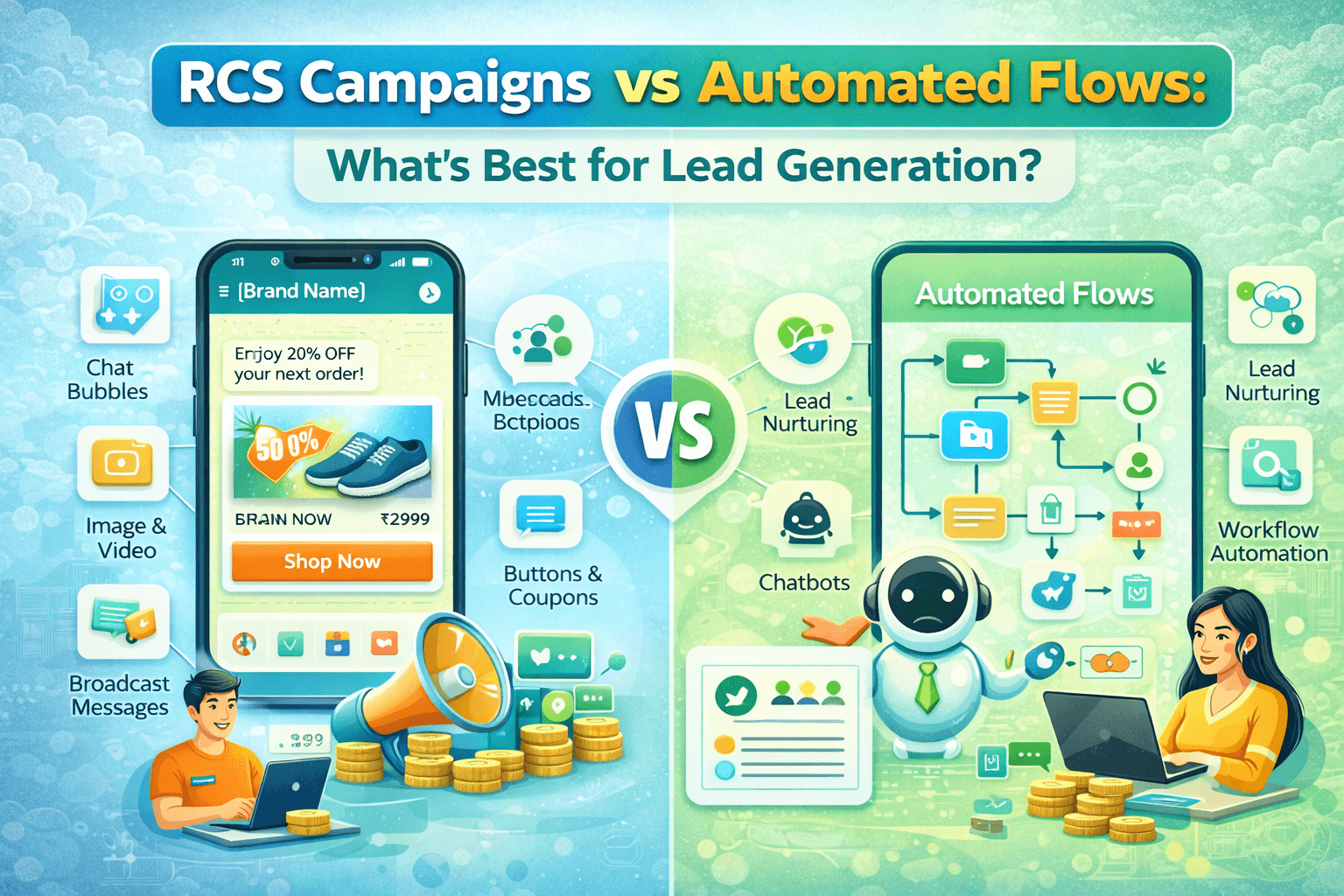
RCS Campaigns vs Automated Flows: What’s Best for Lead Generation?
RCS Campaigns vs Automated Flows for lead generation — complete comparison, 6 industry playbooks, 15+ templates, and the hybrid strategy that generates 3X more leads in 2026
RCS Campaigns vs Automated Flows: What's Best for Lead Generation? (2026)
Every
business wants more leads. But in 2026, the question is not whether to use RCS
messaging for lead generation — it is which type of RCS strategy will generate
the most qualified leads for your specific business. The answer depends on
whether you use RCS Campaigns (one-to-many messages sent to targeted segments)
or Automated Flows (trigger-based sequences personalised to individual prospect
behaviour).
Both
approaches work. But they work differently, they excel in different situations,
and the businesses that understand the distinction generate 2-3x more leads
than those who use only one approach. This guide gives you the complete picture
— with real lead generation benchmarks, 6 industry-specific playbooks, 15+
ready-to-use templates, and a decision framework that tells you exactly which
approach to use for every lead generation scenario your business faces.
Importantly, this guide focuses exclusively on lead generation — not general marketing or customer retention. Every comparison, recommendation, and template in this guide is optimised for one outcome: acquiring new, qualified leads who convert into customers.
|
65% RCS Campaign lead capture rate |
78% Automated Flow lead open rate |
3.8X Better CPL vs email lead gen |
42% Avg lead-to-meeting conversion |
What Is an RCS Campaign for Lead Generation?
An
RCS Campaign for lead generation is a targeted, marketer-initiated message sent
to a defined segment of prospects at a specific time. The campaign is designed
to generate immediate action — submitting a form, requesting a demo,
downloading a lead magnet, or responding to an offer. Unlike general marketing
broadcasts, lead generation campaigns are specifically structured to capture
and qualify new contacts.
In
the context of lead generation, RCS Campaigns are typically used for:
● Cold
or warm outreach to acquired contact lists — delivering your value proposition
to prospects who haven't yet engaged
● Re-engagement
of dormant leads — sending a compelling new offer or insight to leads who went
cold
● Event-driven
lead capture — a webinar announcement, conference follow-up, or product launch
that generates new enquiries
● Content-led
lead generation — distributing a high-value asset (report, whitepaper, tool)
that earns contact details
● Segment-specific campaigns — targeting a precise ICP segment with a hyper-relevant message at the right moment
What Is an RCS Automated Flow for Lead Generation?
An
RCS Automated Flow for lead generation is a pre-built sequence of messages that
activates automatically when an individual prospect takes a specific action —
visiting a landing page, submitting a partial form, clicking an ad, attending a
webinar, or reaching a lead score threshold. The flow then nurtures that
prospect through a personalised journey until they are ready to convert.
In
the context of lead generation, RCS Automated Flows are used for:
● Instant
lead response — triggered the moment a prospect submits an enquiry form,
delivering a personalised follow-up in under 60 seconds
● Lead
qualification sequences — a series of questions delivered conversationally to
score and segment incoming leads automatically
● Long-term
nurturing — a 3-6 month sequence that educates, builds trust, and moves leads
through the funnel at their own pace
● Behaviour-based
escalation — when a prospect visits your pricing page or reads your case study,
an automated flow triggers an immediate, relevant follow-up
● Demo and meeting scheduling — a frictionless booking flow triggered when a lead reaches the right qualification threshold
Here is the definitive comparison focused specifically on lead generation performance:
|
Lead Gen
Metric |
📡 RCS Campaign |
🤖 Automated Flow |
🏆 |
|
Lead
Capture Rate |
65-72% of
recipients engage |
78-85% open
rate (triggered timing) |
Flow ✓ |
|
Lead
Response Speed |
Immediate
reach to full segment |
< 60
seconds from trigger action |
Flow ✓ |
|
Lead
Qualification Rate |
20-35%
self-qualify via buttons |
85-95%
auto-qualified via conversation |
Flow ✓ |
|
Cost Per
Lead (CPL) |
₹150-600
(volume-efficient) |
₹80-300 (high
intent = lower CPL) |
Flow ✓ |
|
Lead
Quality Score |
Medium —
segment-targeted |
High —
intent-triggered |
Flow ✓ |
|
Leads Per
Month Potential |
High — can
reach 10,000+ at once |
Limited by
inbound trigger volume |
Camp. ✓ |
|
Sales
Cycle Impact |
Top-of-funnel
— generates volume |
Mid-funnel —
accelerates conversion |
Both ✓ |
|
B2B Lead
Gen Effectiveness |
Strong for
cold ICP outreach |
Strongest for
enquiry-to-meeting |
Both ✓ |
|
B2C Lead
Gen Effectiveness |
Strong for
offers + events |
Strongest for
sign-up to activation |
Both ✓ |
|
Nurturing
Duration |
Single
touchpoint or short series |
3-6 months
continuous |
Flow ✓ |
|
Setup
Complexity |
Low — design
once, send immediately |
Medium-High —
requires flow architecture |
Camp. ✓ |
|
Analytics
Depth |
Campaign-level
metrics |
Step-by-step
funnel analytics |
Flow ✓ |
|
Lead
Leakage Prevention |
Depends on
follow-up speed |
Zero leakage
— every lead followed up |
Flow ✓ |
|
Peak Lead
Generation |
Excellent for
event-driven surges |
Consistent,
predictable volume |
Camp. ✓ |
Campaign Strategy 1: Lead Magnet Distribution Campaign
The
highest-converting RCS Campaign lead generation strategy distributes a
genuinely valuable asset — a report, tool, template, or calculator — to a
targeted segment of prospects. Unlike gated content on a website (which
requires finding the page, filling a form, waiting for email), an RCS Campaign
delivers the value proposition directly and captures the lead's interest in one
step.
● What
works: Industry-specific reports with
real benchmark data — '2026 Indian SaaS Sales Benchmark: How 500 Companies Are
Performing' sent to a segment of SaaS founders and sales leaders
● What
works: Free tools with instant value —
'Calculate your RCS ROI in 90 seconds' sent with a [Start Calculator] button
● What
works: Expert guides with specific
outcomes — '7 Steps to Reduce CAC by 30% in 90 Days' sent to marketing leaders
● Key principle: The asset must be valuable enough that the prospect would pay for it. Free lead magnets that feel like thinly veiled sales pitches generate leads who never convert.
|
📋 Lead Magnet Campaign — Benchmark Report
— Lead magnet — no-barrier
download builds maximum trust |
|
Hi
{{first_name}}, We just published the
2026 {{Industry}} Performance Report — and the findings are eye-opening. Top insight: {{compelling_stat}} of
{{industry}} companies are struggling with {{pain_point}} — but the top 20%
have solved it with {{solution_approach}}.
Free report — no form, no login, immediate download. [📊 Download Free Report] [👁️ See Key Findings First] [❌ Not Relevant] |
Campaign Strategy 2: Webinar & Event Lead Capture Campaign
Webinar
invitation campaigns are among the highest-ROI RCS Campaign lead generation
strategies because they attract prospects who are actively seeking knowledge in
your category — the highest-intent type of lead. An RCS webinar invitation
achieves 40-60% higher registration rates than email invitations because it
arrives in the prospect's primary messaging app with a one-tap registration
button.
● Pre-event
campaign (7 days before): Full event
details — topic, speakers, agenda preview, registration CTA
● Urgency
campaign (48 hours before): 'Only 200
seats remaining' with real scarcity, speaker highlight, re-registration prompt
for those who registered but haven't confirmed
● Day-of
reminder (2 hours before): Joining link,
agenda summary, what to prepare
● Post-webinar campaign: Recording link + slides download + direct CTA to book a follow-up conversation
|
📋 Webinar Invitation Campaign
— Event invitation — one-tap
registration, limited seats urgency |
|
Hi
{{first_name}}, you are invited to an exclusive webinar: 🎤 '{{webinar_title}}' 📅
{{date}} | {{time}} IST |
Free 👤 Speaker: {{speaker_name}}, {{speaker_title}} You will learn: → {{learning_1}} →
{{learning_2}} → {{learning_3}}
Limited to {{seat_count}} attendees — seats are going fast. [✅ Register Free — 1 Tap] [📋 Full Agenda] [❌ Can't Attend] |
Campaign Strategy 3: Cold ICP Outreach Campaign
For
B2B lead generation, a targeted RCS Campaign to a defined ICP (Ideal Customer
Profile) list — where you have obtained contact details through legitimate
business means — is the fastest way to generate pipeline from a new market
segment. The RCS verified sender badge provides the trust signal that cold
email cannot, dramatically improving response rates.
● Personalisation
variables: Company name, trigger event
(recent funding, new hire, expansion), specific pain point for their industry
and size
● Structure:
Problem statement relevant to their
situation → proof point (stat or mini case study) → low-friction CTA (15-min
call, not a demo)
● Follow-up
cadence: 4-5 messages over 2-3 weeks —
value-first content in messages 2-3, direct ask in message 4-5
● TRAI compliance: Contact list must be from legitimate sources — conference cards, webinar registrations, LinkedIn connections. Never purchased lists.
|
📋 Cold ICP Outreach — Opening Message
— Cold outreach —
trigger-based, hyper-personalised, low-friction ask |
|
Hi
{{first_name}}, I noticed
{{company_name}} recently {{trigger_event}} — excellent news! We help {{target_industry}} companies like
yours achieve {{specific_outcome}}. {{reference_customer}}, a similar
{{company_size}} {{industry}} business, achieved {{result}} in
{{timeframe}}. Would a 15-minute
conversation make sense this week? [📅
Book 15-Min Call] [📋 See Full
Case Study] [❌ Not Right Now] |
Campaign Strategy 4: Re-Engagement Lead Recovery Campaign
Every
business has a graveyard of leads that went cold — prospects who showed initial
interest but stopped responding. An RCS Re-engagement Campaign can reactivate
20-30% of these dormant leads, creating high-quality pipeline from contacts you
have already paid to acquire.
● Timing: Send to leads inactive for 60-90 days — long enough that
they have forgotten your last touch, not so long that they've moved on entirely
● New angle
required: Never re-send the same
message. Re-engage with something genuinely new — a product update, a new case
study, a market development relevant to their situation
● Lower the
friction: The re-engagement CTA should
be even lower-friction than your original outreach — 'A quick 10-minute call'
instead of 'a 30-minute demo'
● Final attempt: A polite 'permission to close your file' message — 'If this is not relevant, please let me know and I won't contact you again' — paradoxically reactivates 15-20% of leads who were simply too busy to respond
|
📋 Lead Re-Engagement Campaign
— Re-engagement — new angle,
lower friction, permission close |
|
Hi
{{first_name}}, it has been a while since we last spoke —
{{days_since_last_contact}} days to be exact!
A lot has changed at {{your_company}}: → {{new_development_1}} →
{{new_development_2}} → New case study: {{customer_name}} achieved
{{result}} I thought these
developments might be relevant to {{company_name}}'s current focus on
{{known_priority}}. Would a quick
10-minute catch-up be worthwhile? [📅
Book 10-Min Call] [📋 See
What's New] [✉️ Close My File] |
Campaign Strategy 5: Referral Lead Generation Campaign
Your
best leads come from your best customers. A systematic RCS Referral Campaign
activates your existing customer base as a lead generation engine — delivering
4x higher close rates and 37% higher lifetime value than any other lead source.
The key is making referral submission frictionless: one tap to refer, one tap
to share the referral link.
● Targeting:
Send to customers who have: been with
you 3+ months, achieved a clear success milestone, or responded positively to
an NPS survey
● Incentive:
Must feel generous and relevant —
account credit, service upgrade, cash reward, or charitable donation in their
name
● Friction removal: The referral flow collects the referred contact's details directly in the RCS conversation — no separate form, no external link
|
📋 Referral Lead Generation Campaign
— Referral campaign —
celebrate their success, make referral effortless |
|
Hi
{{customer_name}}, you have been with {{your_company}} for {{duration}} — and
the results speak for themselves: {{customer_achievement}}! 🎉 Quick question: do you know another
{{target_role}} at a {{target_industry}} company who faces the {{pain_point}}
challenges you had before us? For
every referral who becomes a customer: {{incentive_description}}. [👥 Yes — I Have Someone in
Mind!] [📋 How Referrals
Work] [⏰ Ask Me Later] |
Automated Flow 1: Instant Lead Response Flow (The Most Important Flow)
Research consistently shows that responding to a new lead within 5 minutes increases conversion likelihood by 21x compared to a 30-minute response. Yet most businesses take 4-8 hours to respond to web enquiries — losing the majority of their leads to competitors who respond faster. The Instant Lead Response Flow eliminates this gap entirely.
|
⚡ Step 1 |
Trigger: Lead Form Submission (within 60 seconds) The moment a
prospect submits any lead form — website contact, landing page, Google Ads
lead form extension, Facebook/Instagram lead ad — the RCS flow fires
automatically. No manual intervention required. Response time: under 60
seconds, 24 hours a day. |
|
🏢 Step 2 |
Personalised Opener with Relevant Content The first
message addresses the prospect by name, references exactly what they enquired
about (not a generic 'Thank you for your interest'), and immediately delivers
value — a relevant case study, key benefit, or answer to the most common
first question. Builds instant credibility before asking for anything. |
|
🎯 Step 3 |
Qualification in Conversation 3-4
quick-reply questions delivered naturally over 2-3 messages: budget range,
timeline, company size, specific need. Each response updates the lead score
in your CRM automatically. By message 4, the lead is classified as Hot, Warm,
or Cold — and routed accordingly. |
|
📅 Step 4 |
Meeting/Demo Scheduling for Hot Leads When a lead
scores Hot (budget + timeline + authority confirmed), the flow immediately
presents calendar slots as quick-reply buttons. One tap books the meeting —
no back-and-forth email, no Calendly redirect. Hot leads book meetings at 45%
rate when presented with slots within the same conversation. |
|
🔄 Step 5 |
Nurture Entry for Warm/Cold Leads Warm leads
automatically enter the 3-month nurturing sequence. Cold leads receive a
'keep you updated' opt-in message and enter a long-term content drip. Every
lead is captured and given the right next step — zero lead leakage regardless
of buying timeline. |
|
📋 Instant Lead Response — Opening Message
— Instant response —
personalised, human, qualification embedded naturally |
|
Hi
{{first_name}}, thank you for reaching out about {{enquiry_topic}}! I am {{your_name}} from {{company_name}} —
I will be your dedicated point of contact.
To make sure I give you the most relevant information, one quick
question: which of these best describes your current situation? [🚀 Ready to Start Now] [🔍 Exploring Options] [📋 Researching for Future] [💬 Just Have a Question] |
Automated Flow 2: Lead Scoring and Qualification Flow
Manual
lead qualification is one of the biggest time drains on sales teams — and one
of the most inconsistently executed processes in most businesses. An RCS
automated qualification flow scores every inbound lead against your BANT
criteria through a natural conversation, automatically routing hot leads to
senior sales and cold leads to nurturing — with zero sales team involvement
until the lead is qualified.
● Budget
qualification: 'What is your approximate
budget for this?' delivered as quick-reply buttons — prevents awkward
conversations and captures data consistently
● Authority
qualification: 'Are you the primary
decision-maker for this, or would others be involved?' — identifies champions
vs. gatekeepers
● Need
qualification: 'What is your biggest
challenge with [category] right now?' — identifies the specific pain point for
personalised follow-up
● Timeline
qualification: 'When are you looking to
move forward?' with button options — separates urgent buyers from future
pipeline
● CRM integration: Each qualification response updates the lead record in real time. When all 4 criteria are met, the lead automatically escalates to 'Sales Accepted' stage and triggers a sales team alert.
|
📋 Lead Qualification Flow — Budget Question
— Qualification — budget
question embedded naturally, non-intrusive format |
|
Thanks,
{{first_name}}! To make sure we propose the right solution for
{{company_name}}, could you share your approximate budget range for this
initiative? (This helps me recommend
the most relevant options — we have solutions for every budget.) [💰 Under ₹1 Lakh/month] [💰 ₹1L–₹5L/month] [💰 ₹5L–₹20L/month] [💰 ₹20L+/month] |
Automated Flow 3: Long-Term Lead Nurturing Flow (3-6 Months)
73%
of B2B leads and 65% of considered B2C purchases are not ready to buy at the
moment of first contact. The businesses that systematically nurture these leads
over 3-6 months with valuable, relevant content convert 50% more of them into
customers than businesses that pass unready leads directly to sales (who ignore
them) or send them a single follow-up email (which they never open).
The 3-month RCS nurturing cadence that converts best:
|
Month |
Frequency |
Content
Focus |
Goal |
|
Month 1 |
2 messages/week |
Education —
industry insights, how-to content, problem framing |
Build credibility and trust |
|
Month 2 |
1-2 messages/week |
Validation —
case studies, customer stories, proof of ROI |
Reduce risk perception |
|
Month 3 |
1 message/week |
Conversion —
comparison guides, ROI calculator, limited offer |
Trigger buying decision |
|
Month 4+ |
1 message/month |
Retention —
new features, market updates, check-ins |
Capture delayed buyers |
|
📋 Month 2 Nurture — Case Study Message
— Month 2 validation —
peer-level social proof, no hard sell |
|
Hi
{{first_name}}, a quick update from {{your_company}}. {{reference_customer}}, a {{company_type}}
similar to {{their_company}}, was dealing with the exact same {{pain_point}}
challenge you mentioned. In
{{timeframe}}, they achieved: → {{result_1}} → {{result_2}} →
{{result_3}} I thought their story
might resonate with where {{their_company}} is right now. [📖 Read Full Case Study] [📅 Discuss Your Situation] [👍 Thanks — Keep Sending] |
Automated Flow 4: Behaviour-Triggered Lead Escalation Flow
Not
all leads move through your nurturing sequence at the same pace. Some show
sudden buying signals — visiting your pricing page, reading multiple case
studies, opening every email — that indicate they are ready to buy now, even if
they are only two weeks into a planned six-month nurturing sequence.
Behaviour-triggered escalation flows detect these signals and immediately
fast-track those leads to sales.
● Pricing
page visit trigger: If a nurtured lead
visits your pricing page, immediately send: 'Hi {{name}}, I noticed you were
checking out our pricing page. I would love to walk you through the options
most relevant to {{company_name}} — would 15 minutes work this week?'
● Multiple
content piece trigger: If a lead reads
3+ pieces of content in a single session, trigger: 'It looks like you have been
doing your research on {{topic}} — great! I have put together a personalised
summary for {{company_name}} that might save you time.'
● Lead score
threshold trigger: When a lead's
cumulative score (opens + clicks + page visits) crosses 75 points,
automatically trigger the meeting scheduling flow regardless of where they are
in the nurturing sequence
● Reply trigger: When a lead responds to any nurturing message, immediately notify the assigned sales rep AND send an automated: 'Great to hear from you, {{name}}! Let me connect you with {{rep_name}} directly — here are {{rep_name}}'s available times this week.'
Automated Flow 5: Demo and Meeting Scheduling Flow
The
conversion from 'interested lead' to 'scheduled meeting' is where most B2B lead
generation funnels lose 30-50% of their prospects. The scheduling process —
email back-and-forth, calendar links, time zone confusion, reschedules — is a
friction-filled experience that allows prospects to reconsider and disengage.
An RCS automated scheduling flow makes booking a meeting as easy as tapping a
button.
|
📅 Step 1 |
Present Real-Time Availability Show the next
5 available meeting slots as quick-reply buttons directly in the RCS message.
No calendar link. No redirect. One tap books the slot. Slots are populated
from your sales team's real-time calendar availability. |
|
✅ Step 2 |
Instant Confirmation with Full Details Upon slot
selection: immediate rich card confirmation with date, time, meeting link
(Zoom/Meet/Teams), meeting agenda, and your photo. Calendar invite sent
automatically. Prospect feels the process is professional and effortless. |
|
🔔 Step 3 |
Pre-Meeting Preparation Sequence 24 hours
before: reminder + 'What specific questions would you like to cover?' (their
answer prepares your rep and increases perceived personalisation). 1 hour
before: joining link + 'Looking forward to speaking with you!' |
|
🔄 Step 4 |
No-Show Recovery If the
prospect doesn't attend: 'Hi {{name}}, we missed you — hope everything is
okay! Would any of these times work to reschedule?' 3 new slots. 35-45% of
no-shows rebook from the same-day recovery message. |
The optimal mix of RCS Campaigns and Automated Flows varies significantly by industry. Here are the proven lead generation playbooks for six major industries:
Playbook 1: SaaS and B2B Technology
SaaS
lead generation is primarily inbound-driven — prospects discover you through
SEO, paid ads, and content, then enter your funnel through trial sign-ups or
contact forms. Automated Flows dominate because every new trial or enquiry
needs an instant, personalised response. Campaigns are most effective for
re-engaging cold trials and distributing thought leadership content to opted-in
prospects.
|
Type |
Primary RCS
Campaign Uses |
Primary
Automated Flow Uses |
|
SaaS / B2B
Tech |
● Webinar/product
launch invitations ● Cold
ICP outreach (CTOs, VPs) ● Re-engagement
of expired trials ● Benchmark
report distribution |
● Trial
sign-up → onboarding flow (Priority #1) ● Demo
request → instant scheduling flow ● Feature
adoption nudge sequence ● Upgrade
/ expansion trigger flow |
SaaS lead gen verdict: 30% Campaigns + 70% Automated Flows. Every trial that doesn't convert to paid in 14 days without an automated nurturing flow is a lost lead. The trial-to-paid automated sequence is the single highest-ROI RCS investment for any SaaS business.
Playbook 2: Real Estate
Real
estate lead generation is heavily outbound — prospecting through portals
(99acres, MagicBricks), social ads, and outdoor/digital marketing. Automated
Flows are critical for instant response to portal leads (where response speed
determines who gets the site visit). Campaigns are most effective for new
project launches and festive period outreach.
● Top
Automated Flow (Priority): Portal lead
response — within 60 seconds of 99acres/MagicBricks enquiry submission, a
personalised RCS with property images, agent introduction, and site visit
booking slots
● Top
Campaign use: New project launch to
opted-in prospect database — simultaneous reach to thousands of pre-qualified
property seekers
● Recommended split: 45% Campaigns + 55% Automated Flows
Playbook 3: Financial Services and Lending
Financial
services lead generation requires a careful balance of regulatory compliance
and sales aggression. Prospects are high-intent but comparison-heavy — they
will evaluate 3-5 providers before deciding. Speed of response and quality of
information are the two primary conversion drivers.
● Top
Automated Flow: Loan eligibility enquiry
→ instant eligibility check via conversational flow → pre-approved offer →
document collection sequence
● Top
Campaign use: New product launch (new
credit card, revised FD rates) and policy announcement campaigns to opted-in
customer base
● Compliance
note: All RCS messages for financial
products must comply with RBI advertising guidelines, include relevant risk
disclosures, and avoid misleading rate claims
● Recommended split: 35% Campaigns + 65% Automated Flows
Playbook 4: Education and EdTech
Education
lead generation follows a long consideration cycle — parents and students
research for weeks or months before making an admission or course decision.
Automated nurturing flows are essential for maintaining engagement over this
long decision window. Campaigns are most effective at key decision moments:
exam season, admission deadline reminders, and scholarship announcements.
● Top
Automated Flow: Brochure download →
personalised course information flow → parent/student FAQ sequence → campus
visit scheduling
● Top
Campaign use: Admission deadline
reminders and exam season study material campaigns to opted-in prospect
database
● Regional
language note: EdTech companies
targeting tier-2 and tier-3 India see 2-3x higher engagement when campaigns and
flows are delivered in regional languages (Hindi, Tamil, Gujarati, Marathi)
● Recommended split: 40% Campaigns + 60% Automated Flows
Playbook 5: Healthcare and Wellness
Healthcare
lead generation (for hospitals, clinics, wellness services) involves
high-trust, high-consideration decisions. Automated Flows are the primary
engine — every online appointment enquiry needs an instant response with doctor
availability, fee information, and booking confirmation. Campaigns are used for
health awareness events, seasonal health programmes, and new service launches.
● Top
Automated Flow: Appointment enquiry →
specialty selection → doctor availability → instant booking + confirmation →
pre-appointment preparation
● Top
Campaign use: Health camp announcements,
free health check-up camp invitations, seasonal awareness campaigns (monsoon
health, winter wellness)
● Recommended split: 25% Campaigns + 75% Automated Flows — healthcare is primarily appointment-driven, making instant response flows the dominant lead gen channel
Playbook 6: Professional Services (Consulting, Legal, Accounting)
Professional
services lead generation is relationship-driven and high-consideration. Trust
and demonstrated expertise are the primary purchase drivers — no one hires a
lawyer or consultant from a flash sale promotion. Automated Flows for
personalised follow-up dominate; Campaigns are limited to thought leadership
content distribution and event invitations.
● Top
Automated Flow: Consultation request →
qualification (type of service needed, urgency, budget) → case study delivery →
consultation scheduling
● Top
Campaign use: Monthly thought leadership
newsletter and event invitations (seminars, webinars, industry roundtables)
● Recommended split: 20% Campaigns + 80% Automated Flows — professional services buyers respond to personalised, expert engagement, not mass campaigns
The best RCS lead generation strategy combines Campaigns and Automated Flows in a coordinated system where each type handles the stage it is best suited for. Here is the complete hybrid architecture for maximum lead generation:
Stage 1 — Lead Acquisition (Campaigns Dominate)
RCS Campaigns are your top-of-funnel lead acquisition engine. They generate the volume of new prospects entering your pipeline through: targeted cold outreach to ICP lists, lead magnet distribution to new audiences, event and webinar invitations, and referral programme activation. The goal at this stage is volume and initial qualification — getting prospects to raise their hand.
Stage 2 — Instant Lead Response (Automated Flows Dominate)
The moment a campaign generates a lead action — form fill, button tap, webinar registration — an Automated Flow takes over immediately. The instant response flow fires within 60 seconds, delivers personalised content, begins the qualification conversation, and either schedules a meeting (for hot leads) or enters the lead into the nurturing sequence (for warm/cold leads). This transition from Campaign to Flow is invisible to the prospect — they experience one seamless, fast conversation.
Stage 3 — Lead Nurturing (Automated Flows Dominate)
Warm and cold leads from the Campaign and initial response flow enter a long-term automated nurturing sequence. This runs for 3-6 months, delivering valuable content at optimal intervals, scoring engagement behaviour, and automatically escalating high-intent leads to sales. The nurturing flow converts 40-60% more leads into customers compared to no nurturing — with zero ongoing manual effort after initial setup.
Stage 4 — Re-Engagement (Campaigns Dominate)
Leads that have been in the nurturing flow for 3+ months without converting, and leads that went cold before entering any flow, are periodically re-activated through targeted re-engagement Campaigns. These campaigns offer a new angle, a new piece of content, or a new offer — giving cold leads a fresh reason to re-engage. 20-30% of re-engagement campaign targets re-enter the active pipeline.
|
Stage 1 Acquisition: Campaigns |
Stage 2 Response: Flows |
Stage 3 Nurture: Flows |
Stage 4 Re-engage: Campaigns |