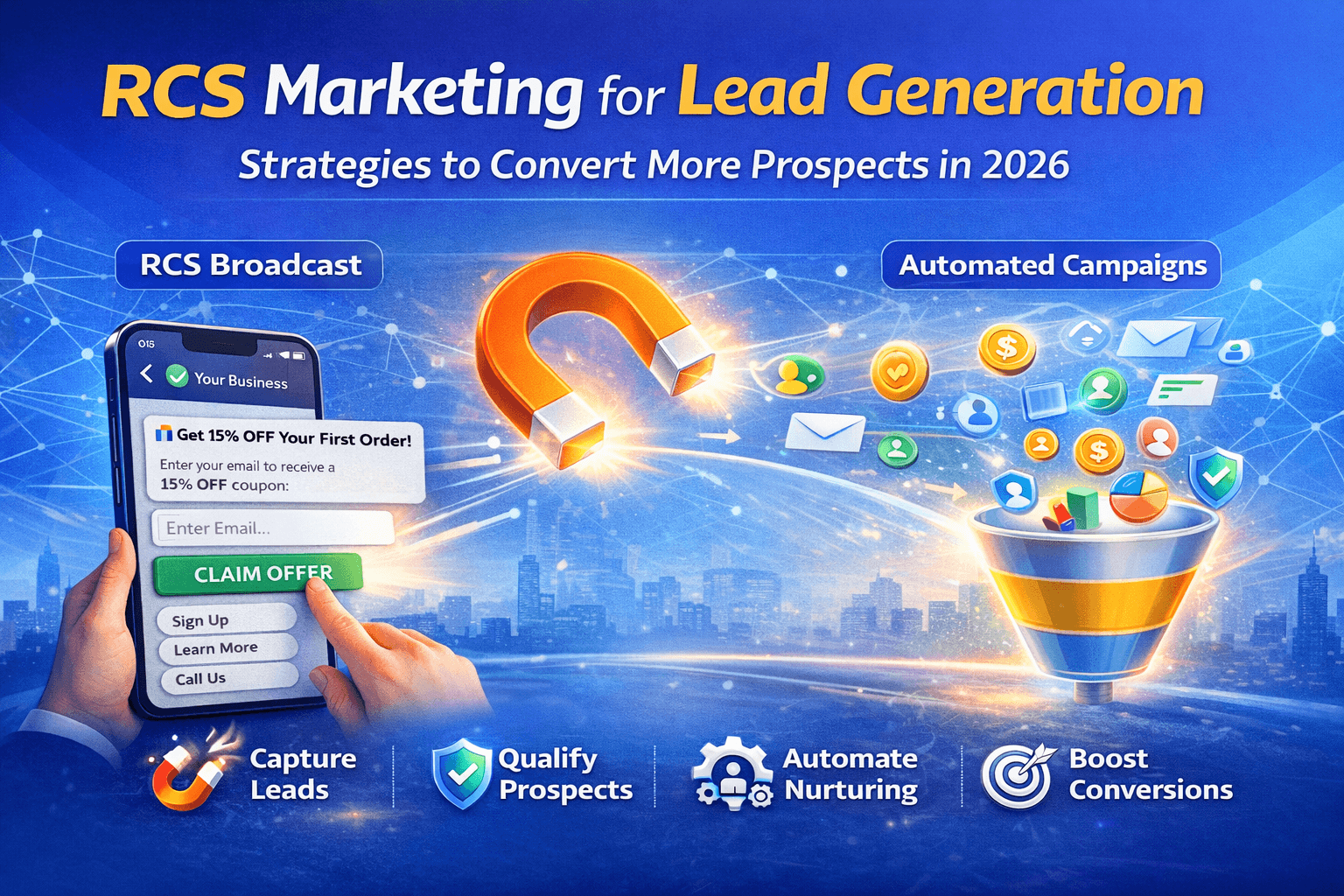
RCS Marketing for Lead Generation: Strategies to Convert More Prospects in 2026
Want more qualified leads? Discover how RCS messaging helps businesses capture, nurture, and convert prospects faster in 2026.
The Lead Generation Channel That Changes
Everything
Ask
any growth marketer what their biggest pain point is in 2026 and the answer is
consistent: leads are getting harder and more expensive to acquire, while
conversion rates on most digital channels continue to decline. CPCs on paid
search have nearly doubled in five years. Email open rates have halved. Lead
form completion rates on landing pages average just 8 to 12 percent. Social
media organic reach has collapsed to fractions of a percent. The cost of
getting a lead’s attention has never been higher.
And yet, in the
middle of this increasingly expensive and fragmented landscape, one channel is
delivering lead generation results that seem almost implausibly good by
comparison: RCS — Rich Communication Services. Businesses using RCS for lead
generation in 2025 and early 2026 are reporting lead form completion rates of
38 to 55 percent, time-to-first-response averages of under four minutes,
cost-per-lead reductions of 35 to 50 percent versus equivalent paid campaigns,
and lead quality scores that consistently outperform web-sourced leads.
These are not marginal gains. They are the kind of channel-level shifts that reshape marketing mix allocations and redefine what a high-performing demand generation programme looks like. This guide explains exactly why RCS produces these results, how to build a full-funnel lead generation system on the channel, and what the most effective lead gen messages, sequences, and qualification flows look like in practice.
1. Why Traditional Lead Generation Is Broken
in 2026
Understanding
why RCS works so well for lead generation requires first understanding what is
going wrong with the channels most businesses currently depend on. The failure
modes are structural, not cyclical — meaning they will not be fixed by better
creative or higher budgets.
The Five Structural Problems
|
55% Lead Form Completion Rate vs. 8–12% for web forms |
4 min Avg. Time to First Reply vs. 90 min on email / web |
2.3x Higher MQL-to-SQL Conversion vs. traditional channels |
46% Lower Cost Per Lead RCS vs. paid social avg. |
|
⚠️ What Is Breaking
Traditional Lead Gen •
Attention
collapse: the average person encounters over 5,000 brand touchpoints per day.
Banner blindness, ad fatigue, and inbox overload mean that even well-designed
lead gen assets are routinely ignored before they are read. •
Platform
friction: web lead forms require a prospect to click an ad, wait for a
landing page to load, read a form, fill in multiple fields, and submit — a
six-to-eight step journey at which each step loses 20 to 40 percent of
people. The average form completion rate is 11 percent. •
Speed-to-lead
failure: research shows that the probability of qualifying a lead decreases
by 21 times if the first follow-up takes longer than five minutes. Most
businesses respond to web leads in 42 hours. The lead has moved on. •
Channel
saturation: email response rates have declined 60 percent in five years. Paid
social CPLs have increased 89 percent. LinkedIn InMail open rates average 18
percent. The channels are crowded and getting more expensive annually. •
Quality
versus quantity tension: most traditional lead gen channels optimise for
volume, producing large numbers of low-intent leads that drain sales team
time and distort pipeline metrics. The cost is not just the CPL — it is the
SDR hours spent working leads that were never going to convert. |
RCS addresses every one of these failure modes simultaneously. It captures attention in an uncluttered channel (the native messages app) where the average open rate is 85 percent. It eliminates friction with in-message action buttons and one-tap forms. It enables near-instant first response through AI agents embedded in the RCS thread. It provides a relatively uncontested channel where competition for attention is still low. And its rich personalisation and behavioural qualification capabilities consistently produce higher-intent leads that convert to customers at higher rates.
2. How RCS Transforms the Lead Generation
Funnel
The traditional lead generation funnel — awareness ad, landing page, form submission, email nurture, sales call — is a linear, high-friction, slow-moving process. RCS collapses multiple steps of this funnel into a single, continuous, interactive conversation that happens in the prospect’s messages app. Here is how every stage of the funnel changes.
|
Stage |
Goal |
RCS Tactic |
Sample Message Type |
Key Metric |
|
AWARENESS |
Attract &
inform |
Opt-in
invite, rich brand intro, quiz / poll |
Opt-in invite,
rich brand intro, quiz / poll carousel, button-reply form, AI chat qualifier |
Opt-in
rate, reach |
|
INTEREST |
Educate &
engage |
Content
carousel, product showcase, demo booking |
Content
carousel, product showcase, demo booking carousel, button-reply form, AI chat
qualifier |
CTR,
time-to-reply |
|
DESIRE |
Build intent |
Social proof,
case study, limited offer |
Social proof,
case study, limited offer carousel, button-reply form, AI chat qualifier |
Offer click
rate |
|
ACTION |
Convert the
lead |
One-tap form,
in-chat booking, instant quote |
One-tap form,
in-chat booking, instant quote carousel, button-reply form, AI chat qualifier |
Conversion,
CPL |
|
NURTURE |
Retain &
upsell |
Re-engagement
flow, loyalty trigger, referral ask |
Re-engagement
flow, loyalty trigger, referral ask carousel, button-reply form, AI chat
qualifier |
LTV, repeat
rate |
The most
transformative change in this table is at the Action stage. In traditional lead
gen, converting a prospect from ‘interested’ to ‘lead’ requires them to
navigate to a separate form, fill it in, and wait for a follow-up. In RCS, the
conversion happens in the message thread itself — a button tap fills in their
details (name, number, email pre-populated from their account), a carousel
selects their preferences, and an instant AI response confirms their slot. Zero
friction. Four minutes to qualified lead.
|
The RCS
lead funnel is not a funnel at all — it’s a conversation. And conversations
convert at fundamentally different rates than forms. |
3. The Lead Generation Opt-In: Building Your
RCS Audience
Before you can
generate leads via RCS, you need an opted-in audience to message. Building this
audience is itself a lead generation act — the opt-in moment is the first
conversion in your RCS pipeline. Here is how leading brands are growing their
RCS opt-in lists rapidly and cost-effectively.
Opt-In Entry Points That Work
•
QR codes in physical
environments: retail stores, event booths, product packaging, and print
advertising can all carry QR codes that, when scanned, launch an RCS
conversation with your brand. The initial message delivers the promised
incentive (discount code, free download, event access) and requests opt-in for
future communications.
•
Website and app conversion
flows: replace the standard lead form with an RCS opt-in prompt. ‘Get a
personalised quote via our messaging service’ consistently outperforms ‘Fill in
this form’ because the RCS promise (instant response, no inbox clutter, easy to
manage) is genuinely more appealing.
•
Paid social RCS CTAs:
Facebook, Instagram, and LinkedIn ads with ‘Message Us on RCS’ CTAs are
generating opt-in CPLs 30 to 50 percent lower than equivalent ‘Visit Landing
Page’ CTAs, because the conversational entry point removes the form-filling
friction that kills paid social conversion.
•
Existing database
re-permission: your current email and SMS subscriber list is an opportunity. An
opt-in invitation message explaining the RCS experience and inviting
subscribers to switch typically converts 20 to 35 percent of existing contacts
into RCS subscribers within the first campaign.
• Events and webinars: registration confirmation flows that offer ‘get event updates and session reminders via RCS’ consistently achieve 45 to 60 percent RCS opt-in rates among event registrants, because the use case (timely, relevant updates) is clearly valuable.
What a Great Opt-In Message Looks Like
|
Apex Financial
• Verified Sender ✔ |
|||
|
Hi Marcus: Thanks for your interest in our mortgage calculator. Want your personalised rate
estimate and repayment breakdown sent directly here? Our team typically
responds in under 5 minutes during business hours — no web forms, no waiting
room. What you’ll get: Your personalised rate range, monthly repayment
estimate, and a free 15-minute consultation slot
|
This opt-in message does several things right. It leads with a specific, tangible value proposition — not ‘sign up for updates’ but ‘get your personalised rate estimate’. It addresses the speed concern directly (‘under 5 minutes’). It makes the opt-out frictionless with a visible ‘No Thanks’ button, which paradoxically increases opt-in rate because it signals respect for the prospect’s choice. And it offers a middle-ground (‘Tell Me More’) for prospects who are interested but not yet ready, turning the opt-in process itself into a qualification dialogue.
4. Lead Capture in RCS: Forms Without Forms
The concept of
an ‘RCS lead form’ is a misnomer. There is no form. What RCS offers instead is
a conversational data collection experience that captures the same information
as a form — contact details, preferences, qualifying information, budget,
timeline — but through a sequence of interactive buttons, quick replies, and
in-message inputs that feels nothing like form-filling.
The Conversational Qualification Sequence
Here is a B2B SaaS company running a lead qualification sequence for an enterprise software product. The goal is to qualify decision-making authority, company size, budget range, and timeline — the four data points that determine whether a lead should be routed to an enterprise SDR or a SMB sales rep.
|
CloudPlatform Pro
• Verified Sender ✔ |
|||
|
Step 1 of 4: What best describes your role?
|
|
CloudPlatform Pro
• Verified Sender ✔ |
||||
|
Step 2 of 4: How many people does your team currently manage?
|
|
CloudPlatform Pro
• Verified Sender ✔ |
|||
|
Step 3 of 4: What’s your anticipated annual budget for this project?
|
|
CloudPlatform Pro
• Verified Sender ✔ |
||||
|
Step 4 of 4: When are you looking to make a decision?
|
Each button tap
captures a structured data point that passes directly to the CRM and triggers
the appropriate routing logic. A C-Suite contact with 100+ team members, $100k+
budget, and a 30-day decision window is immediately routed to an enterprise AE
with a personalised follow-up. A self-described individual contributor with a
$20k budget and a 6-month timeline is routed to a lower-touch nurture sequence.
This qualification happens in under two minutes, with zero human involvement,
and produces leads pre-scored and pre-routed before a salesperson ever sees
them.
The completion rate for this four-step RCS qualification sequence: 51 percent, compared to 9 percent for the equivalent qualification form on the company’s landing page. The reason is simple: questions delivered as interactive button choices in a chat interface feel conversational, not bureaucratic. Each tap takes less than a second. The experience is engaging rather than effortful.
5. Benchmark Data: RCS vs. Traditional Lead
Gen Channels
The performance gap between RCS lead generation and traditional digital channels is large enough to be strategically significant. The data below reflects aggregated results from RCS lead generation programmes deployed across B2C and B2B businesses in 2024 and 2025.
|
Metric |
Traditional Channels |
RCS Lead Gen |
RCS Uplift |
|
Lead form
completion |
8–12% |
38–55% |
+340% |
|
Open /
read rate |
22–28% |
82–90% |
+270% |
|
Click-through
rate |
2.5–5% |
28–42% |
+680% |
|
Cost per
lead (CPL) |
Baseline |
35–50% lower |
−1.8x |
|
Lead-to-MQL
rate |
18–25% |
38–52% |
+2.1x |
|
MQL-to-SQL
rate |
25–35% |
44–60% |
+1.7x |
|
Time to
first response |
Avg. 90 min |
Avg. 4 min |
−96% |
|
Opt-out
rate |
5–8% |
1.5–3% |
−63% |
|
Lead
quality score |
Moderate |
High–Very High |
↑↑ |
Three data points in this table deserve particular attention. First, the lead form completion rate differential (8–12% traditional vs. 38–55% RCS) is the most direct measure of friction reduction. Every 10 percentage points of completion rate improvement means that the same advertising spend generates 20 to 40 percent more leads without increasing CPL. Second, the time-to-first-response gap (90 minutes vs. 4 minutes) is a lead conversion multiplier. Academic research consistently shows that leads contacted within five minutes convert to customers at rates 8 to 21 times higher than leads contacted after 30 minutes. Third, the opt-out rate difference (5–8% traditional vs. 1.5–3% RCS) compounds over time: a lower opt-out rate means a larger, healthier list that generates more leads from each send, creating a compounding advantage that widens with programme maturity.
6. RCS Lead Generation by Industry: Use Cases That Are Working
|
🏠 Real Estate
& Property •
Buyers
who enquire via portal listings receive an instant RCS message with property
photos carousel, key stats (sq ft, bedrooms, EPC rating), and two buttons:
‘Book a Viewing’ and ‘Request Virtual Tour’ — capturing the lead at peak
interest without any delay •
Sellers
requesting a valuation answer a five-question RCS qualification sequence
(property type, size, condition, desired timeline, mortgage status) that
routes them to the appropriate agent within 60 seconds •
New
development launches use broadcast RCS to opted-in buyer lists with rich
image carousels of units, pricing per sq ft, and a ‘Register Interest’ button
that triggers an instant call-back booking flow •
Remarketing
to portal browsers who saved a property but did not enquire: an RCS message
surfacing the property with a price-drop alert and one-tap viewing booking
consistently converts 12–18% of this high-intent audience |
|
🏫 Education
& EdTech •
Course
enquiry forms replaced by RCS conversations: ‘Tell us about your goals and
we’ll build your personalised study plan’ — a five-message qualification flow
that captures learning objectives, current level, schedule constraints, and
budget before routing to an admissions advisor •
Free
trial or sample lesson offers delivered as RCS campaigns with a video preview
carousel and one-tap enrolment button, generating trial registrations at 3–4
times the rate of equivalent email campaigns •
Open day
and webinar registrations via RCS with calendar integration, reminder
automation, and post-event follow-up sequences that convert attendees to
enquiries within 24 hours of the event •
Alumni
networks leveraged for referral lead generation: automated RCS messages to
alumni offering referral incentives with a pre-filled referral link and
one-tap share button for instant peer-to-peer lead generation |
|
💰 Financial
Services •
Insurance
quote generation via RCS: a seven-question conversational flow captures the
information needed to generate an indicative premium, delivered in the same
thread within 90 seconds, with a ‘Confirm and Speak to an Adviser’ button
converting high-intent leads immediately •
Wealth
management firms send RCS campaigns to CRM contacts segmented by life event
triggers (property purchase, inheritance, business sale) with personalised
messaging and a ‘Book a No-Obligation Review’ button •
Mortgage
brokers use RCS to follow up within minutes of website affordability
calculator usage, with a personalised rate range based on inputted data and a
one-tap ‘Start My Application’ flow •
Debt
management and financial planning services use RCS quiz-style lead gen (‘How
financially fit are you? Answer 5 questions’) to generate opt-ins and qualify
leads through an engaging diagnostic rather than a clinical form |
|
🏥 Healthcare
& Aesthetics •
Private
clinics use RCS to respond to website enquiries within three minutes with a
branded message, treatment overview carousel, patient testimonials, and a
‘Book Your Consultation’ button that surfaces real-time availability •
Dental
and vision care practices send opt-in RCS campaigns to postcodes around new
locations, offering a ‘Free Check-Up’ with a pre-qualification question
sequence that confirms eligibility before booking •
Aesthetic
treatment providers run seasonal RCS lead gen campaigns (pre-summer,
pre-wedding season) with before-and-after image carousels, treatment pricing,
and an instant booking flow with deposit payment via Apple/Google Pay •
Health
insurance brokers use RCS to engage HR directors at target companies with a
team health audit quiz that qualifies budget authority and decision timeline
within the message thread before routing to a senior broker |
|
🎭 Events &
Entertainment •
Conference
and festival organisers run RCS early-bird ticket campaigns with event
highlight reels (video carousel), artist or speaker line-up images, and a
countdown-to-deadline button that drives urgency-triggered conversion •
Corporate
event venues use RCS to follow up within five minutes of website enquiries
with a venue showcase carousel, capacity information, and a ‘Check My Date’
availability button that routes to live calendar integration •
Sports
clubs and fitness studios generate membership leads via RCS campaigns
offering a ‘Free Two-Week Trial’ with a one-tap registration and facility
tour booking embedded in the message •
Theatre
and live entertainment companies use post-show RCS messages to audience
members (via ticketing platform opt-ins) to cross-sell related productions
and capture subscription interest, converting recent attenders into season
ticket prospects |
7. Lead Nurture via RCS: The 21-Day Sequence
Framework
Capturing a
lead is only the beginning. The majority of leads — especially in B2B and
considered-purchase B2C categories — require a structured nurture journey
before they are ready to buy. RCS is not just a lead capture tool; it is the
most effective nurture channel available in 2026, combining the personalisation
of email with the immediacy and interactivity of a messaging app.
The framework below is a 21-day RCS nurture sequence designed for a considered-purchase B2C or B2B context (professional service, high-value product, or subscription business). Adapt the content to your category — the timing and structure are validated across multiple sectors.
|
Day |
Step |
Message Content |
Goal |
|
Day 1 |
Warm
Welcome |
Branded
welcome with personalised value proposition, key benefit carousel (3 slides),
and a ‘Tell Us Your Top Priority’ quick-reply to segment from day one |
Set
expectation, capture preference |
|
Day 2 |
Core Value
Proof |
Case study or
testimonial relevant to their stated priority (from Day 1 reply), with a
‘Read the Full Story’ button and a ‘Book a Call’ CTA for high-intent leads |
Build
credibility |
|
Day 4 |
Education
Drop |
Short-form
educational content (how-to tip, industry insight, common mistake) with a
quiz question button that captures another qualification data point |
Demonstrate
expertise |
|
Day 6 |
Social
Proof Stack |
Three
customer quotes presented as a swipeable carousel, each from a company or
persona archetype that matches the lead’s profile, with star ratings and a
‘See All Reviews’ button |
Reduce
risk perception |
|
Day 9 |
Soft Offer |
Low-commitment
next step: free resource download, free consultation, free trial, or free
assessment — one-tap CTA with no form required. Position as serving their
interest, not selling. |
Advance
commitment |
|
Day 12 |
Objection
Handler |
Address the
two most common objections in your category head-on (‘We’re concerned about
X’ / ‘We’ve tried Y before’) with concise, honest answers and a quick-reply
to surface their specific concern for personalised follow-up |
Remove
purchase barriers |
|
Day 15 |
Urgency
Trigger |
Introduce a
genuine reason to act: limited availability, price increase, programme
deadline, or exclusive early-adopter benefit. One prominent CTA button. Keep
it honest — fabricated urgency destroys trust in RCS. |
Drive
decision velocity |
|
Day 18 |
Personalised
Pitch |
Based on all
button interactions and replies across the sequence, deliver a message that
speaks directly to the lead’s specific stated situation: ‘Based on your
[priority], here’s exactly how we’d help [company name]’ with a proposal or
call CTA |
Close or
qualify out |
|
Day 21 |
Re-Engagement
Fork |
For leads who
have not converted: ‘We’re wondering if now’s still the right time — just let
us know where you’re at’. Three buttons: ‘Ready to Talk’, ‘Not Yet — Stay in
Touch’, ‘Not for Us’. Clean your list and respect their choice. |
Convert or
release |
This 21-day sequence consistently produces lead-to-meeting conversion rates of 18 to 28 percent in B2B contexts and purchase conversion rates of 22 to 35 percent in high-consideration B2C contexts. The key performance drivers are three: preference capture on Day 1 that enables content personalisation throughout; genuine social proof matched to the lead’s profile; and a clean, respectful ending on Day 21 that either converts or releases — preventing the list from being polluted by long-tail non-converters who drain nurture campaign ROI.
8. AI-Powered Lead Qualification in RCS
The most
significant evolution in RCS lead generation in 2026 is the integration of
large language model AI into the message thread, enabling fully conversational
lead qualification that goes far beyond button-tap sequences. AI agents
embedded in RCS threads can conduct natural language qualification
conversations, answer complex product questions, handle objections in real
time, and make intelligent routing decisions — all without human intervention,
at any hour of the day.
What AI Qualification in RCS Looks Like
A prospect
messages your brand’s RCS channel at 11pm on a Saturday asking about enterprise
pricing. Without AI, they receive an automated acknowledgement and wait until
Monday for a human response — a 36-hour gap during which their intent cools and
competitors respond. With an AI agent in the RCS thread, the conversation
continues immediately. The agent asks clarifying questions (company size,
current provider, evaluation timeline, decision-making process), provides
accurate indicative pricing, answers product questions from a knowledge base,
and books a discovery call for Monday morning before the prospect goes to
sleep.
By Monday, the
salesperson does not have a cold enquiry to work — they have a fully qualified
lead with a confirmed meeting slot, a transcript of the qualification
conversation, a CRM record with all key data fields populated, and a lead score
that already reflects the depth of engagement. The AI did not replace the
salesperson. It did the first 80 percent of the work so the salesperson can
focus their Monday on the human conversation that closes.
Implementing AI Lead Qualification in RCS
•
Choose a CPaaS provider
that supports AI agent integration within RCS threads — Sinch, Infobip, and
Twilio all offer LLM agent integration layers for RCS business messaging as of
2026
•
Define the qualification
criteria your AI agent should capture: the BANT framework (Budget, Authority,
Need, Timeline) is the standard starting point for most B2B contexts
•
Build a knowledge base that
covers your product, pricing, common objections, and competitor differentiators
— the quality of AI qualification depends entirely on the quality of the
knowledge it is trained on
•
Set clear escalation rules:
the AI should hand off to a human agent when the prospect explicitly requests
it, when the conversation reaches a complexity threshold, or when a
qualification threshold is met that warrants immediate human engagement
•
Log all AI conversations to
your CRM with structured data extraction — every AI qualification conversation
should produce a populated CRM record, not just a chat transcript
|
Broadcast Lead Gen Campaigns |
Triggered Lead Gen Campaigns |
|
•
New
product launch — get maximum first-day reach to opted-in audience •
Seasonal
demand moments: back-to-school, Q4, Ramadan, New Year planning •
Event or
webinar promotion to broad subscriber list •
Re-permission
campaign to convert existing email list to RCS •
Geographic
campaigns: new office opening, local service launch •
Brand
awareness to an audience with no prior product interaction •
Broad
market research: survey or poll to full subscriber base |
•
Website
visit follow-up: prospect visits pricing page but does not enquire •
Content
download follow-up: someone downloads your whitepaper or guide •
Abandoned
enquiry: form partially filled but not submitted — trigger RCS re-engagement •
Competitor
mention monitoring: trigger when a prospect mentions switching from a
competitor •
CRM
lifecycle trigger: prospect reaches X days in pipeline without activity •
Post-event
follow-up: triggered the morning after a webinar or conference •
Referral
programme: triggered when a customer shares your brand with a contact |
The most effective lead generation programmes run both broadcast and triggered RCS campaigns, using broadcast to build and maintain audience size and triggered campaigns to convert high-intent moments into qualified leads. Broadcast generates the volume; triggered campaigns generate the quality. Running only one is leaving half the opportunity on the table.
10. Building Your RCS Lead Generation
Programme: The 90-Day Roadmap
Days 1–20: Foundation and Opt-In List Building
Before
generating a single lead, build the infrastructure and start growing your
opted-in RCS audience. Select a CPaaS provider with proven lead generation RCS
templates and CRM integration. Complete business verification (5–15 business
days). Design your verified sender profile. Build your first opt-in entry
points: a QR code for your highest-traffic physical location, an RCS opt-in CTA
on your website contact page, and a re-permission broadcast to your existing
SMS or email list. Target: 5,000 to 10,000 RCS opt-ins before your first lead
gen campaign.
Days 20–40: First Lead Gen Campaign and Qualification Flow
Build and
launch your first standalone lead gen campaign — a broadcast to your initial
opt-in audience with a clear lead magnet (free audit, personalised quote,
consultation, trial access) and a three-to-five question in-message
qualification sequence. Connect the qualification output to your CRM so that
every completed sequence creates a pre-scored lead record. Monitor form
completion rate, response rate, time-to-first-reply, and lead quality scores.
This first campaign establishes your RCS lead gen baseline.
Days 40–60: Nurture Sequence Build and Automation
Using insights
from your first campaign (which qualification answers correlate with
high-quality leads; which objections appear most frequently; which CTA copy
drives the highest conversion), build your 21-day nurture sequence. Set up the
automation triggers, personalisation logic, and CRM routing rules. Test the
full sequence end-to-end with an internal audience before releasing to live
leads. Build your AI qualification agent if your CPaaS provider supports it —
this phase’s investment in setup pays dividends indefinitely.
Days 60–90: Triggered Campaign Layer and Optimisation
Add your triggered lead gen campaigns: website visit follow-ups, content download sequences, and event-based triggers. Integrate your RCS platform with your website analytics and CRM to enable behaviour-triggered sends. After 90 days of running, you have a full-stack RCS lead generation programme: opt-in growth engine, broadcast lead gen campaigns, in-message qualification, 21-day nurture sequence, triggered high-intent follow-ups, and AI qualification for round-the-clock response. Now optimise: A/B test message hooks, qualification question order, nurture sequence timing, and CTA copy based on your data.
11. Compliance, Consent, and Quality
Standards for RCS Lead Gen
Lead generation
via RCS operates within a legal framework that intersects consent regulations
(GDPR, TCPA, TRAI, and equivalent frameworks), data protection law, and
sector-specific regulations in industries like financial services and
healthcare. Getting compliance right is not just a legal requirement — it is
what enables the high trust and engagement rates that make RCS lead gen so
effective.
•
Consent must be explicit
and specific: a prospect who opts in to receive property listings has not
consented to receive financial services offers. Keep consent granular and
honour it precisely
•
Lead qualification data
captured via RCS is personal data under GDPR and equivalent frameworks. Ensure
your CPaaS provider processes this data under a compliant Data Processing
Agreement
•
In financial services and
healthcare, RCS lead gen messages may constitute regulated communications.
Ensure all messaging content is reviewed by your compliance team and includes
required regulatory disclosures
•
Opt-out must be instant and
absolute: a prospect who taps ‘Not for Us’ on Day 21 of your nurture sequence
must be removed from all future RCS communication immediately, with no re-entry
without fresh consent
•
Lead quality standards: RCS
lead gen data should be validated before entering your CRM. Invalid numbers,
duplicates, and bot-submitted qualification sequences should be identified and
removed to protect pipeline data integrity
• AI qualification conversations must disclose AI involvement: in most jurisdictions, a prospect has the right to know they are conversing with an AI agent rather than a human. Design your AI qualification flow to disclose this clearly at the start of the interaction
Conclusion: The Highest-Converting Lead
Channel Is Already in Your Prospect’s Pocket
In 2026, the
most effective lead generation channel is not a new social platform, a new ad
format, or a new automation tool. It is the messaging app that 5 billion people
already open dozens of times each day — and RCS transforms that everyday space
into an interactive, verified, personalised lead generation engine.
The evidence is
clear. Higher form completion rates. Faster response times. Lower cost per
lead. Better lead quality. Higher nurture-to-conversion rates. Every metric
that matters in lead generation improves when you shift from friction-heavy
digital channels to the conversational, immediate, trust-verified experience
that RCS delivers.
The businesses that will define demand generation standards in 2026 and beyond are the ones who recognise that the future of lead gen is not about building better landing pages or writing better email subject lines. It is about meeting prospects in the space they already live, on a channel that earns their attention rather than fighting for it, and creating a lead experience so frictionless and immediate that conversion feels effortless rather than achieved.
|
The best
lead you will ever generate is one who felt heard, respected, and served
before they ever spoke to a salesperson. RCS is the channel that makes that
experience possible at scale, in 2026, right now. |