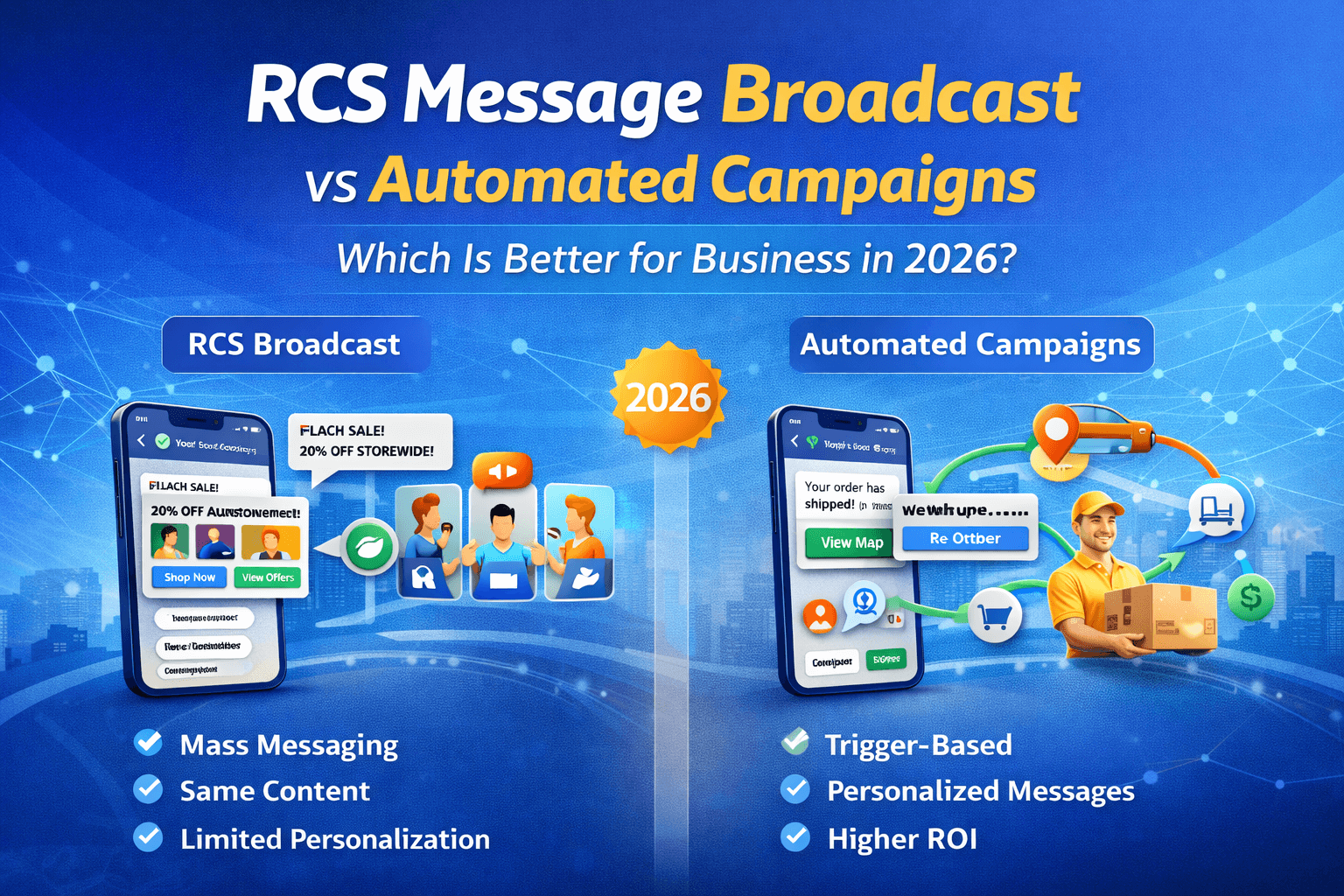
RCS Message Broadcast vs Automated Campaigns: Which Is Better for Business in 2026?
Compare RCS message broadcast and automated campaigns to discover which strategy drives better engagement, personalization, and ROI. Learn how RCS automation transforms business messaging in 2026.
You
have built your RCS channel. Your sender profile is verified, your audience is
opted in, and you are staring at a campaign planning calendar with two levers
to pull: send a broadcast to everyone, or let automation trigger messages based
on behaviour. Which do you choose? When do you choose it? And is the choice
actually that binary?
These are the
questions that marketing, CRM, and growth teams ask most frequently when they
graduate from SMS to RCS. The answers matter enormously, because broadcast and
automated campaigns produce fundamentally different outcomes — different
engagement profiles, different opt-out risks, different ROI timelines, and
different operational demands. Getting the choice wrong means either leaving
revenue on the table with under-personalised blasts or failing to capture
immediate demand with over-engineered automation that takes weeks to build.
This guide gives you the complete framework. We will define each approach precisely, compare them across every dimension that matters, walk through real message examples, and give you a 14-scenario decision matrix that tells you which to use, every time. We will also show you the hybrid strategy that the most sophisticated RCS marketers are running in 2026 — one that uses both approaches in concert, each doing what it does best.
1. RCS Broadcast Campaigns: What They Are
and When They Shine
A broadcast
campaign is a single RCS message — or a short sequence of messages — sent
simultaneously to an entire audience segment at a time chosen by the marketer.
The trigger is the calendar or the campaign plan, not customer behaviour.
Everyone on the list receives the same message, at the same moment, with
personalisation limited to merge fields (name, account balance, nearest store)
drawn from your CRM.
The Core Strengths of Broadcast
|
3.2x Higher CTR Automated vs. broadcast avg. |
85%+ RCS Open Rate Both campaign types |
40% Lower Opt-Outs Automated vs. broadcast |
2–5x ROI on Lifecycle Vs. one-off broadcasts |
|
⚡ Broadcast RCS: Core
Strengths •
Immediacy:
a broadcast lands in every inbox simultaneously, creating urgency and a
shared moment that drives peak traffic and purchase spikes •
Simplicity:
a single message or short sequence is designed once, reviewed once, approved
once, and sent. No complex trigger logic or journey mapping required •
Reach:
broadcasts address the entire opted-in audience, making them the right tool
for announcements, events, and time-sensitive offers where maximum coverage
matters •
Speed to
market: a broadcast can go from brief to delivery in hours. For fast-moving
opportunities — a competitor price match, a viral moment, a weather-triggered
sale — nothing moves faster •
Brand
consistency: every recipient sees the same message at the same time, creating
a unified brand moment that can feel like an event rather than a one-to-one
communication |
Broadcast
campaigns are powerful but blunt. They send the same message to a customer who
bought yesterday and one who has not engaged in six months. They cannot adapt
to individual behaviour, purchase history, or lifecycle stage without complex
pre-segmentation. Sent too frequently, they generate the highest opt-out rates
of any RCS campaign type, because irrelevant messages in a high-attention
channel feel intrusive.
The broadcast model also demands ongoing creative and planning resource. Every campaign requires a new brief, new creative, new approvals, and active send management. For teams with limited bandwidth, the operational load of running frequent broadcast campaigns can become unsustainable.
What Great Broadcast RCS Looks Like
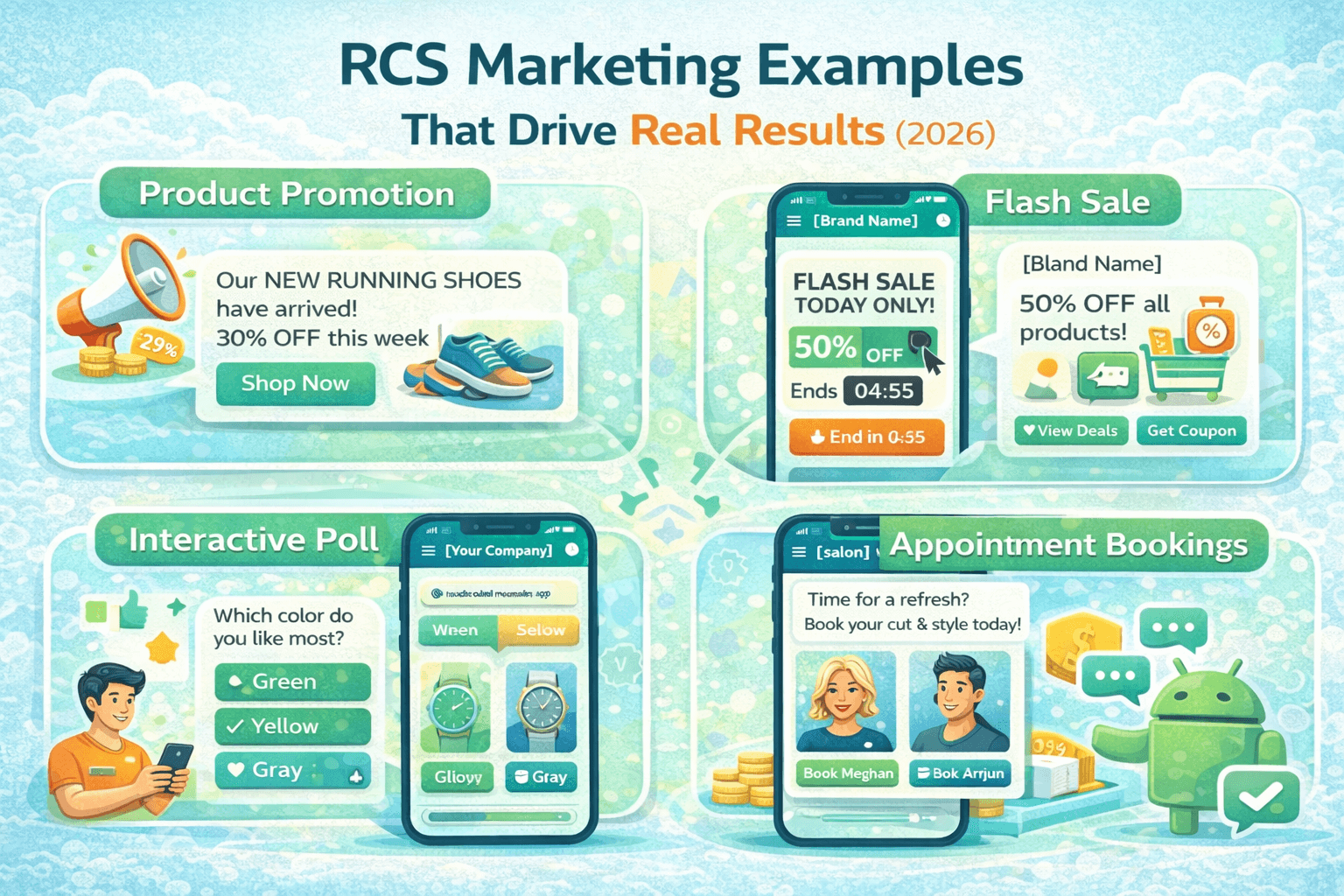
Here is a real-world example of a broadcast campaign done correctly: a fashion retailer’s flash sale notification, sent at 9:00 AM to their full opted-in subscriber list of 280,000 customers.
|
ZARA Style • Verified Sender ✔ |
|||
|
Flash Sale: Up to 50% off — New Collection Hi Sarah, our biggest sale of
the season starts NOW. 500+ styles reduced for 24 hours only. Sizes selling
fast. Ends: Tonight at midnight
• In-store & online
|
2. RCS Automated Campaigns: What They Are
and Where They Excel
An automated
campaign is a message or sequence of messages triggered by a specific customer
action, lifecycle event, or data condition — not by a marketer pressing send.
The trigger is the customer’s behaviour: they abandoned a cart, completed a
purchase, went 60 days without buying, reached a loyalty tier, clicked a
specific button, or celebrated a birthday. The message arrives when it is most
contextually relevant, not when the campaign calendar says it should.
The Core Strengths of Automated Campaigns
|
⚙️ Automated RCS: Core
Strengths •
Relevance:
the message arrives at a moment of demonstrated intent or need, making it
feel less like marketing and more like a useful service — which is why
opt-out rates are 40–60% lower than broadcast •
Personalisation
depth: automated flows have access to the full context of customer behaviour
— what they browsed, bought, ignored, or returned — enabling a level of
personalisation impossible in broadcast •
Scalability
without proportional effort: once built and tested, an automated flow runs
indefinitely without team intervention. A welcome series built once serves
every new subscriber forever •
Lifecycle
coverage: automated campaigns can nurture a customer from first touch to
loyal advocate, with different messages at each stage — a coherent long-term
relationship that broadcast alone cannot build •
Superior
conversion rates: because they land at high-intent moments, automated RCS
messages typically convert at 2–3 times the rate of equivalent broadcast
campaigns |
The Limitations of Automated Campaigns
Automation is
powerful but slow to build correctly. Designing trigger logic, mapping customer
journeys, setting up CRM integrations, building branch conditions, writing
multiple message variants, and testing end-to-end flows takes weeks, not hours.
For fast-moving opportunities or time-sensitive announcements, automation is
not the answer.
Automated flows also require ongoing maintenance. As products change, prices update, and audience behaviour evolves, automated messages can become stale or inaccurate. A ‘recommended for you’ automated message based on 18-month-old browse data is worse than no message. Automation demands governance: regular audits, content updates, and performance reviews to ensure the flows remain accurate and effective.
What Great Automated RCS Looks Like
Here is an abandoned cart recovery sequence — one of the highest-ROI automated flows in RCS. Triggered 45 minutes after a customer leaves checkout without completing purchase.
|
SportsDirect • Verified Sender ✔ |
|||
|
Still thinking it over?: Hi Marcus, you left something
behind. Your Nike Air Max 97 in size 10 is still in your basket — and it’s
one of our last pairs in that size. Your basket: Nike Air Max 97 (UK 10, Black/White) —
£149.99 In stock: Only 2 pairs remaining
|
If the customer does not act, a second message fires 24 hours later with a 10% discount. If still no action, a final message at 72 hours closes the loop. This three-message automated sequence consistently recovers 18–25% of abandoned carts in RCS — compared to 6–10% for the same sequence in email. The key is trigger precision: the message arrives when the purchase intent is still warm, personalised to the exact item left behind.
3. Head-to-Head: Broadcast vs. Automated
Across Every Dimension
The table below compares both campaign types across the full range of operational, strategic, and performance dimensions. Use this to identify which approach is better suited to a specific campaign goal or team context.
|
Dimension |
Broadcast |
Automated |
|
Trigger
mechanism |
Marketer-initiated (calendar) |
Customer behaviour / data event |
|
Setup
complexity |
Low — hours to launch |
High — days/weeks to build |
|
Ongoing
effort |
High (every send) |
Low (post-setup maintenance) |
|
Audience
size |
Full list or broad segment |
Behaviour-triggered subset |
|
Personalisation |
Merge fields only |
Full behavioural context |
|
Message
timing |
Marketer-chosen moment |
Customer-defined moment |
|
Speed of
deployment |
Very fast |
Slow (initial), then instant |
|
Open rate
(avg.) |
78–85% |
82–90% |
|
CTR (avg.) |
18–28% |
30–45% |
|
Conversion
rate |
3.5–6.5% |
7–15% |
|
Opt-out
risk |
Medium–High if over-sent |
Low–Medium (high relevance) |
|
Revenue
pattern |
Immediate spike |
Steady long-term lift |
|
Best for |
Events, launches, promotions |
Lifecycle, retention, recovery |
|
Analytics
visibility |
Campaign-level open/click |
Journey-stage + conversion |
|
Content
shelf life |
Single use |
Evergreen (with maintenance) |
|
Team
resource req. |
Creative + planning each time |
Technical + creative upfront |
Neither column is categorically superior. The broadcast column wins on speed, simplicity, and immediate revenue generation. The automated column wins on personalisation, opt-out risk, conversion rate, and long-term ROI. The most effective RCS programmes run both, with a clear strategy for which type serves which objective.
4. Performance Benchmarks: What the Numbers
Actually Look Like
Data from RCS campaigns run in 2024 and 2025 across retail, financial services, travel, and SaaS industries reveals consistent patterns in how broadcast and automated campaigns perform on key metrics. The table below reflects median performance across those sectors.
|
Metric |
Broadcast RCS |
Automated RCS |
|
Open Rate |
78–85% |
82–90% |
|
Click-Through Rate |
18–28% |
30–45% |
|
Conversion Rate |
3.5–6.5% |
7–15% |
|
Opt-Out Rate |
2.5–4% |
0.8–1.5% |
|
Revenue per Message |
Moderate–High |
High–Very High |
|
Cost per Conversion |
Medium |
Low–Medium |
|
Time to Launch |
Hours |
Days–Weeks (setup) |
|
Ongoing Team Effort |
High (each send) |
Low (post-setup) |
|
Personalisation Depth |
Moderate |
Deep |
|
Audience Size |
Entire list |
Behaviour-triggered segment |
|
Best ROI Horizon |
Immediate (campaign) |
Long-term (lifecycle) |
Several patterns in this data deserve specific attention. First, both campaign types achieve dramatically higher open rates than SMS (22–25%) or email (20–28%), confirming that RCS’s native, verified, rich format commands attention regardless of campaign type. Second, the conversion rate gap between broadcast (3.5–6.5%) and automated (7–15%) is significant but not disqualifying for broadcast — because broadcast sends to a much larger audience, the absolute conversion volume can be comparable or greater, depending on list size. Third, opt-out rates are the most important metric to monitor for broadcast campaigns: the moment opt-out rate exceeds 3.5%, it signals that frequency or relevance has become a problem that will erode the list over time.
|
A
broadcast that converts at 5% against a list of 200,000 produces 10,000
conversions. An automated flow that converts at 12% against a triggered
audience of 40,000 produces 4,800. Both are valuable — but they are doing
fundamentally different jobs. Optimise each for what it actually is. |
5. The Decision Matrix: 14 Scenarios, Clear
Answers
Stop deliberating on a case-by-case basis. The matrix below covers the 14 most common RCS campaign scenarios and gives a clear recommendation — broadcast, automated, or a hybrid approach — based on trigger type, urgency, audience definition, and personalisation requirements.
|
Campaign Scenario |
Best Approach |
Confidence |
|
Flash sale —
ends midnight tonight |
Broadcast |
●●● |
|
Welcome
series for new subscribers |
Automated |
●●● |
|
Monthly
newsletter / product update |
Broadcast |
●●● |
|
Abandoned
cart recovery |
Automated |
●●● |
|
Seasonal
promotion (Black Friday, Eid, Diwali) |
Broadcast |
●●● |
|
Post-purchase
upsell sequence |
Automated |
●●● |
|
Brand
announcement / PR moment |
Broadcast |
●●● |
|
Re-engagement
campaign for lapsed users |
Automated |
●●● |
|
Event invite
to full subscriber list |
Broadcast |
●●● |
|
Birthday /
anniversary reward message |
Automated |
●●● |
|
Product
recall or urgent notice |
Broadcast |
●●● |
|
Lead nurture
sequence (B2B) |
Automated |
●●● |
|
VIP-only
early access campaign |
Either — segment + trigger |
●○○ |
|
Cross-sell
based on purchase history |
Automated |
●●● |
Three dots
indicate high confidence — the scenario almost always calls for that approach.
Two dots indicate moderate confidence — the recommendation holds in most cases
but depends on list size, segmentation quality, or team bandwidth. One dot
(●○○) indicates that the choice is genuinely contextual and requires further
analysis of your specific situation.
The ‘Either’ classification for VIP early access campaigns reflects a real hybrid opportunity: broadcast the campaign to the VIP segment (treating the segment definition as the trigger), while using automated follow-up sequences based on whether each VIP opened, clicked, or purchased. This is the hybrid strategy covered in the next section.
6. The Hybrid Strategy: Using Both
Approaches Together
The most
sophisticated RCS programmes in 2026 do not choose between broadcast and
automated — they use both in a coordinated system, where broadcast campaigns
act as the top-of-funnel demand generator and automated flows handle the
follow-through. This architecture delivers the immediate reach and urgency of
broadcast combined with the personalisation precision and conversion power of
automation.
How the Hybrid Model Works
The principle is straightforward: every broadcast campaign becomes the entry point for an automated journey. When a customer receives a broadcast and takes an action — clicking a product, browsing a sale, opening without buying — that behaviour triggers a personalised automated follow-up that the broadcast alone could never deliver.
|
1 Broadcast Send Full list receives launch campaign |
→ |
2 Behaviour Split Track who clicked, who opened, who ignored |
→ |
3 Segment Fork Route each group to tailored automated path |
→ |
4 Auto Follow-Up Personalised sequences by behaviour |
→ |
5 Convert & Close Purchase, booking, or desired outcome |
Example: A Product Launch in Hybrid Mode
A beauty retailer launches a new skincare range. On launch day, they broadcast a rich RCS campaign with the new product carousel to their full list of 150,000 subscribers. From that one send, three automated journeys activate immediately afterwards, each triggered by what the customer did with the broadcast.
|
🟣 Path A:
Clicked but did not purchase (38,000 customers) •
Hour 1:
Automated message with the specific product they clicked, social proof
(‘5,000 five-star reviews’), and a ‘complete your order’ button •
Hour 24:
If still no purchase, an RCS with a bundle offer — ‘pair with our bestselling
serum for 15% off’ •
Hour 72:
Final automated message with user-generated content (‘See what customers are
saying’ image carousel) and last-chance framing |
|
🟢 Path B:
Opened but did not click (61,000 customers) •
Day 2:
Automated message with a different product angle — if they did not click on
the hero product, surface the second bestseller with a different hook
(routine fit, ingredient story, skin type matching) •
Day 5:
If still no engagement, send a ‘find your perfect match’ interactive quiz via
RCS — a swipeable carousel of skin concerns that routes to personalised
recommendations •
Day 10:
Final automated send with a time-limited free sample offer for this segment |
|
⚪ Path C: Did not open
the broadcast (51,000 customers) •
Day 3:
Send an entirely different creative variant of the launch campaign —
different hero image, different headline, different CTA. Test whether it was
the content or the timing •
Day 7:
If still no open, route to a ‘we noticed you’ve been quiet’ reactivation flow
that leads with value (‘exclusive offer for subscribers only’) rather than
product •
Day 14:
Final send. If no engagement across all attempts, flag for opt-out risk
review and reduce future broadcast frequency for this segment |
This three-path hybrid architecture turns a single broadcast into an orchestrated 14-day programme that reaches every customer with the right message for their level of engagement. The broadcast provides immediate scale and urgency. The automated journeys provide the personalisation precision that transforms interest into purchase. Combined, this approach typically produces 35–60% more total revenue from a launch campaign than broadcast alone.
7. Advanced Automated Campaign Types Worth
Building Now
Beyond the core abandoned cart and welcome series, a mature RCS automated programme includes a range of lifecycle flows, each targeting a specific customer moment. Here are the highest-value automated campaigns that leading brands are running in 2026.
Loyalty Milestone Triggers
Automated
messages that fire when a customer crosses a loyalty points threshold, achieves
a new tier, or approaches a reward expiry date. These messages have some of the
highest open rates in RCS (89–93%) because they are inherently personalised to
a tangible achievement. Including a one-tap ‘redeem now’ button directly in the
message drives immediate transactions and reduces the ‘forgot to use my points’
dropout that erodes loyalty programme ROI.
Win-Back Sequences for Lapsed Customers
Triggered when
a customer reaches a defined inactivity threshold — typically 60, 90, or 120
days without a purchase — win-back automated sequences use progressive
incentives and emotional reconnection to reactivate lapsed value. RCS win-back
campaigns outperform email equivalents by a factor of three to four on
reactivation rate, primarily because the rich message format (personalised
product imagery, one-tap offer redemption) reduces the friction that causes
email win-backs to fail.
Post-Purchase Upsell and Cross-Sell Flows
Triggered 7–14
days after a confirmed purchase, these automated sequences surface
complementary products based on the original purchase, accessories, consumables
(replacement filters, compatible charging cables), or next-category
recommendations. The timing is deliberate: early enough that the original
product is still top of mind, late enough that the customer has experienced it
and is more receptive to the brand. Post-purchase automated sequences in RCS
convert at 9–18%, making them among the highest-ROI flows in the entire
programme.
Behavioural Browse Triggers
Triggered when
a customer views a product page two or more times without purchasing — a strong
signal of consideration without conversion. The automated RCS message surfaces
the browsed product with fresh context: updated stock levels (‘only 3 left’), a
recent customer review (‘rated 4.8 stars this week’), or a relevant companion
product. Unlike retargeted ads, which feel like surveillance, an RCS message
framed correctly (‘We noticed you’ve been looking at this’) can feel helpful
rather than intrusive.
Subscription Renewal and Churn Prevention
For SaaS, media, and subscription businesses, automated RCS flows triggered by upcoming renewal dates, usage drops, or cancellation intent signals can prevent churn at a fraction of the cost of reactive win-back. A message triggered 14 days before renewal that highlights features used, celebrates milestones (‘You’ve created 847 designs with us this year’), and offers proactive renewal incentives consistently outperforms reactive retention efforts. Churn prevention automated flows in RCS report 20–35% higher retention rates than equivalent email programmes.
8. Building Your RCS Campaign Programme: The
Sequenced Approach
For teams new to RCS, the sequenced approach below prevents the most common mistake: trying to build everything simultaneously and building nothing well.
Phase 1 (Weeks 1–4): Broadcast Foundation
Start with
broadcast. It is faster to build, easier to test, and generates immediate data
about what your audience responds to in the RCS channel. Launch three to five
broadcast campaigns covering your core commercial objectives: a promotional
offer, a new product launch, a seasonal moment, and a brand content send
(survey, preference update, content piece). Measure open rates, CTR, opt-out
rates, and revenue attribution. This data becomes the creative intelligence
that informs your automated flows.
Phase 2 (Weeks 4–8): Core Automation Builds
With broadcast
benchmarks established, build your three highest-priority automated flows: the
welcome series for new subscribers, the abandoned cart recovery sequence, and a
post-purchase upsell flow. These three automations alone typically generate
40–60% of the total revenue from an RCS programme, because they target the
highest-intent moments in the customer lifecycle. Test thoroughly before going
live — automated flows run indefinitely, so errors compound at scale.
Phase 3 (Weeks 8–16): Hybrid Integration
Connect your
broadcast and automated systems. Every broadcast campaign should now route
recipients into behaviour-segmented automated follow-up paths based on their
response. Build the branching logic in your CPaaS or marketing automation
platform. Test the end-to-end journey from broadcast receipt through each
automated path to conversion. Measure the incremental lift from the hybrid
architecture versus standalone broadcast performance.
Phase 4 (Month 4 onward): Lifecycle Expansion
Expand your automated programme to cover the full customer lifecycle: win-back sequences, loyalty milestone triggers, browse abandonment flows, churn prevention sequences, and anniversary or birthday programmes. Each new automation should be evaluated against a clear ROI threshold before build — not every flow will pay back equally, and team resource is finite. Prioritise flows by estimated revenue impact divided by build complexity.
9. Compliance Considerations for Both
Campaign Types
Both broadcast
and automated RCS campaigns must comply with applicable consent regulations,
but the compliance requirements manifest differently in each type.
Broadcast Compliance
Broadcast
campaigns send to the entire opted-in list — meaning list hygiene is critical.
Every send should be preceded by a suppression check: remove recent opt-outs,
customers who have complained, and any contacts whose consent status is
ambiguous. Broadcast frequency should be capped to avoid generating opt-outs
that erode the list faster than it grows. Most brands find that two to four
broadcast RCS campaigns per month is the sustainable limit; beyond that,
opt-out rates begin climbing and list quality degrades.
Automated Campaign Compliance
Automated flows
require specific attention to two compliance risks. First, trigger accuracy:
ensure that automated messages only fire when the triggering condition is
genuinely satisfied — a bug that triggers an abandoned cart message for
customers who did complete their purchase is not only ineffective, it is a
trust-destroying error. Second, content accuracy over time: automated messages
approved at launch may contain prices, product availability, or promotional
terms that become inaccurate as time passes. Build a content review schedule
into every automated flow — quarterly at minimum, monthly for promotional
content.
•
Always include an easy,
visible opt-out mechanism in every RCS message, broadcast or automated
•
For automated flows, build
a hard cap on maximum messages per customer per time period, even if they
qualify for multiple trigger conditions simultaneously
•
Maintain suppression lists
that apply across both broadcast and automated sends — an opt-out from a
broadcast must suppress all automated flows as well
• Store consent records with trigger-level granularity for automated programmes — ‘what did this customer consent to, and when’ must be answerable for every message in a regulatory audit
10. The Future: AI-Driven Campaign Selection
The broadcast
vs. automated distinction — while still strategically relevant — is beginning
to blur at the edges as AI decision engines mature. In 2026, a new class of
intelligent campaign orchestration platforms can analyse individual customer
context in real time and make autonomous decisions about whether to include
that customer in a broadcast send, route them into an automated flow, or hold
communication until a more optimal moment.
These systems
evaluate dozens of signals simultaneously: recency of last purchase, predicted
lifetime value score, current engagement trend, day-of-week open patterns,
product affinity vectors, and churn risk probability. A customer who would
previously receive the same broadcast as every other subscriber might instead
be routed into a personalised automated journey because the AI has identified
that they are in a high-consideration phase where a targeted trigger message
will outperform a broadcast.
This is not science fiction. Several enterprise RCS deployments in 2025 and 2026 are running AI-orchestrated sends where the campaign type — broadcast or triggered — is determined programmatically for each customer individually, at send time. For most teams, this level of sophistication is a 2027 goal rather than a 2026 starting point. But understanding its direction informs how to architect your RCS data infrastructure today: capture behavioural signals, build clean CRM integration, and invest in the consent and preference data that AI orchestration requires.
|
The future
of RCS campaign strategy is not ‘broadcast or automated’ — it is
AI-determined per-customer routing that makes that decision in milliseconds,
at scale, for every individual on your list. |
Conclusion: Stop Choosing, Start Combining
The question
this guide opened with — ‘broadcast or automated, which works better?’ — now
has its full answer: both, in the right sequence, for the right reasons, at the
right moments. Neither approach is universally superior. Each does something
the other cannot.
Broadcast
campaigns deliver immediate reach, urgency, and commercial impact when you have
something time-sensitive to say to your entire audience. Automated campaigns
deliver relevance, personalisation, and compounding lifetime value by saying
the right thing to the right person at precisely the right moment. The hybrid
model extracts the maximum from both by connecting broadcast reach to automated
precision in a single, orchestrated customer journey.
The practical path forward is clear: start with broadcast to build your RCS muscles and gather audience intelligence. Layer in your core automated flows — welcome, abandoned cart, post-purchase. Connect the two with hybrid architectures that use broadcast as the entry point and automation as the follow-through. Then expand your automated programme systematically, guided by ROI analysis and lifecycle priority.
|
Every
broadcast you send is an opportunity to learn what your audience responds to.
Every automated flow you build is a system that converts that learning into
revenue, indefinitely, while you sleep. |