RCS Messaging for Education: Fee Reminders, Admissions & Student Support (2026 Guide)
Discover how schools, colleges, coaching institutes and EdTech platforms use RCS messaging for fee reminders, admissions campaigns, exam alerts, results and student support in 2026.
Every school,
college, coaching institute, and EdTech platform in India relies on messaging
to communicate with students and parents — and almost all of it still happens
through plain SMS. Fee due reminders go out as unbranded text messages from
short codes that parents do not recognise. Admission inquiry follow-ups are 160
characters of plain text with a URL that half the recipients never click. Exam
schedule notifications arrive without any interactive way to download the
timetable, confirm attendance, or ask a question. And every piece of this
critical communication generates zero analytics — institutions have no idea
which messages were read, which prompted action, and which were ignored.
RCS messaging
for education changes all of this. It brings verified brand identity, rich
media, interactive buttons, and real-time analytics to the communication
infrastructure that educational institutions already use — without requiring
students or parents to download any app, create any account, or change any
behaviour. It works on the native Messages app on every Android phone and every
iPhone running iOS 18 or later, using the same carrier-delivered channel as SMS
but with a feature set that today's students and parents actually engage with.
This guide covers the eight most impactful use cases for RCS messaging in education — from fee collection and admissions campaigns to exam notifications, results communication, student support, and EdTech engagement — with real message templates, performance data, India-specific compliance guidance, and a step-by-step setup process for every type of educational institution.
|
55% Reduction in Fee Payment No-Shows — RCS
vs SMS Reminders |
3× Higher Admissions Inquiry Response Rate
— RCS vs SMS |
70% Higher Student Engagement — RCS vs
Plain Text Notifications |
|
45–65% RCS Open Rate vs 20–30% for Plain SMS |
95%+ Of Indian Students on Android —
RCS-Ready |
₹0.01–₹0.05 Per-Message Cost for RCS Business
Messaging India |
The Problem Every Education Institution Recognises
Educational
institutions have three primary communication audiences. Students need
real-time notifications, exam schedules, results, and support access. Parents
need fee reminders, attendance alerts, progress updates, and event
notifications. Prospective students and their families need admissions
information, campus tour invitations, scholarship details, and application
follow-ups. All three audiences share one characteristic: they are reachable on
their mobile phone, and they engage most readily when the message arrives
directly in their native messaging app.
The problem
with plain SMS is structural, not circumstantial. Unbranded short codes create
immediate distrust — parents receiving a fee reminder from an unrecognised
sender ignore or delete it. The 160-character limit prevents meaningful
information delivery. There are no interactive buttons to Pay Now, Confirm
Receipt, or Book a Meeting. There are no read receipts to confirm critical exam
notifications reached every student. And there is no analytics visibility to
tell institutions which messages are driving outcomes and which are being
ignored.
The Four Capabilities RCS Adds to Education Messaging
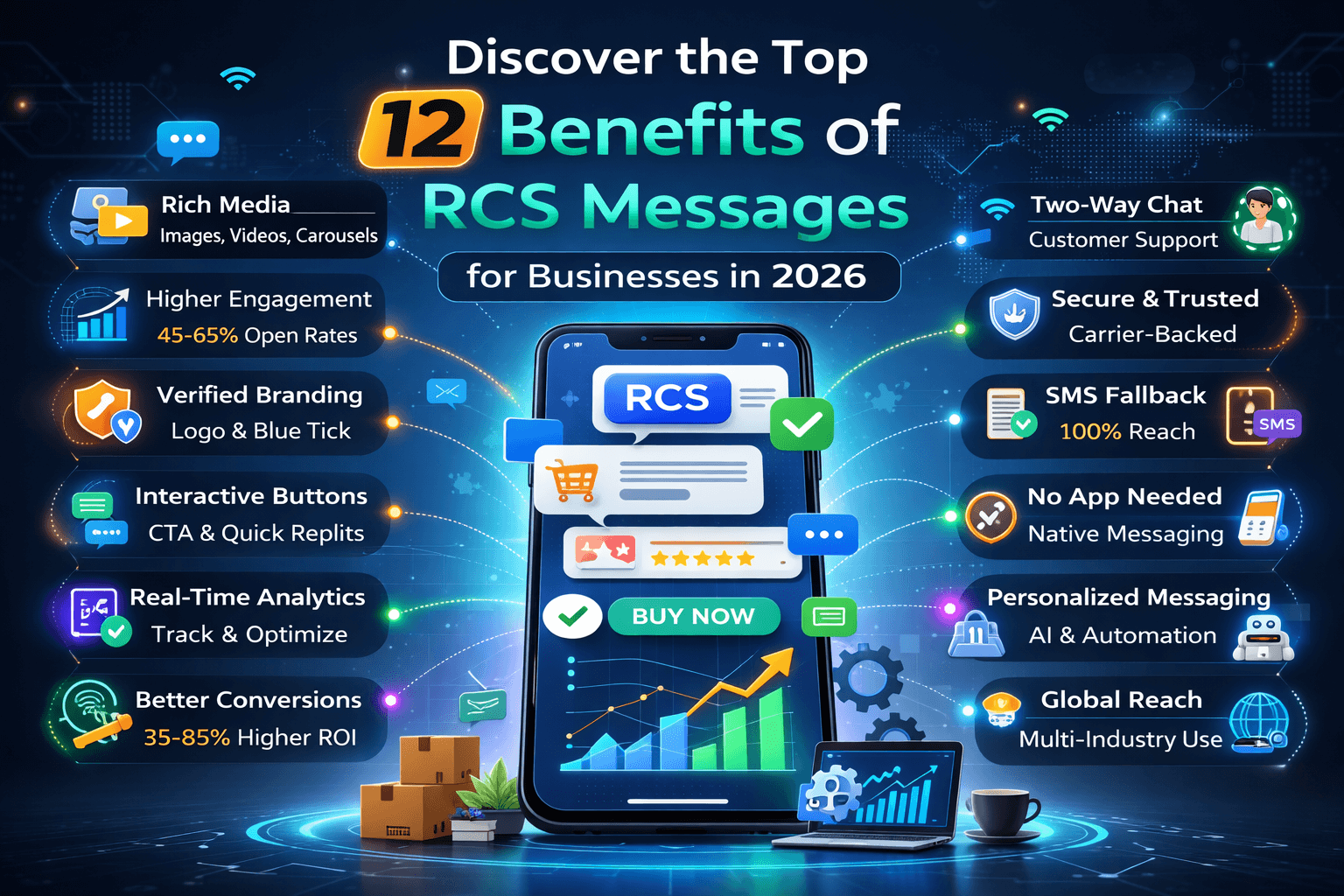
RCS adds four structural capabilities that SMS cannot provide. First, verified brand identity — every RCS message arrives with your institution name, logo, and a verified badge, so students and parents immediately recognise and trust the sender. Second, rich media — fee reminders include a payment summary card, admissions messages include a campus image carousel, exam notifications include a structured timetable display, and results include a personalised scorecard. Third, interactive buttons — one-tap Pay Now for fee reminders, Book Campus Visit for admissions, Download Timetable for exam schedules, and Chat with Counsellor for student support. Fourth, real-time analytics — delivery, open, click, and conversion data for every message sent, giving institutions the data to continuously improve their communication.
|
Feature |
📱 SMS |
🔵 RCS |
|
Sender
identity |
Short code / unknown number |
✅ Verified logo + name + badge |
|
Message
format |
Plain text, 160 chars |
Rich text, no character limit |
|
Media
support |
❌ None |
✅ Images, video, carousels |
|
Interactive
buttons |
❌ None |
✅ Pay Now, Book, Download, etc. |
|
Read
receipts |
❌ Delivery only |
✅ Delivered + read + clicked |
|
Document
access |
Link only (friction) |
✅ One-tap view/download button |
|
Response
capture |
❌ Not possible |
✅ Structured button responses |
|
Analytics |
Delivery rate only |
✅ Open + click + conversion |
|
Open rate |
20–30% |
45–65% — up to 3× higher |
|
SMS
fallback |
It is SMS |
✅ Auto-fallback for all devices |
|
App
required |
None |
None — native Messages app |
The Fee Collection Problem and How RCS Solves It
Fee collection
is the single most operationally critical communication challenge for every
educational institution. Late fee payments create cash flow problems,
administrative burden, and the uncomfortable follow-up conversations that
consume staff time. The root cause of most late payments is rarely the
unwillingness to pay — it is the friction in the reminder-to-payment journey. A
plain SMS fee reminder requires a parent to read an unbranded message, remember
the fee amount and due date, navigate manually to the payment portal, recall
their login credentials, and complete a multi-step payment process. Most
parents intend to pay but procrastinate because the path requires too many
steps.
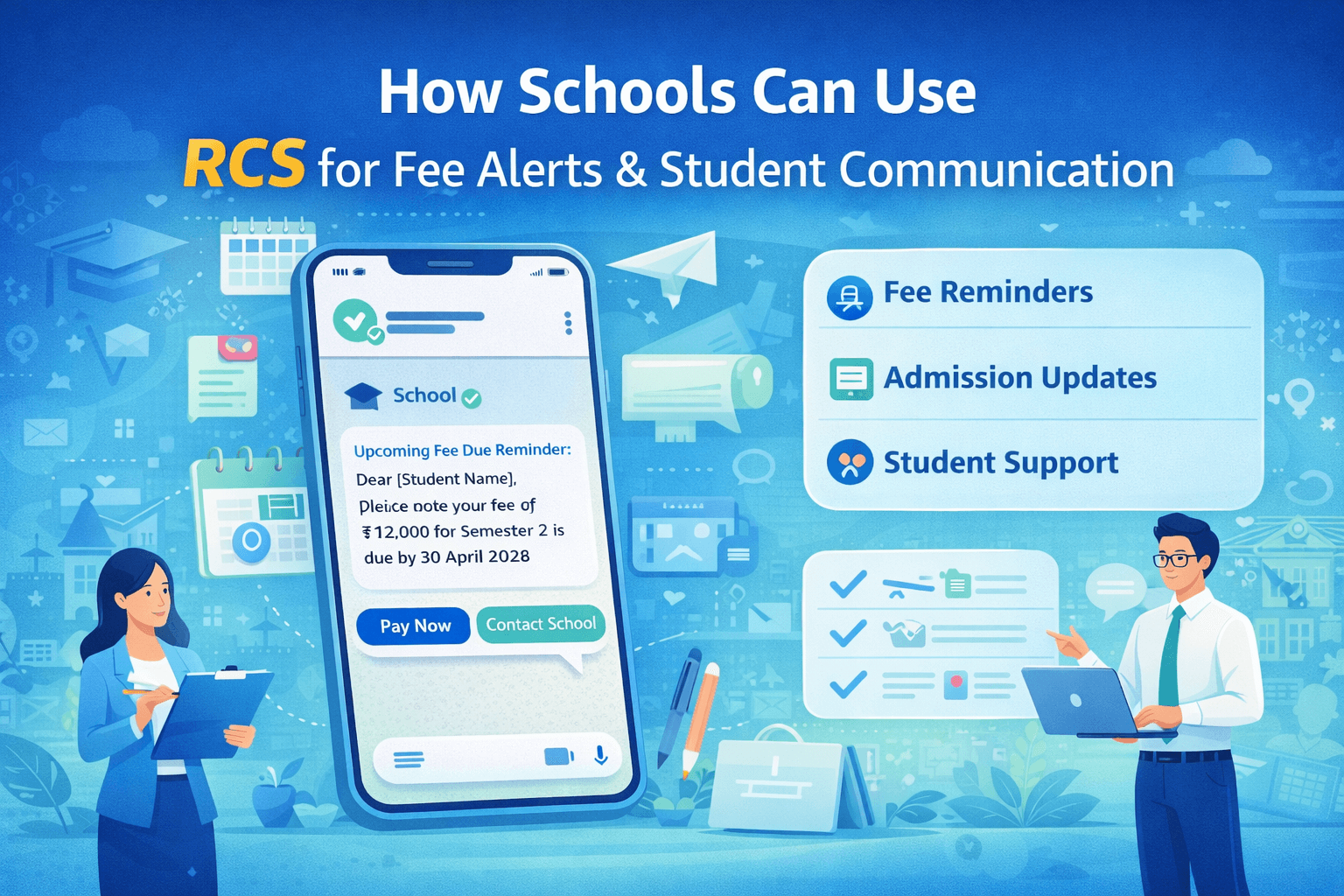
RCS fee reminders solve this with a single structural change: a verified, branded message that shows the fee amount, due date, and student name in a clean card format, with a one-tap Pay Now button that opens the payment gateway directly. The parent sees the message, taps Pay Now, and completes payment in under 60 seconds. No navigation, no credential recall, no friction. Institutions using RCS fee reminder campaigns report fee payment completion rates 40–55% higher on due day compared to SMS reminders — a direct improvement in cash flow and a dramatic reduction in the administrative burden of manual follow-up.
|
📱 Sample RCS Fee Reminder — [Your Institution
Name] 🏫 [Institution
Logo] [Verified Badge] [Institution Name] Dear Mrs. Sharma, This is a friendly reminder that the following fee is due for
your ward: 👤 Student
Name: Arjun Sharma |
Class 10-B 📋 Fee
Type: Term 2 Tuition Fee 💰 Amount
Due: ₹18,500 📅 Due
Date: March 5, 2026 ⚠️ Late Fee Applicable
After Due Date: ₹500/week Please tap below to pay instantly: 🔘 [ Pay Now —
₹18,500 ] 🔘 [ View Fee
Breakdown ] 🔘 [ Request a
Payment Plan ] |
The three-button structure covers the three most common parent responses: those ready to pay immediately (Pay Now), those who want to verify the breakdown first (View Fee Breakdown), and those facing financial difficulty who need a conversation (Request a Payment Plan). By providing all three options in a single message, the institution reduces inbound phone calls about fee queries while making payment as easy as possible for parents in every financial situation.
The 3-Message Fee Escalation Sequence
The most effective RCS fee reminder programmes use a structured three-message escalation sequence that balances urgency with empathy:
|
1 |
Early Reminder — 7 Days Before Due Date Friendly, informative tone. Full fee details displayed in a
clean card — student name, class, fee type, amount, and due date. Buttons:
Pay Now · View Fee Breakdown · Contact Finance Office. No mention of late
fees — this message is an early, helpful reminder, not a threat. Open rates
at this stage are typically highest in the sequence, making it the most
valuable message to get right. |
|
2 |
Due Date Morning — Day of Deadline Urgent but respectful tone. Clearly states 'Due today — late
fee of ₹500/week begins tomorrow.' Buttons: Pay Now Today · View Fee
Breakdown · Request an Extension. The specific late fee amount in the message
creates concrete urgency without feeling punitive. This message typically
drives the highest same-day payment completion rate in the sequence. |
|
3 |
Overdue Notice — 3 Days After Due Date Empathetic but firm. Shows original fee plus accumulated late
fee. Provides a clear escalation path. Buttons: Pay Now (with late fee added)
· Speak to Finance · Request Late Fee Waiver. The Request Late Fee Waiver
button is a key design feature — it channels parents who would otherwise call
to request a waiver through a structured, trackable digital pathway, reducing
the administrative overhead of waiver management significantly. |
3. RCS for
Admissions Campaigns — Convert Enquiries Into Enrolled Students
Why Admissions Follow-Up Fails and How RCS Fixes It
Every
educational institution invests significant resources in generating admissions
inquiries — through advertisements, education fairs, digital marketing
campaigns, and word-of-mouth referrals. But the conversion from inquiry to
enrolled student is where most institutions lose the majority of their
potential intake. A prospective student or parent submits an inquiry through a
website form or education fair registration — and then receives a plain SMS
from an unrecognised short code with a generic URL. The message has no visual
appeal, no personalisation, no clear next step, and nothing that communicates
the quality and character of the institution.
RCS admissions campaigns solve this by delivering a visually rich, verified, personalised first response that immediately communicates institutional quality. A prospective student who receives an RCS message featuring the campus in an image carousel, the specific programme details they enquired about, key credibility metrics (placement rates, faculty credentials, batch outcomes), and four clear next-step buttons — Download Prospectus, Book Campus Visit, Apply Now, Talk to Counsellor — has a fundamentally different experience than the recipient of a plain SMS link.
|
📱 Sample RCS Admissions First Response —
[Institution Name] 🎓 [Institution
Logo] [Verified Badge] [Institution Name] Dear Priya, Thank you for your interest in our B.Tech Computer Science
programme. Here is everything you need to take the next step: 📌
Programme: B.Tech Computer
Science (4 Years, Full-Time) 📅 2026 Batch
Start Date: July 14, 2026 📋
Eligibility: PCM in Class 12 —
Minimum 60% 🏆 Placement
Rate: 94% of 2025 Graduating Batch 💰 Annual
Fee: ₹1,20,000 |
Scholarships Available 🪑 Seats
Remaining: 28 of 120 🔘 [ Download
Full Prospectus ] 🔘 [ Book a
Campus Visit ] 🔘 [ Apply Now —
2026 Intake ] 🔘 [ Talk to an
Admissions Counsellor ] |
The Seats Remaining indicator — '28 of 120' — is a high-value addition to admissions RCS messages. Limited-seat visibility creates genuine urgency without manufactured scarcity, and is particularly effective for popular programmes where seats genuinely do fill. Including the placement rate as a formatted data point rather than a claim in a paragraph converts it from a promotional statement into a credibility signal — parents and students treat formatted data more like evidence than advertising.
RCS Admissions Nurture Sequence — 4 Messages From Inquiry to Enrolment
|
1 |
Inquiry Acknowledgement — Sent Within 5 Minutes Speed of first response is the single most important variable
in admissions inquiry conversion — inquiries responded to within 5 minutes
convert at dramatically higher rates than those receiving responses hours
later. This message introduces the institution with a campus image carousel,
the specific programme details the student enquired about, key credibility
metrics, and four next-step buttons. Sets the institutional tone while the
prospect's interest is at its peak. |
|
2 |
Programme Deep-Dive — Day 3 Personalised to the specific programme enquired about.
Includes curriculum highlights, faculty credentials with a photo carousel,
career outcomes for recent graduates, and scholarship and financial aid
information. Buttons: View Full Curriculum · Meet Our Faculty · Check
Scholarship Eligibility · Book a Campus Visit. This message answers the
detailed questions that drive the decision from interested to committed. |
|
3 |
Campus Visit Invitation — Day 7 A formal, visually branded campus visit invitation with event
details card, campus photography carousel, and a clear agenda for the visit
day (campus tour, faculty interaction, student Q&A panel, financial
counselling). Confirm Attendance button with pre-assigned slot time, Get
Directions button linked to Google Maps, and a View Student Testimonials
button. Personalised slot times improve attendance rates significantly over
open-invitation formats. |
|
4 |
Application Deadline Push — Day 14 Final conversion message — application deadline reminder with
specific deadline date and time, any early-bird scholarship or fee waiver for
applications submitted before a cutoff, live seat availability indicator, and
an Apply Now button linked directly to the pre-filled application form (with
the student's name and programme preference pre-loaded from the inquiry
data). The pre-filled form dramatically reduces abandonment at the final
conversion step. |
From Plain Text Alerts to Interactive, Confirmed Exam Communication
Exam schedule
communication is among the highest-stakes notification categories in education.
A student who misses an exam because they did not receive or clearly understand
the schedule notification creates problems for the student, the institution,
and the administrative staff managing the consequences. Plain SMS exam
notifications have three structural limitations: they cannot embed the
timetable (students must navigate to a portal), they cannot confirm that the
student received and read the message (institutions have no evidence of
delivery), and they cannot provide the interactive actions — calendar addition,
timetable download, hall ticket access — that students need to act on the
notification.
RCS exam notifications solve each of these limitations in a single message. The timetable is displayed as a structured data card within the message — dates, times, subjects, and hall assignments in a clean visual format that students can reference directly from their Messages app without any navigation. A Confirm Receipt button generates a read confirmation that flows back to the institution's database, providing evidence that each student received the schedule. A Download Timetable PDF button provides one-tap access to the full timetable document. And an Add All Exams to Calendar button adds each exam as a phone calendar event with a single tap — the single most requested feature from students receiving exam notifications.
|
📱 Sample RCS Exam Schedule Notification —
[Institution Name] 📚 [Logo] [Verified Badge] [Institution Name] Dear Rohan, Your Term 3 Examination Schedule has been officially
published. 📋 CLASS
12 SCIENCE — EXAMINATION SCHEDULE ──────────────────────────────────────────────── March 10 | 9:00 AM – 12:00 PM |
Physics | Hall A — Row 3 March 12 | 9:00 AM – 12:00 PM |
Chemistry | Hall B — Row 1 March 14 | 9:00 AM – 12:00 PM |
Mathematics | Hall A — Row 3 March 17 | 9:00 AM – 12:00 PM |
Biology | Hall C — Row 2 March 19 | 9:00 AM – 12:00 PM |
English | Hall A — Row 3 ──────────────────────────────────────────────── 📍 Reporting
Time: 30 minutes before each exam 📋 Carry: Hall Ticket + Valid School / Government ID 🔘 [ Download
Full Timetable PDF ] 🔘 [ Add All
Exams to My Calendar ] 🔘 [ Confirm
I've Received This Schedule ] 🔘 [ Contact
Exam Controller ] |
|
💡 Pro Tip: Track Confirm Receipt button click rates in real time on your aggregator dashboard. For any student who has not confirmed receipt within 24 hours of the n |
Delivering Results as an Experience, Not a Redirect
Result
announcements are among the most emotionally significant communications an
educational institution sends — and the channel through which they are
delivered directly affects how students and parents experience that moment. A
plain SMS reading 'Your result is available at portal.institution.ac.in/results
— Login to view' requires the student to navigate to the portal, recall their
login credentials, and retrieve their result from a table of data — a journey
of friction during an already emotionally charged moment. The experience
communicates institutional indifference to the student at the precise moment
when institutional connection matters most.
An RCS result notification delivers the student's actual result summary directly in the message — their name, individual subject scores, total marks, percentage, distinction classification, and class and school rank — in a personalised card that requires no navigation, no credential recall, and no additional steps to see. Buttons to download the full marksheet, apply for re-evaluation, book a parent-teacher meeting to discuss performance, and access career counselling convert the result moment into a structured, actionable next step. Institutions that deliver results this way consistently report higher student and parent satisfaction with institutional communication.
|
📱 Sample RCS Result Notification — [Institution
Name] 🎓 [Logo] [Verified Badge] [Institution Name] Congratulations, Meera! 🎉 Your Term 2 Examination Results are now officially available. 👤 Meera
Krishnamurthy | Class 11 Commerce |
Roll No. 2024-11C-047 📊 YOUR
RESULT SUMMARY: ──────────────────────────────────── Accountancy : 92 / 100
✅ Business Studies : 88 / 100
✅ Economics : 85 / 100
✅ English : 90 / 100
✅ Mathematics : 78 / 100
✅ ──────────────────────────────────── 📈 Total: 433 / 500
| Percentage: 86.6%
| DISTINCTION 🏆 Class
Rank: 4th of 52 |
School Rank: 12th of 210 🔘 [ Download
Your Full Marksheet ] 🔘 [ Apply for
Re-Evaluation (Deadline: Mar 25) ] 🔘 [ Book a
Parent-Teacher Meeting ] 🔘 [ Access
Career Counselling ] |
The Apply for Re-Evaluation button with an explicit deadline — 'Deadline: Mar 25' — is a critical addition to result messages. Students who want to apply for re-evaluation often miss the deadline because they are not aware of it or forget to apply in the emotional aftermath of receiving results. Including the deadline directly in the button label captures attention and drives timely action, reducing the administrative burden of managing late re-evaluation requests while protecting students' right to challenge their results.
|
🤝 #A |
Academic Support and Tutoring Access Connect students to the help they need with one tap —
not a phone call or office visit RCS academic support messages are most
powerful when triggered automatically by student performance data. When a
student's assessment scores fall below a defined threshold, a proactive RCS
message can be sent automatically — showing their recent performance summary
in a structured card, acknowledging the challenge without stigma, and
providing direct one-tap booking buttons for tutoring sessions with specific
faculty members, access to recorded lecture libraries for the topics they are
struggling with, and personalised study plan recommendations from the
institution's academic support team. Institutions that implement proactive, performance-triggered
RCS academic support messages report significantly higher engagement with
support services than those relying on reactive phone calls or email
outreach. The key insight: a student who might not respond to a phone call
from an unknown institutional number — or who might feel embarrassed to
request support in person — is significantly more likely to tap a button in a
supportive, branded RCS message that arrives privately in their messaging
app. |
|
📋 #B |
Attendance Alerts and Parent Notifications Keep parents informed and students accountable through
real-time, branded attendance updates RCS attendance notifications deliver
weekly attendance summaries directly to parents — showing the student's
current attendance percentage, the number of sessions attended and missed,
and the minimum attendance required for exam eligibility — with a Review Full
Attendance Record button linking to the parent portal, and a Contact Class
Teacher button for parents who want to follow up directly. For students
approaching the minimum attendance threshold, a personalised warning message
with their exact current percentage and a Book a Counselling Appointment
button creates a structured, documented intervention pathway. Schools and colleges implementing RCS attendance notifications
report significantly higher parental engagement with attendance management
than those relying on SMS. The rich, personalised, verified message format —
showing precise numbers for their specific child, from a verified institution
sender — builds the kind of clarity and trust that drives parental action,
particularly for borderline attendance situations where the consequences of
continued absence are severe. |
|
🎯 #C |
Career Counselling and Placement Support Connect students to career opportunities and
counselling at the moments of highest intent Career support RCS messages are most
effective when triggered by specific student lifecycle events — result
announcements (when students are future-focused), course completion
milestones (when students are transitioning), internship application windows
(when career interest is highest), and campus recruitment event
announcements. A placement drive announcement via RCS — featuring a carousel
of recruiting company logos, salary package ranges, the registration
deadline, and an Apply for the Drive button — drives dramatically higher
registration rates than equivalent plain SMS announcements. EdTech platforms and colleges using RCS for placement drive
announcements with company logo carousels, CTC ranges, and single-tap
registration buttons report registration rates 3–5 times higher than
equivalent email or SMS announcements — driven by the immediacy of the
messaging channel, the visual credibility of the company logos, and the
zero-friction single-tap registration action that removes every barrier
between seeing the opportunity and expressing interest. |
|
💬 #D |
Mental Health and Student Wellbeing Support Create a trusted, low-friction pathway to student
wellbeing resources through verified RCS Student mental health support is an
increasingly critical responsibility for educational institutions — and one
where the communication channel matters enormously. RCS enables institutions
to deliver regular, normalised wellbeing check-in messages to students, with
a simple response button set — 'I'm doing well' / 'I could use some support'
/ 'I'd like to speak to someone' — that captures wellbeing data and
automatically routes students who indicate they need support to the
appropriate counselling resource, with a Book a Confidential Appointment
button and the counsellor's name displayed prominently. The verified brand identity of RCS is particularly important
for sensitive communications like mental health support. Students are
significantly more likely to engage with a message that arrives with a
familiar, trusted institution name and logo than with an anonymous short
code. The structured button-based response also reduces the barrier to
seeking help by removing the need to compose and send a message requesting
support — a step that many students experiencing difficulty find difficult to
take. |
Parent-Teacher Meetings, Annual Days, Open Days, and Workshops
Educational event communication — annual days, parent-teacher meetings, workshops, seminars, sports days, open days, orientation programmes, and graduation ceremonies — represents a high-frequency, high-importance communication category where RCS delivers immediate and visible improvements over plain SMS. An RCS event invitation arrives with event imagery, structured event details, a clear RSVP or registration button, and a Get Directions button — creating a significantly more compelling and actionable invitation than a plain text message with a link to navigate separately.
|
📱 Sample RCS Parent-Teacher Meeting Invitation
— [School Name] 🏫 [School
Logo] [Verified Badge] [School Name] Dear Mr. and Mrs. Patel, You are cordially invited to attend the Parent-Teacher Meeting for your ward: Ananya
Patel | Class 8-A 📅 Date: Saturday, March 8, 2026 ⏰ Your Appointment
Slot: 10:30 AM – 10:45 AM 📍 Venue: Conference Room 2, Block B, Ground Floor 👩🏫
Class Teacher: Mrs. Sunita
Rao |
Subject: Mathematics Discussion Points:
Academic progress, attendance, upcoming board preparation 🔘 [ Confirm My
Attendance ] 🔘 [ Request a
Different Time Slot ] 🔘 [ Get
Directions to School ] 🔘 [ View
Ananya's Progress Report Before the Meeting ] |
Two design decisions in this template deserve attention. The pre-assigned appointment slot — '10:30 AM – 10:45 AM' rather than 'Please choose a time' — increases confirmation rates significantly. Parents who receive a pre-assigned time respond more quickly and reliably than those presented with a scheduling task. The View Progress Report Before the Meeting button is a high-value addition for teachers: parents who review their child's academic data before attending have more informed, productive conversations, reducing the time required to bring each parent up to speed and allowing more substantive discussion of progress and concerns.
Using RCS Across the Full EdTech Student Journey
For EdTech platforms — online coaching, skill development courses, test preparation, and corporate training providers — RCS messaging addresses the fundamental engagement challenge of a digital-only learning environment. Without the physical accountability of attending a classroom, EdTech students are vulnerable to disengagement, low completion rates, and subscription churn. RCS provides the engagement infrastructure to keep students connected, motivated, and progressing — from course discovery and enrolment through active learning, milestone recognition, and subscription renewal.
|
🚀 #1 |
Course Launch and Enrolment Campaigns Launch new courses with visual, interactive
announcements that drive immediate enrolment EdTech course launch RCS messages combine a course preview
image or short video thumbnail, programme highlights in a structured card
(duration, faculty credentials, learning outcomes, certificate value and
recognition), a limited-time early-bird offer with a clearly visible
deadline, and an Enrol Now button with a direct link to the checkout page
with the offer price pre-applied. For test preparation platforms announcing
new batch starts for JEE, NEET, UPSC, or CAT, the batch details card —
showing start date, seats available, faculty names, previous batch rank
achievements, and fee with scholarship information — drives significantly
higher same-day enrolment than equivalent email or SMS announcements. |
|
📺 #2 |
Live Class and Session Reminders Reduce live class no-shows with personalised, one-tap
session reminders sent 30 minutes before each class Live class reminder RCS messages sent 30 minutes before each
session include the session topic and description, the faculty name and
photo, the expected duration, a Join Now button with a direct link to the
live class platform (no portal navigation, no credential recall required),
and a Can't Attend? button that triggers a watched-later notification flag
and ensures the recorded session is automatically added to the student's
review queue. EdTech platforms using RCS live class reminders report live
attendance rates 40–60% higher than those relying on email reminders alone. |
|
📈 #3 |
Progress Reports and Achievement Notifications Celebrate milestones and identify at-risk students with
personalised, data-rich progress messages Regular progress report RCS messages — weekly or bi-weekly —
show each student's course completion percentage, scores in recent
assessments, learning streak data (consecutive days of platform activity),
and comparative performance against batch averages. For high-performing
students reaching completion milestones, a personalised achievement
notification with a digital badge graphic and a Share Your Achievement button
linking to a shareable certificate creates social recognition that drives
continued engagement and organic word-of-mouth referral. For at-risk students
— those with declining scores, low completion percentage, or platform
inactivity exceeding 7 days — a proactive, supportive RCS message with a
Contact Your Mentor button and a View Your Personalised Study Plan button
creates a warm, structured re-engagement pathway before the student
disengages completely. |
|
🔄 #4 |
Subscription Renewal and Win-Back Campaigns Retain active students and recover churned
subscriptions with personalised, timely RCS outreach Subscription renewal RCS messages — sent 7 days before, 3 days
before, and on renewal day — include the student's progress summary (how far
they have come, what they have achieved, what remaining content they would
lose access to by not renewing), the renewal offer with any loyalty discount
pre-applied, and a Renew Now button with pre-filled payment details to
minimise completion friction. For students whose subscriptions have already
lapsed, a win-back RCS campaign showing course updates added since they left,
new live sessions scheduled, new faculty joining, and their saved progress
data — with a Resume Your Learning button — drives re-subscription rates
significantly higher than email win-back campaigns for the same audience. |
The TRAI DLT Compliance Pathway — What Every Institution Needs to Know
Educational institutions in India sending commercial communications — including fee reminders, admissions campaigns, and promotional EdTech messages — must comply with the TRAI DLT framework under the Telecom Commercial Communications Customer Preference Regulations (TCCCPR) 2018. The compliance pathway for RCS is identical to SMS: entity registration, sender ID registration, and template registration on the DLT platform. Institutions already operating commercial SMS programmes under DLT can extend their existing entity registration to cover RCS without starting from scratch.
|
1 |
TRAI DLT Entity Registration — Your Compliance
Foundation Register your institution as a Principal Entity (PE) on the
TRAI DLT platform. This provides your unique PE ID, which is the foundation
of all subsequent sender ID and template registrations. Institutions already
registered on DLT for commercial SMS — which includes most schools and
colleges that send any fee or promotional communications — have this step
already complete. Your existing PE ID carries over directly for RCS
registration. For new institutions, DLT entity registration typically takes
5–10 business days. |
|
2 |
RCS Sender ID Registration Register your institution's RCS sender name — the verified
brand name that appears with every RCS message you send — on the DLT
platform, linked to your PE ID. Your sender name should be your institution's
official name as registered, matching your DLT entity exactly. Schools with
multiple campuses may register individual campus sender IDs or a single group
institution sender ID depending on their communication strategy. Processing
time: 3–7 business days after submission. |
|
3 |
Template Library Registration Create and register your complete RCS message template library
on the DLT platform — covering all the use cases you plan to run: fee
reminders, admissions nurture, exam notifications, results, event
invitations, attendance alerts, and any other recurring communication types.
Register each template under the correct DLT category — Transactional for fee
due notices and exam schedules, Service for attendance and student support
communications, Promotional for admissions campaigns and EdTech marketing.
Incorrect categorisation creates DND compliance risk. Build a library of at
least 10–12 approved templates before your launch date. |
|
4 |
Select an Education-Experienced RCS Aggregator Choose an RCS Business Messaging aggregator with specific
education sector experience and pre-built integrations for common school and
college management systems (Fedena, Entab, iCampus, Edunext), EdTech LMS
platforms, and Indian payment gateways (Razorpay, PayU, Instamojo). Evaluate
aggregators on message builder quality (supports carousels, all button types,
full personalisation variables), analytics dashboard depth, DLT compliance
support quality, and the ability to handle education-specific personalisation
— student name, class, roll number, fee amount, due date, result data — at
scale. |
|
5 |
Integrate With Your Student Information System Connect your RCS platform to your institution's Student
Information System or management software — the source of truth for student
data, fee records, exam schedules, attendance, and result data. This
integration enables automatic personalisation of every RCS message with
student-specific data and enables triggered campaigns: automatic fee reminder
7 days before due date, automatic result notification within minutes of
results being published in the SIS, automatic attendance alert when a student
crosses the warning threshold. Without SIS integration, RCS personalisation
requires manual data uploads — which limits campaign frequency and
personalisation depth. |
|
6 |
Run a Pilot, Measure Performance, Then Scale Before rolling out RCS to your full student and parent
database, run a focused 2–3 week pilot with one class or cohort — covering
fee reminders and one additional use case. Measure RCS open rates, button
click rates, and fee payment completion rates against your SMS baseline for
the same message type. Document the performance improvement. Use this
comparative data to build your internal business case for full institutional
deployment, and to identify any integration or template improvements needed
before scaling to your full database. |
Frequently Asked
Questions — RCS Messaging for Education
Q: Can schools and colleges in India send RCS messages to parents and students?
A: Yes. Any registered educational institution can send
RCS Business Messages to parents and students through a TRAI DLT-registered RCS
aggregator. The compliance requirements are identical to commercial SMS —
entity registration, sender ID registration, and message template registration
on the DLT platform. Institutions already registered on DLT for commercial SMS
can extend their existing registration to cover RCS sender IDs and templates
without starting the compliance process from scratch.
Q: Does RCS work on every
parent's and student's phone in India?
A: RCS works on all Android smartphones running Google
Messages as the default messaging app — which covers the vast majority of
phones in India, as over 95% of Indian smartphones run Android and most come
with Google Messages as the default app. It also works on iPhones running iOS
18 or later. For parents or students whose devices or carriers do not support
RCS, messages are automatically delivered as SMS fallback — ensuring 100% reach
regardless of device or carrier, with no configuration required from the
institution.
Q: Is RCS more expensive
than SMS for educational institutions?
A: RCS Business Messaging is typically priced at ₹0.01 to
₹0.05 per message through aggregators — comparable to or slightly above premium
SMS pricing. The key measure is cost-per-outcome, not cost-per-message. For fee
collection, RCS fee reminders that drive 40–55% higher payment completion rates
on due day produce an economic return that typically outweighs the incremental
messaging cost by a factor of 10–50 times for institutions with meaningful fee
volumes. For admissions, RCS campaigns that generate 3.7 times more
applications from the same inquiry pool at the same or similar message cost
produce dramatically better cost-per-application economics than SMS follow-up
alone.
Q: Can RCS messages
include attachments like fee receipts, hall tickets, or admit cards?
A: RCS messages can include rich media cards (images and
video) and buttons that link to PDF documents hosted on your institution's
portal or a secure file hosting service. For fee receipts, hall tickets, and
admit cards, the standard approach is a branded RCS message with a View /
Download button that links directly to that specific student's document on your
portal — providing instant, personalised, one-tap document access without
requiring the student to navigate, log in, or remember their credentials. Check
with your specific aggregator regarding their support for inline document
display versus link-based access.
Q: How do we handle
consent and opt-in for RCS communications with parents?
A: RCS Transactional and Service category messages — fee
reminders, exam notifications, attendance alerts, result announcements, and
student welfare communications — do not require explicit opt-in under the TRAI
DLT framework. They can be sent to all parent and student contact numbers in
your database as part of the existing institutional communication relationship.
RCS Promotional category messages — admissions campaigns, EdTech product
promotions, and commercial marketing — require documented opt-in consent. For
most schools and colleges, the overwhelming majority of parent and student
communication falls into the Transactional or Service categories, and can be
sent without additional consent beyond the institution-student enrolment
relationship.
Q: Can RCS messaging
replace our school management app or parent portal?
A: RCS is most effectively deployed as a complementary engagement layer alongside your existing communication infrastructure — not as a replacement for your student information system, school management app, or parent portal. RCS handles the notification and engagement layer: alerting parents and students to important events, delivering key information directly in the message, and providing one-tap access to deeper functionality in your portal. The detailed data, full records, and complete institutional functionality remain in your SIS or portal. Think of RCS as the front door that makes your portal instantly accessible to every parent and student from their native messaging app — without requiring them to remember URLs, app names, or login credentials.
Conclusion —
Education Communication That Works in 2026
The gap between
the messaging experience that educational institutions currently provide and
what students and parents expect in 2026 is the gap between 1992 SMS and the
rich, interactive, verified communication that RCS makes possible. Every fee
reminder that gets ignored costs the institution real cash flow. Every
admissions inquiry that goes cold costs real enrolment. Every exam notification
that creates confusion costs real operational time. Every student support
message that fails to connect costs real student outcomes. All of these losses
are, in part, a consequence of communicating through a channel that was never
designed for the complexity and stakes of educational communication.
RCS closes this
gap without asking students or parents to change any behaviour — no new apps to
download, no new accounts to create, no new platforms to learn. The verified
institutional identity that arrives with every message builds trust. The rich
media delivers information that plain text never could. The interactive buttons
remove every barrier between receiving a message and taking the intended
action. And the real-time analytics give institutions, for the first time, the
data to understand which communications are driving outcomes and which need
improvement.
Start with fee
reminders — the use case with the most immediate, measurable financial return.
Demonstrate the improvement in payment completion rates and cash flow. Use that
data to build the institutional case for deploying RCS across admissions, exam
communication, results, and student support. The institutions that build their
RCS communication infrastructure now are building a compounding advantage in
fee collection efficiency, admissions conversion, student engagement, and
parent satisfaction that will grow every year as RCS adoption in India
continues its rapid acceleration.