Telegram vs RCS: Which Platform Is Right for Your Business in 2026?
Compare Telegram vs RCS in 2026. Discover features, benefits, and which messaging platform is best for your business growth.
Introduction: The Messaging Platform Decision That Could Define Your 2026Strategy
Two of the most talked-about business messaging platforms in 2026 could not be more different in their origins, their architectures, and the audiences they serve — yet both are being seriously evaluated by brands worldwide as the foundation of their customer communication strategy.
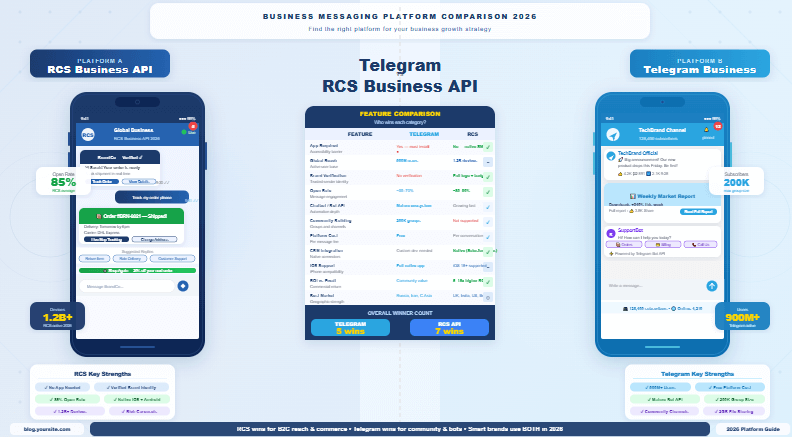
Telegram, the privacy-focused, app-based messaging platform with over 900 million active users, has evolved from a consumer chat tool into a formidable business messaging channel with channels, bots, and a growing ecosystem of business tools. RCS (Rich Communication Services) — delivered via the RCS Business API — is the carrier-level upgrade to SMS, built directly into the native messaging app on Android and iOS devices, requiring no app download whatsoever.
Both platforms offer rich media, interactive messaging, and automation capabilities. But they target fundamentally different audiences, operate on fundamentally different infrastructure, and deliver fundamentally different results depending on your use case, your market, and your business model.
This comprehensive guide compares Telegram and RCS across every dimension that matters to business decision-makers in 2026 — from reach and pricing, to security, automation, industry use cases, and a definitive verdict for each business scenario.
Platform Overview: Telegram and RCS in 2026
What Is Telegram for Business?
Telegram is a cloud-based messaging app founded in 2013 by Pavel Durov. It is available on all major platforms — Android, iOS, Windows, Mac, and Linux — and has grown to over 900 million monthly active users globally. For businesses, Telegram offers several distinct tools: Telegram Channels (broadcast-only, unlimited subscribers), Telegram Groups (up to 200,000 members with bot moderation), Telegram Bots (automated accounts that can handle complex interactions), and Telegram Business (a suite of features for commercial messaging introduced in 2024 and expanded in 2025–2026).
Telegram's key
differentiators are its strong privacy credentials (end-to-end encryption in
Secret Chats, strong server-side encryption elsewhere), its open Bot API, its
zero advertising in core features, and its dominant position in specific
geographic markets — particularly Russia, Ukraine, Iran, and parts of Central
Asia and Eastern Europe. In 2026, Telegram has also expanded its monetisation
features including paid channels, Telegram Stars (in-app currency), and premium
subscription tools.
What Is RCS Business Messaging (RCS Business API)?
RCS (Rich Communication Services) is the next-generation messaging standard built directly into the native messaging app on Android (Google Messages) and iOS (Messages, since iOS 18). Unlike Telegram, RCS requires no app download — it works through the device's default messaging application, making it accessible to virtually every smartphone owner without any deliberate opt-in to a separate platform.
The RCS Business API (also called the RBM API) allows businesses to send verified, branded, interactive messages to any RCS-enabled device. Messages appear with the business's verified name, logo, and colour scheme. The API supports rich cards, carousels, action buttons, suggested replies, file sharing, payment integration, and AI chatbot flows. As of 2026, RCS is active on over 1.2 billion devices across 60+ countries, with rapid growth continuing as Apple's iOS adoption expands the addressable audience.
|
900M+ Telegram Monthly Users requires app install |
1.2B+ RCS-Active Devices native — no app needed |
60+ Countries — RCS via Google RBM platform |
180+ Countries — Telegram available worldwide |
Telegram vs RCS: Head-to-Head Feature Comparison
The table below compares Telegram and RCS across 20 key dimensions that matter to business decision-makers. The 'Winner' column indicates which platform has the stronger position for each feature in the context of business messaging.
|
Feature |
Telegram |
RCS Business API |
Winner |
|
App
Required |
Yes — users
must install Telegram |
No — works
in native SMS app |
RCS |
|
Global
Reach |
900M+ users
in 180+ countries |
1.2B+ devices
in 60+ countries |
Both |
|
Verified
Brand Identity |
No official
verification system |
Verified
name, logo, colour per message |
RCS |
|
Rich Media
Support |
Images,
video, audio, files, stickers |
Images,
video, audio, cards, carousels |
Both |
|
Interactive
Buttons |
Inline
keyboard buttons via Bot API |
Action +
quick-reply chips — native |
RCS |
|
Broadcast
Messaging |
Channels —
unlimited subscribers |
API broadcast
to opted-in numbers |
Telegram |
|
Chatbot /
Automation |
Full Bot
API — highly mature ecosystem |
RBM Flows +
AI NLP — rapidly growing |
Telegram |
|
Community
Building |
Groups
(200K members), channels |
Not designed
for community features |
Telegram |
|
End-to-End
Encryption |
Secret
Chats only (not default groups) |
Encryption in
transit; varies by carrier |
Telegram |
|
Pricing
Model |
Free
platform; Bot hosting costs vary |
Per-conversation
(RBM pricing by market) |
Telegram |
|
iOS
Support |
Native iOS
app — full feature parity |
iOS 18+ via
Apple Messages (2024+) |
Telegram |
|
Older
Device Support |
Any device
with app installed |
Requires
RCS-capable device + carrier |
Telegram |
|
Payment
Integration |
Telegram
Payments (Stripe, etc.) |
Market-specific
(India, Brazil, expanding) |
Both |
|
Analytics
& Reporting |
Basic —
third-party tools needed |
Native
delivery, read, click analytics |
RCS |
|
Customer
Opt-In |
User joins
channel/group voluntarily |
Explicit
phone number opt-in required |
Telegram |
|
Branding
Per Message |
Profile pic +
name only |
Full logo,
colour, verified badge |
RCS |
|
No-Code
Flow Builder |
Limited —
requires Bot development |
Available
via BSP platforms (Sinch, etc.) |
RCS |
|
CRM
Integration |
API-based;
custom dev needed |
Native BSP
integrations (Salesforce, etc.) |
RCS |
|
Geographic
Dominance |
Russia, Iran,
Ukraine, C.Asia |
UK, India,
Brazil, Germany, USA, Nigeria |
Market-specific |
|
Regulatory
Compliance |
Complex —
data residency concerns |
GDPR,
PDPA, LGPD via BSP platforms |
RCS |
Deep-Dive Comparisons: The Metrics That Matter Most
1. Reach & Audience Accessibility
This is the most fundamental difference between Telegram and RCS, and it is one that business decision-makers frequently underestimate.
Telegram's 900 million users are an active, opted-in community of people who have chosen to install and use the app. This is a significant base — but it is self-selected. To receive messages from your business on Telegram, a customer must: know Telegram exists, have it installed on their device, actively find your channel or bot, and choose to subscribe or initiate contact. Every one of those steps creates friction that reduces your accessible audience.
RCS has no such
barriers. Because it is built into the native messaging app on Android and iOS
devices, any RCS-enabled smartphone user is potentially reachable — with no app
download, no account creation, and no deliberate platform choice required. The RCS
message arrives in the same app where they receive their texts from friends and
family. The accessibility gap between the two platforms is enormous,
particularly for B2C brands targeting mainstream consumers rather than
tech-savvy early adopters.
|
✔
VERDICT: RCS wins on reach for mainstream B2C audiences For niche communities and markets with
high Telegram penetration, Telegram's self-selected audience can be more
valuable than a larger but less engaged RCS broadcast list. |
2. Messaging Rich Media and Interactivity
Both platforms support rich media — but there are meaningful differences in how that richness is experienced.
Telegram is genuinely excellent at media delivery. Files up to 2GB can be shared (versus RCS's more variable file size limits), inline sticker packs have become a cultural phenomenon on the platform, and Telegram's native video and audio message formats are among the best in any messaging app. For brands building content-rich community experiences — newsletters, media channels, entertainment brands — Telegram's media capabilities are formidable.
RCS Business API messages, however, are designed specifically for commercial interactivity. Rich cards with image, title, description, and up to two action buttons. Carousels of multiple cards for product showcasing. Suggested reply chips for guided conversation flows. Payment request buttons. Location sharing. These interactive elements are rendered natively within the messaging interface without any redirection to an external app or browser. For brands focused on driving specific commercial actions — purchases, appointments, support resolution — RCS's interactive format outperforms Telegram's in controlled testing.
|
✔
VERDICT: RCS wins for commercial interactivity Telegram wins for large file sharing,
media-rich content channels, and sticker/community culture engagement. |
3. Chatbot & Automation Capabilities
Telegram has a significant head start in the chatbot ecosystem. The Telegram Bot API, launched in 2015, has had nearly a decade to mature. There are thousands of pre-built Telegram bot frameworks, open-source libraries, and developer communities built around it. Telegram bots can do extraordinary things — from complex e-commerce flows to customer service automation, payment processing, mini-apps, and even games. The bot ecosystem is one of Telegram's genuine competitive advantages.
RCS chatbot capabilities in 2026 have matured significantly through BSP platforms. Sinch, Infobip, Vonage, Twilio, and others now offer visual flow builders with NLP intent recognition and large language model integration that make deploying sophisticated RCS chatbot experiences accessible to non-technical teams. However, the depth of the developer community and the range of pre-built components still lags behind Telegram's more mature ecosystem.
That said, for most business chatbot use cases — FAQ handling, order tracking, appointment booking, lead qualification — both platforms deliver more than adequately. The Telegram advantage is most pronounced for highly complex, custom-built bot applications that require deep developer investment.
|
✔
VERDICT: Telegram wins on chatbot ecosystem maturity RCS is closing the gap fast in 2026
with AI-powered no-code flow builders suitable for most B2C automation needs. |
4. Security & Privacy
Security is one of Telegram's most prominent selling points — and one of its most nuanced. Telegram offers end-to-end encryption only in 'Secret Chats' between two individuals. Regular group chats, channels, and bot conversations use server-side encryption (client-to-server), where Telegram's servers can theoretically access message content. This is a meaningfully different security posture than platforms like Signal or WhatsApp, where E2E encryption is the default.
For business messaging specifically, Telegram's privacy reputation — while strong in consumer perception — has faced scrutiny following regulatory actions and founder Pavel Durov's arrest in France in 2024, which raised questions about the platform's cooperation with law enforcement and data governance practices.
RCS Business API messages are encrypted in transit between the device and the carrier/server infrastructure, but the standard is not end-to-end encrypted by default. For business messaging contexts — notifications, marketing, support — this is generally considered appropriate and sufficient. The verified sender identity system in RCS actually provides stronger anti-phishing and anti-fraud protection than Telegram, where any account can impersonate a brand with no verification barrier.
|
✔
VERDICT: Context-dependent — neither has clear advantage Telegram wins for consumer privacy
perception. RCS wins for brand verification and anti-fraud protection. For
regulated industries, evaluate both against your specific compliance
requirements. |
5. Pricing & Commercial Model
Telegram is free to use for businesses. There are no platform fees for creating bots, channels, or running broadcast messaging. The costs of a Telegram business presence are primarily development costs for bot creation and maintenance, and server/hosting costs if you are running complex bot infrastructure. Telegram Premium subscriptions are available for end users, and Telegram now offers paid promotion features for channels — but the core business messaging functionality has no per-message cost.
RCS Business API messaging uses a per-conversation pricing model (where each 24-hour conversation window is billed) or per-message pricing depending on the provider. Costs vary by market — from as low as $0.004 per conversation in India to $0.085+ in Western Europe for marketing messages. At scale, these costs are generally lower than equivalent email marketing platform costs on a per-engaged-customer basis, given RCS's dramatically higher open and conversion rates. However, for brands with very limited budgets or very high message volumes, the per-message cost model requires careful financial planning.
|
✔
VERDICT: Telegram wins on base cost — RCS wins on ROI Telegram has zero per-message cost.
RCS has measurable per-message cost but delivers 3–15x higher ROI per message
sent versus other paid digital channels. |
Telegram vs RCS: Which Platform Wins by Industry?
The right platform depends enormously on your industry, your customer base, and your communication objectives. Here is a market-by-market and industry-by-industry analysis.
|
Industry |
Why Telegram Works |
Why RCS Works Better |
2026 Verdict |
|
E-Commerce
& Retail |
Community
groups, product channels, flash sale broadcasts to subscribers |
Verified
abandoned cart recovery, product carousels, one-tap checkout, order tracking |
RCS — higher
conversion on transactional flows |
|
Financial
Services |
Premium
investor communities, crypto/trading signal channels |
OTP
authentication, fraud alerts, account updates, verified sender builds trust |
RCS —
regulation & verification advantage |
|
Healthcare |
Patient
community groups, wellness content channels |
Appointment
reminders, prescription alerts, compliance-grade messaging |
RCS —
HIPAA/GDPR compliance & verification |
|
Education |
Student
communities, class groups, alumni channels |
Fee
reminders, admissions journeys, attendance alerts, payment flows |
Split —
Telegram for community, RCS for admin |
|
Travel
& Hospitality |
Travel
community channels, destination content |
Boarding
passes, itinerary updates, hotel check-in flows |
RCS —
transactional update superiority |
|
Media
& Publishing |
News
channels, content distribution, subscriber communities |
Breaking news
alerts, subscription renewal, event notifications |
Telegram —
content channel ecosystem |
|
Technology
& SaaS |
Developer
communities, product update channels, support bots |
Onboarding
sequences, billing alerts, support ticket flows |
Split —
Telegram for community, RCS for ops |
|
FMCG &
Consumer Brands |
Brand
ambassador groups, loyalty communities |
Promotional
campaigns, loyalty point updates, product launches |
RCS — scale
and reach advantage |
|
Real
Estate |
Property
listing channels, investor groups |
Viewing
appointment reminders, document requests, mortgage alerts |
RCS —
verification builds buyer trust |
|
NGO &
Non-Profit |
Volunteer
communities, campaign groups |
Donation
campaigns, event reminders, supporter journeys |
Telegram —
community building strength |
Geographic Market Analysis: Where Telegram Leads and Where RCS Wins
Geographic market context is critical in the Telegram vs RCS decision. The right platform for a brand in Germany may be entirely different from the right platform for the same brand expanding into Russia or Indonesia.
Markets Where Telegram Has a Significant Advantage
•
Russia — Telegram is the
dominant messaging platform following the blocking of other services; essential
for any brand targeting Russian consumers
•
Ukraine — Very high
Telegram penetration driven by news and communications during the ongoing
conflict; key for humanitarian, media, and regional brands
•
Iran — Telegram retains
dominant position despite periodic government restrictions; strong for diaspora
and international brands
•
Central Asia (Kazakhstan,
Uzbekistan, Kyrgyzstan) — Telegram is the primary social and news channel in
these markets
•
Eastern Europe broadly —
Higher Telegram penetration than Western Europe across Poland, Romania, and the
Baltics
•
Crypto / Web3 / Fintech
communities globally — Telegram is the de facto communication platform for this
sector worldwide
• Developer and technical communities — Telegram Groups and bots are deeply embedded in global developer culture
Markets Where RCS Has a Significant Advantage
•
United Kingdom — High RCS
carrier support, strong consumer adoption via Google Messages and iOS 18;
preferred for B2C retail, finance, and healthcare
•
India — Very high RCS
penetration given Android dominance; major operators (Airtel, Jio, Vi) all
support RCS; booming RCS commerce ecosystem
•
Brazil — Strong RCS
adoption on Android; WhatsApp remains dominant but RCS growing rapidly for
business-to-consumer transactional messaging
•
Germany, France, Spain —
Growing RCS adoption with telco support; preferred for regulated industries
requiring verified sender identity
•
United States — RCS now
supported across all major carriers (AT&T, T-Mobile, Verizon) following
2023 rollout; growing fast in retail and healthcare
•
Australia — High Android
penetration drives strong RCS adoption; preferred for transactional and
marketing messaging
•
Nigeria, South Africa —
Rapid RCS growth as Android devices dominate and carriers deploy RCS
infrastructure
• Indonesia, Philippines — Growing RCS base driven by Android market share; key for e-commerce and fintech brands
How to Choose: A Decision Framework for Business Leaders
Use this framework to make the Telegram vs RCS decision for your specific business context. Answer each question honestly — the pattern of answers will point clearly to the right choice.
|
Question to Ask Yourself |
If Telegram |
If RCS |
|
What is
the primary goal of my messaging programme? |
Community
building / content distribution |
Transactional
messaging / marketing automation |
|
Where is
my primary customer base located? |
Russia, Iran,
C.Asia, crypto communities |
UK, India,
Brazil, Germany, USA, Nigeria |
|
Does my
audience have Telegram installed? |
Yes —
confirmed high penetration |
Unknown or
mixed — cannot assume app install |
|
Do I need
verified brand identity in every message? |
No — brand
name via profile is sufficient |
Yes —
regulated industry or trust-sensitive brand |
|
What is my
budget model for messaging? |
Zero
per-message cost is essential |
Per-message/conversation
cost is acceptable |
|
Do I need
deep CRM and e-commerce integration? |
Have dev
resources to build custom |
Need
pre-built no-code integrations |
|
How
important is regulatory compliance (GDPR, HIPAA etc.)? |
Willing to
manage compliance independently |
Prefer
compliance framework from BSP partner |
|
Do I need
chatbots with complex custom logic? |
Yes —
Telegram Bot API is more mature |
Standard
flows — visual builder is sufficient |
|
Am I
building a media / content channel brand? |
Yes —
Telegram Channels excel at this |
No —
notifications and commerce focus |
|
Do I need
iOS feature parity without app download? |
Yes —
Telegram iOS app is full featured |
Yes — RCS on
iOS 18 covers native messaging |
The 60-Second Verdict by Business Type
|
Business Type |
Recommended Platform |
Primary Reason |
|
B2C
Retailer / E-commerce |
RCS |
Abandoned
cart recovery, product carousels, order tracking — all native, no app needed |
|
B2B SaaS /
Technology |
Telegram + RCS |
Telegram for
developer community; RCS for onboarding & billing notifications |
|
Financial
Services / Banking |
RCS |
Verified
sender essential; compliance-grade messaging; OTP authentication |
|
Healthcare
/ Pharma |
RCS |
Regulatory
compliance, verified identity, appointment and prescription flows |
|
Media /
Content Publisher |
Telegram |
Channels for
content distribution; subscriber communities; monetisation tools |
|
Travel
& Hospitality |
RCS |
Boarding
passes, hotel check-in, itinerary updates — all native in messaging app |
|
NGO /
Non-Profit |
Telegram |
Free,
community-native, volunteer groups, global reach at zero platform cost |
|
Crypto /
Web3 / Blockchain |
Telegram |
De facto
platform for this sector globally; ecosystem, bots, community |
|
Education
(Schools / Universities) |
Both |
Telegram for
student communities; RCS for admin, fee payments, and parent comms |
|
FMCG /
Consumer Brands |
RCS |
Scale,
verified branding, promotional campaigns to mass consumer audiences |
|
Real
Estate / Mortgage |
RCS |
Verified
sender builds buyer trust; document requests; appointment flows |
|
Regional
brand — CIS / Eastern Europe |
Telegram |
Telegram
dominates in Russia, Ukraine, Kazakhstan — unavoidable for these markets |
Telegram vs RCS: Full Pros and Cons for Business
Telegram for Business — Pros and Cons
|
PROS |
CONS |
|
Free platform
— no per-message cost |
Requires app
installation — limits mass consumer reach |
|
900M+ active
users globally |
No verified
sender system — brand impersonation risk |
|
Mature Bot
API with large developer ecosystem |
Secret Chat
E2E only — groups not end-to-end encrypted |
|
Powerful
community tools (groups up to 200K) |
Basic native
analytics — third-party tools needed |
|
Large file
sharing (up to 2GB) |
Complex
regulatory position in some markets |
|
Dominant in
key markets (Russia, Iran, C.Asia) |
No native BSP
integrations — custom dev often needed |
|
Open API —
highly customisable |
Reputation
risk following 2024 regulatory events |
|
Telegram
Channels — unlimited broadcast subscribers |
Limited brand
identity controls within messages |
|
Cross-platform
iOS/Android/Desktop parity |
App-dependent
— not accessible on all devices |
|
Mini Apps
ecosystem for in-app experiences |
Telegram
Premium monetisation still evolving |
RCS Business API — Pros and Cons
|
PROS |
CONS |
|
No app
download — native in device messaging app |
Per-message/conversation
cost (varies by market) |
|
Verified
brand name, logo, and colour per message |
Requires
RCS-capable device and carrier support |
|
Native on
Android + iOS 18+ |
Not available
in all countries (60+ vs Telegram's 180+) |
|
Rich cards,
carousels, action buttons, payments |
No
community/group features — one-to-one/broadcast only |
|
Full delivery
and read receipt analytics |
iOS RCS
feature set still slightly limited vs Android |
|
GDPR/PDPA/LGPD
compliance via BSP platforms |
Opt-in
consent required — cannot cold-message at scale |
|
Pre-built
no-code flow builders via BSPs |
Chatbot
ecosystem less mature than Telegram Bot API |
|
Seamless CRM
and e-commerce integrations |
Agent
registration and verification takes 1–4 weeks |
|
Highest open
rates of any digital channel (85%+) |
Green tick
verification not available to all businesses |
|
5–15x ROI vs
email in commercial campaigns |
Market
coverage still expanding — not all operators live |
Frequently Asked Questions: Telegram vs RCS for Business 2026
These FAQs are structured for Google's People Also Ask feature. Add FAQPage JSON-LD schema markup when publishing.
Conclusion: Telegram vs RCS — The Answer Depends on Who You Are
There is no single correct answer to the Telegram vs RCS question in 2026 — and any guide that claims otherwise is oversimplifying a genuinely nuanced decision. Both platforms are powerful, both are growing, and both deliver real commercial value for businesses that deploy them thoughtfully.
RCS wins when you need to reach mainstream consumers at scale, when verified brand identity matters, when seamless integration with e-commerce and CRM platforms is a priority, and when you are operating in markets where Android and iOS RCS penetration is high. If you are a B2C brand with a mass consumer audience, transactional messaging needs, and markets in the UK, India, USA, Brazil, or Germany — RCS should be at the centre of your 2026 messaging strategy.
Telegram wins when community is your product, when your audience has already opted into the Telegram ecosystem, when developer-extensible bot functionality is essential, when your market is dominated by Telegram (Russia, Central Asia, crypto/Web3), or when zero per-message cost is a hard constraint. If you are building engaged audiences, distributing content, or operating in Telegram-dominant markets — it is not just an option, it is often a necessity.
The smartest
brands in 2026 are not asking 'Telegram or RCS?' They are asking 'How do we use
each platform for the use cases and markets where it excels?' Build that
strategy, execute it well, and you will be ahead of the vast majority of your
competitors — most of whom are still treating business messaging as an
afterthought.
|
Q: Is Telegram better than
RCS for business messaging? |
|
A:
It depends entirely on your use case and target market. Telegram is better
for community building, content distribution, bot-heavy applications, and
markets like Russia and Central Asia where Telegram has dominant penetration.
RCS is better for mass-market B2C messaging, verified brand communications,
transactional notifications, and markets where Android and iOS RCS are widely
supported (UK, India, USA, Brazil, Germany). For most mainstream B2C brands,
RCS delivers higher reach and better commercial ROI. For community-focused or
market-specific strategies, Telegram often wins. |
|
Q: Does RCS work on iPhones
in 2026? |
|
A:
Yes. Apple added native RCS support in iOS 18, released in September 2024.
This means RCS Business Messages — including rich cards, suggested replies,
and action buttons — are now delivered to iPhone users in most markets
through the native Messages app. As of 2026, the vast majority of active
iPhones support RCS, significantly expanding the total addressable audience
for RCS Business API campaigns beyond Android-only reach. |
|
Q: Can I use both Telegram
and RCS for my business? |
|
A:
Absolutely — and for many businesses, using both is the optimal strategy. A
brand might use Telegram to build an engaged community of loyal customers,
brand advocates, and a developer ecosystem, while simultaneously using the
RCS Business API for transactional messaging, marketing campaigns, and
customer service automation across its full consumer base. The two platforms
are complementary rather than mutually exclusive, and a well-designed
omnichannel messaging strategy can leverage the unique strengths of each. |
|
Q: Is RCS more secure than
Telegram for business communications? |
|
A:
Both platforms have different security profiles suited to different needs.
Telegram offers end-to-end encryption only in Secret Chats — standard group
messages and bot communications use server-side encryption. RCS Business API
messages are encrypted in transit but not end-to-end encrypted by default.
However, RCS has a significant advantage in verified sender identity — every
RCS Business message comes from a verified, authenticated business agent,
providing strong protection against phishing and brand impersonation. For
regulated industries (finance, healthcare), both platforms require evaluation
against specific regulatory frameworks. |
|
Q: How much does it cost to
use Telegram vs RCS for business? |
|
A:
Telegram's core business messaging features are free — there are no
per-message fees for broadcasting to channels or running bots. Primary costs
are development time for bots and any server infrastructure. RCS Business API
messaging is priced per message or per 24-hour conversation window, varying
by market and provider. Costs range from approximately $0.004 per
conversation in India to $0.085+ for marketing messages in Western Europe.
While RCS has a higher base cost, brands consistently achieve 5–15x higher
ROI per message due to dramatically better open rates and conversion rates
versus other digital channels. |
|
Q: Which is better for
e-commerce — Telegram or RCS? |
|
A:
For e-commerce, RCS is generally the stronger platform in 2026. RCS Business
API's native product carousels, verified sender identity, one-tap checkout
buttons, order tracking notifications, and abandoned cart recovery flows —
all delivered without any app download — deliver superior conversion rates
compared to Telegram-based e-commerce flows, which require the customer to
have Telegram installed and actively use the bot. RCS e-commerce campaigns
consistently deliver abandoned cart recovery rates of 25–35% and checkout
completion rates that outperform email and SMS significantly. |
|
Q: Will Telegram or RCS
grow faster in 2026 and beyond? |
|
A:
Both platforms are growing, but in different directions. RCS is growing
fastest in terms of total addressable device count — Apple's iOS adoption has
added hundreds of millions of newly reachable devices, and carrier
deployments continue to expand in new markets. Telegram's user growth has
also been strong, particularly in privacy-conscious markets and following
news events that drive users away from other platforms. In terms of business
messaging revenue and commercial deployment volume, RCS is growing faster in
2026 as enterprise brands shift budget from SMS and email to RCS campaigns.
Both platforms will be relevant and growing through 2026 and beyond. |