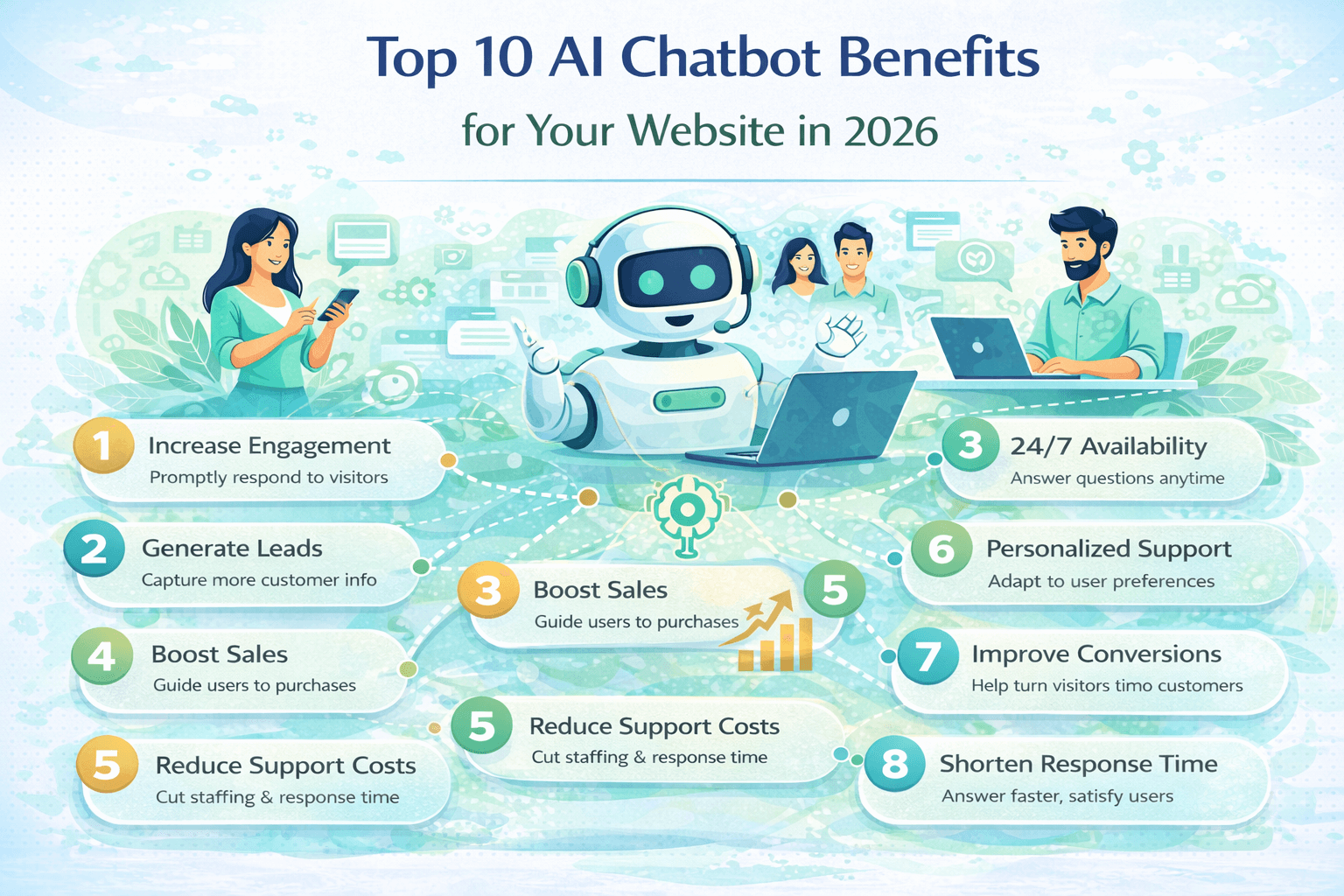
Top 10 AI Chatbot Benefits for Your Website in 2026
Discover the top 10 benefits of adding an AI chatbot to your website in 2026 — from 24/7 support and lead capture to SEO improvements and cost savings.
Top 10 Benefits of an AI Chatbot for Your Website (2026)
Your
website is open 24 hours a day, 7 days a week — but is it working for you
around the clock? Every minute that passes without engaging a visitor,
answering a question, or capturing a lead is a missed revenue opportunity. In
2026, AI chatbots have become the most cost-effective tool businesses of all
sizes use to transform their passive websites into active, intelligent sales
and support engines.
The
numbers are compelling. Businesses that deploy AI chatbots on their websites
report average revenue increases of 23-35% from improved lead capture alone,
customer support cost reductions of 30-50%, and customer satisfaction
improvements of 20-40%. These are not projections — they are benchmarks from
thousands of live deployments across e-commerce, SaaS, healthcare, real estate,
education, and financial services.
But what exactly does an AI chatbot do, and which specific benefits can your business realistically expect? This guide breaks down the top 10 proven benefits of adding an AI chatbot to your website in 2026 — with real data, industry-specific examples, and practical implementation guidance for each one.
|
💡 What Is an AI Website Chatbot in 2026? A 2026 AI
website chatbot is a conversational AI system — typically powered by large
language models (LLMs) like GPT-4, Claude, or Gemini — that lives on your
website and engages every visitor in real time. Unlike rule-based chatbots of
the past, modern AI chatbots understand natural language, remember context
within conversations, personalise responses based on visitor behaviour, and
handle thousands of simultaneous conversations without any human involvement. |
|
24/7 Always-on engagement |
67% Of users prefer chat for support |
3X Faster lead response time |
40% Average support cost reduction |
The
single most universally valuable benefit of an AI chatbot is simple: it never
sleeps. Your website receives visitors at 2 AM on Sunday, on national holidays,
during your team's lunch breaks, and in every timezone around the world.
Without a chatbot, every one of those off-hours visitors leaves without getting
help. With an AI chatbot, every visitor gets an instant, intelligent response —
every time.
The Business Case for 24/7 Availability
Consider
the economics: hiring a customer support agent in India costs ₹20,000-50,000
per month. That agent works 8 hours a day, 5-6 days a week — leaving 16 hours a
day completely unserved. Adding a second shift costs double. A third shift
covering weekends costs triple. One AI chatbot subscription covers 24/7 support
at a fraction of the cost of a single human agent.
● Average
off-hours website traffic: 35-45% of
total daily visitors arrive outside business hours
● Conversion
rate drop after 5 minutes: If a visitor
does not get a response within 5 minutes, conversion likelihood drops by 80%
● AI chatbot
response time: Under 3 seconds — every
single time, regardless of query complexity
● Cost comparison: AI chatbot ₹2,000-15,000/month vs human agent ₹25,000-50,000/month
Real-World Applications by Industry
● E-commerce:
Handle order status queries, return requests, product questions at midnight —
peak shopping hours in India
● Healthcare:
Answer appointment queries, symptom FAQs, insurance questions outside clinic
hours
● Real
estate: Respond to property enquiries within 60 seconds — even when agents are
unavailable
● SaaS/Tech: Provide technical support and onboarding help during global off-hours
The
average website converts only 2-4% of visitors into leads. That means 96-98% of
people who find your website, show enough interest to visit, and spend time on
your pages — leave without giving you any contact information. This is the most
expensive problem in digital marketing, and AI chatbots are the most effective
solution.
A
well-configured AI chatbot proactively engages visitors at the right moment —
when they have been on a product page for 30 seconds, when they are about to
exit, or when they arrive from a specific ad campaign. It asks qualifying
questions conversationally, collects contact details naturally, and routes hot
leads to your sales team instantly.
The Lead Qualification Framework
Modern
AI chatbots use a BANT-style qualification framework delivered
conversationally:
1. Budget:
'What is your approximate budget for this solution?' — delivered as a
quick-reply button choice
2. Authority:
'Are you the decision-maker for this purchase, or would others be involved?' —
identifies influencer vs buyer
3. Need:
'What is your biggest challenge with [relevant area] right now?' — captures
pain point for personalised follow-up
4. Timeline:
'When are you looking to implement/buy/move forward?' — filters urgent vs
exploratory leads
This qualification data is captured automatically, scored, and pushed to your CRM — giving your sales team fully qualified leads instead of raw email addresses.
Lead Capture Metrics
|
Metric |
Without Chatbot |
With AI Chatbot |
|
Website
Conversion Rate |
2-4% |
5-12% (+3x) |
|
Lead
Qualification Rate |
20-30% (manual) |
85-95% (automated) |
|
Time to First
Response |
Hours to days |
Under 3 seconds |
|
Cost Per
Qualified Lead |
₹500–₹5,000 |
₹80–₹400 |
|
Leads
Captured After Hours |
~0% |
35-45% of total |
Customer
support is one of the largest operational costs for any business with a
significant customer base. AI chatbots do not replace your support team — they
handle the repetitive, high-volume, low-complexity queries that consume 60-80%
of your support team's time, freeing human agents to focus on complex,
high-value interactions that require empathy, judgment, and expertise.
What AI Chatbots Handle vs What Humans Handle
|
AI Chatbot
Handles (60-80% of volume) |
Human Agents
Handle (20-40% of volume) |
|
● Order
status and tracking queries ● FAQs
about products, pricing, policies ● Password
reset and account access ● Appointment
scheduling and rescheduling ● Return
/ refund process initiation ● Standard
troubleshooting steps ● Business
hours and location queries ● Onboarding
checklist guidance |
● Complex
complaints requiring investigation ● High-value
sales and negotiation ● Emotional
support and escalations ● Exceptions
outside standard policy ● Technical
debugging for edge cases ● Legal
or compliance-sensitive issues ● VIP
customer relationship management ● New
product feedback and insights |
The financial impact is substantial. A company handling 10,000 support queries per month at ₹120 per human-handled query (salary + overhead) pays ₹12 lakh per month. If an AI chatbot handles 70% of those queries at ₹2 per automated query, the remaining 30% of queries still need human handling — but total monthly cost drops from ₹12 lakh to ₹2.4 lakh. Annual savings: approximately ₹1.15 crore.
An
AI chatbot on your website is not just a support tool — it is an active sales
assistant that engages every visitor, understands their needs, recommends the
right products or services, handles objections in real time, and guides them to
checkout. Done well, AI chatbot sales assistance increases conversion rates by
20-40% and average order values by 10-25%.
How AI Chatbots Drive Sales
● Proactive
engagement: The chatbot greets
high-intent visitors (those spending 30+ seconds on product pages) before they
leave — capturing sales opportunities that would otherwise be lost
● Personalised
recommendations: 'Based on what you have
looked at, I think you would love X' — AI recommendations outperform static
'Related Products' by 3-5x
● Objection
handling: When a visitor says 'It is too
expensive', the AI can offer a payment plan, highlight the value, or surface a
current promotion — all without a human agent
● Abandoned
cart recovery: Real-time detection of
cart abandonment triggers a chatbot conversation: 'I noticed you left something
behind — can I help with any questions?' Recovers 15-25% of abandoned carts
● Upsell and cross-sell: At checkout, the AI suggests complementary products or higher-tier plans based on what is in the customer's cart — adding 10-25% to average order value
Customer
experience is the number one competitive differentiator in 2026. Businesses
with superior customer experience grow revenue 4-8% faster than their
competitors and achieve 60% higher customer lifetime value. AI chatbots improve
customer experience across four critical dimensions: speed, accuracy,
consistency, and personalisation.
The Four CX Pillars AI Chatbots Transform
● Speed — Instant gratification: The average customer support wait time via phone is 11 minutes; via email, 12 hours. An AI chatbot responds in under 3 seconds. This alone drives significant satisfaction improvement — 90% of customers rate 'immediate response' as important or very important when they have a query.
● Accuracy — Always-current knowledge: Unlike human agents who forget policies, give inconsistent answers, or haven't been trained on the latest product update, an AI chatbot always pulls from your most current knowledge base. Accuracy rates of 92-97% are typical for well-configured AI chatbots vs 78-85% for human agents handling high volumes.
● Consistency — Same quality every time: Your best human agent has great days and difficult days. The AI chatbot delivers the same quality, tone, and accuracy at 3 AM on a Monday as it does at 10 AM on a Friday. Customers who interact with your chatbot always get your best answer.
● Personalisation — Remembers everything: A well-integrated AI chatbot knows the customer's name, purchase history, past queries, and preferences. It addresses them personally and tailors every response to their specific context — 'Hi Priya, I see your last order was the blue kurta in size M — are you looking for something similar today?'
Customer Satisfaction Metrics
|
4.2/5 Avg Chatbot CSAT |
92% Query Resolution Rate |
<3s Response Time |
67% Prefer Chat vs Call |
Your
AI chatbot has thousands of conversations with your website visitors every
month. Each of those conversations is a goldmine of business intelligence —
what questions people ask, what objections stop them from buying, what they
cannot find on your website, what features they most want, and what competitors
they are comparing you with.
Most
businesses collect website analytics that tell them where visitors click — but
not why they leave, what confused them, or what almost made them buy. AI
chatbot analytics provide the missing 'why' layer.
What AI Chatbot Analytics Reveal
● Top
visitor questions: What your website is
failing to answer clearly — each top FAQ is a content improvement opportunity
● Objection
patterns: The most common reasons people
don't buy — price, feature gaps, competitor comparisons, trust issues — with
exact frequency data
● Drop-off
moments: Where in the conversation do
people disengage — identifies friction points in your sales funnel
● Product
interest signals: Which products,
features, or plans generate the most chatbot enquiries — direct input for your
product roadmap
● Seasonal
demand shifts: How visitor questions
change month-to-month — informs your content calendar and promotional planning
● Competitor mentions: How often and in what context visitors mention competitors — real competitive intelligence from your own traffic
This analytics layer transforms your chatbot from a cost center into a strategic business intelligence tool. Product teams use chatbot conversation data to prioritise features. Marketing teams use it to improve website copy. Support teams use it to build better self-service content. Sales teams use it to refine their pitches.
One
of the most powerful economic benefits of AI chatbots is their ability to scale
instantly and infinitely at near-zero marginal cost. When your business runs a
major promotion, gets featured in a viral social post, or simply has a busy
seasonal period — your AI chatbot handles the surge without any additional
cost, staffing, or preparation.
The Scalability Advantage in Practice
Consider
a D2C brand running a Diwali sale. On a typical day, their website chatbot
handles 500 conversations. During the 48-hour peak sale period, that number
spikes to 8,000 conversations. With a human support team, this would require
emergency staffing, overtime pay, and still likely result in unacceptable wait
times. With an AI chatbot, the 8,000 conversations are handled simultaneously,
each with the same quality and speed as any other day. The additional cost:
essentially zero.
● Simultaneous
conversations: One AI chatbot can handle
unlimited parallel conversations — there is no queue, no wait time, no
degradation in quality
● Instant
language switching: Scale to new markets
overnight — configure the chatbot for Hindi, Tamil, or any other language
without hiring multilingual staff
● Product
expansion: Add new products to your
website and the chatbot answers questions about them immediately — no
retraining of staff needed
● Geographic expansion: Serve customers in new cities, states, or countries without opening local offices or hiring local support teams
India
is linguistically one of the most diverse markets in the world — with 22
officially recognised languages and hundreds of regional dialects. A business
that can only communicate in English is effectively locked out of the 600
million+ Indians who prefer to interact in their native language. AI chatbots
with multilingual capability break this barrier entirely.
Multilingual AI Chatbot Capabilities in 2026
Modern
AI chatbots powered by LLMs like GPT-4, Claude, and Gemini understand and
respond fluently in all major Indian languages — without requiring separate
bots or separate training. A customer can start a conversation in Hindi and
switch to English mid-conversation — the AI follows seamlessly.
● Hindi: Essential for NCR, UP, Rajasthan, MP, Bihar — 530 million
speakers
● Bengali: Critical for West Bengal and Northeast India — 100
million speakers
● Telugu: Required for Andhra Pradesh and Telangana — 82 million
speakers
● Marathi: Key for Maharashtra including Mumbai — 83 million
speakers
● Tamil: Important for Tamil Nadu and Chennai — 77 million
speakers
● Gujarati: Essential for Gujarat and Gujarati diaspora — 56 million
speakers
● Kannada: Important for Karnataka and Bengaluru — 44 million speakers
For businesses targeting tier-2 and tier-3 Indian cities — where the next 500 million internet users are coming from — multilingual AI chatbot support is not an optional enhancement. It is a fundamental requirement for market reach.
A
standalone AI chatbot is useful. An AI chatbot deeply integrated with your CRM,
calendar, inventory system, payment gateway, and marketing automation platform
is transformative. In 2026, the best AI chatbots do not just answer questions —
they take actions: booking appointments, updating CRM records, triggering
workflows, processing requests, and passing enriched lead data to your sales
team.
Key Integrations That Amplify Chatbot Value
● CRM
Integration (Salesforce, HubSpot, Zoho): Every
lead captured by the chatbot is automatically created in your CRM with full
conversation context, qualification data, and interest signals. Sales reps
receive warm, enriched leads instead of raw contact forms.
● Calendar
& Scheduling (Calendly, Google Calendar): The chatbot checks real-time availability and books
appointments directly — no back-and-forth email scheduling. Reduces
time-to-appointment by 80%.
● E-commerce
(Shopify, WooCommerce): The chatbot can
pull real-time inventory, check order status, initiate returns, and apply
discount codes — all within the conversation.
● Payment
Gateways (Razorpay, Paytm, Stripe): For
simple transactions (subscription renewals, document fees, service bookings),
the chatbot can process payments directly without redirecting to a checkout
page.
● Analytics
(Google Analytics, Mixpanel): Chatbot
interaction events are logged as custom events, enriching your website
analytics with conversation data.
● Marketing Automation (Mailchimp, Klaviyo): Leads captured by the chatbot are automatically added to relevant email sequences based on their product interest and qualification data.
Integration Impact by Business Type
|
Business
Type |
Key
Integration |
Specific
Benefit |
|
E-Commerce |
Shopify +
Razorpay |
Real-time
order tracking + one-click returns |
|
SaaS / Tech |
HubSpot +
Calendly |
Demo booking
+ lead scoring automation |
|
Healthcare |
Hospital HMS
+ Calendar |
Appointment
booking + patient record lookup |
|
Real Estate |
CRM + Maps +
WhatsApp |
Property
showcase + instant agent connect |
|
Education /
EdTech |
LMS + Payment
Gateway |
Course
enquiry + instant enrollment payment |
|
Financial
Services |
Core Banking
+ CRM |
Loan
eligibility + instant application start |
|
Hospitality |
PMS + Booking
Engine |
Room
availability + instant reservation |
This
is a benefit that surprises most business owners: an AI chatbot does not just
help visitors — it improves your Google search rankings. The mechanism is
indirect but powerful, working through the user experience metrics that Google
uses as ranking signals in 2026.
How AI Chatbots Boost SEO
● Lower
bounce rate: The most powerful SEO
signal a chatbot affects. When a visitor is about to leave and the chatbot
proactively engages them, bounce rate drops by 15-25%. Lower bounce rate
signals to Google that your content is valuable and relevant.
● Higher
time on site: Visitors who engage with a
chatbot spend 2-3x longer on your website. Average session duration is a key
Google ranking factor — longer sessions correlate directly with higher
rankings.
● More pages
per session: Chatbot recommendations
drive visitors to explore more of your website — 'Have you seen our pricing
page?' or 'Let me show you a case study about this'. More pages per session
improves your overall site engagement score.
● Lower
pogo-sticking: When users get their
questions answered on your site (instead of returning to Google to find a
better answer), you signal to Google that your page fully satisfied the search
intent. This is one of the strongest positive SEO signals available.
● Improved Core Web Vitals indirectly: By reducing frustration and improving user experience, chatbots reduce rage-clicks and rapid exits — negative signals that can indirectly drag down Core Web Vitals scores.
A B2B SaaS company that deployed an AI chatbot on their website saw their average session duration increase from 1 minute 45 seconds to 3 minutes 20 seconds, bounce rate drop from 68% to 49%, and pages per session increase from 1.8 to 3.2. Within 4 months, their target keywords climbed an average of 6 positions in Google search results — with zero additional SEO work beyond the chatbot deployment.
|
# |
Benefit |
Primary KPI |
Avg
Improvement |
Time to See
Impact |
|
1 |
24/7 Customer
Support |
Off-hours
leads captured |
+28% |
Week 1 |
|
2 |
Lead Capture
& Qualification |
Website
conversion rate |
+3x |
Week 2-4 |
|
3 |
Support Cost
Reduction |
Cost per
support ticket |
-40-60% |
Month 1-2 |
|
4 |
Sales
Conversion Boost |
Revenue per
visitor |
+20-40% |
Month 1-3 |
|
5 |
Customer
Experience |
CSAT score |
+20-35pts |
Month 1-2 |
|
6 |
Visitor
Insights & Analytics |
Actionable
insights/month |
10-50 new |
Month 1 |
|
7 |
Instant
Scalability |
Peak capacity |
Unlimited |
Immediate |
|
8 |
Multilingual
Support |
Tier-2/3
conversion rate |
+150-300% |
Week 1 |
|
9 |
CRM &
Tool Integrations |
Lead to CRM
time |
-95% |
Week 1-2 |
|
10 |
SEO &
Bounce Rate |
Organic
search ranking |
+6 pos avg |
Month 3-6 |
Choosing the right AI chatbot platform depends on your technical capability, business size, and specific use case. Here is a focused comparison of the most popular options:
|
Platform |
Best For |
No-Code? |
India Pricing |
Hindi/Regional |
Rating |
|
Tidio |
SMBs, e-commerce |
✅ Yes |
Free–₹2,500/mo |
✅ Yes |
⭐⭐⭐⭐½ |
|
Intercom |
SaaS, B2B |
✅ Yes |
₹4,500–₹18,000 |
✅ Yes |
⭐⭐⭐⭐⭐ |
|
Freshchat |
Support-heavy |
✅ Yes |
Free–₹3,000/mo |
✅ Yes |
⭐⭐⭐⭐½ |
|
Gupshup |
India-first, RCS+Web |
✅ Yes |
₹999–₹8,000/mo |
✅ 12 lang |
⭐⭐⭐⭐⭐ |
|
Botpress |
Developers, custom |
⚠️ Low |
Free–₹5,500/mo |
✅ Yes |
⭐⭐⭐⭐ |
|
ManyChat |
E-commerce, social |
✅ Yes |
Free–₹2,200/mo |
✅ Yes |
⭐⭐⭐⭐ |
|
Zoho SalesIQ |
CRM-integrated |
✅ Yes |
Free–₹1,500/mo |
✅ Yes |
⭐⭐⭐⭐½ |
Structured Data (FAQ Schema) — Paste in <head>
<script type="application/ld+json"> { "@context": "https://schema.org", "@type": "FAQPage", "mainEntity": [ { "@type": "Question", "name": "What are the main benefits of an AI chatbot for a website?", "acceptedAnswer": { "@type": "Answer", "text": "The top benefits include 24/7 customer support, automated lead capture, support cost reduction, higher sales conversion, improved customer experience, visitor analytics, instant scalability, multilingual support, CRM integrations, and better SEO through reduced bounce rates." } } ] } </script>
Category & Tags
● Category:
AI / Chatbots / Website
● Tags: #AIChatbot #WebsiteChatbot #ChatbotBenefits #AI2026 #LeadCapture #CustomerSupport #Automation #BusinessGrowth #IndiaAI #ConversionOptimization #ChatbotMarketing #AIForBusiness
The most common questions businesses ask before adding an AI chatbot to their website:
|
Q1: How much does an AI
chatbot for a website cost in India in 2026? |
|
AI chatbot
pricing in India ranges from free (basic plans from Tidio, Freshchat, Zoho
SalesIQ) to ₹1,500-18,000 per month for mid-market platforms (Intercom,
Gupshup, Freshchat Pro). Enterprise custom AI chatbots built on GPT-4 or
Claude cost ₹50,000-5,00,000+ for development plus ₹10,000-50,000/month for
API usage. For most Indian SMBs, a ₹1,500-5,000/month SaaS platform delivers
excellent ROI from week one. |
|
Q2: Can an AI chatbot
replace my human customer support team? |
|
Not entirely
— and you should not want it to. AI chatbots are best deployed to handle
60-80% of repetitive, high-volume, low-complexity queries (FAQs, order
status, basic troubleshooting), freeing your human agents to focus on complex
complaints, high-value sales, and emotionally sensitive interactions. The
result is not fewer staff — it is staff who spend more time on meaningful,
value-adding work while overall support quality and speed improve
dramatically. |
|
Q3: How long does it take
to set up an AI chatbot on a website? |
|
A basic AI
chatbot can be live on your website in as little as 30 minutes using no-code
platforms like Tidio, Freshchat, or Zoho SalesIQ — install a JavaScript
snippet, configure basic responses, and you are live. A more sophisticated
chatbot with custom knowledge base, CRM integration, and multiple
conversation flows typically takes 1-4 weeks to configure and test properly.
A fully custom enterprise chatbot with deep integrations takes 2-4 months to
build and deploy. |
|
Q4: Do AI chatbots work for
small businesses and startups? |
|
Yes — small
businesses often see the highest proportional ROI from AI chatbots because
the cost savings from replacing manual follow-up and support work are most
impactful at smaller scale. A 5-person startup that deploys a ₹2,000/month AI
chatbot can operate with the customer responsiveness of a 20-person team.
Free-tier chatbots from Tidio and Zoho SalesIQ allow even bootstrapped
businesses to start benefiting immediately with zero investment. |
|
Q5: Will an AI chatbot
actually improve my Google rankings? |
|
Indirectly,
yes. Google uses user experience signals — bounce rate, session duration,
pages per session — as ranking factors. AI chatbots consistently reduce
bounce rates by 15-25% and increase session duration by 50-100% by engaging
visitors who would otherwise leave. These improved engagement signals are
interpreted by Google as indicators of higher content quality and relevance,
which over time correlates with ranking improvements. Businesses typically
see SEO impact within 3-6 months of chatbot deployment. |
|
Q6: Can AI chatbots handle
Indian languages like Hindi, Tamil, and Telugu? |
|
Yes. Modern
AI chatbots powered by LLMs (GPT-4, Claude, Gemini) understand and respond in
all major Indian languages without requiring separate training or separate
bots. Gupshup specifically supports 12 Indian languages natively and is built
for India's multilingual market. For businesses targeting tier-2 and tier-3
Indian cities, multilingual capability is a significant competitive advantage
— Indian consumers convert 3x more when served in their native language. |
|
Q7: What is the difference
between a rule-based chatbot and an AI chatbot? |
|
A rule-based
chatbot follows a fixed script — it only responds to specific inputs it has
been explicitly programmed for and breaks when users ask something
unexpected. An AI chatbot (powered by LLMs) understands natural language — it
can handle any phrasing of a question, maintain context across a multi-turn
conversation, and generate coherent responses to queries it has never been
specifically trained on. In 2026, rule-based chatbots are obsolete for most
business use cases — AI chatbots are the standard. |
|
Q8: How do I measure the
ROI of an AI chatbot for my website? |
|
Track these
metrics before and after deployment: leads captured per day (target:
+30-50%), lead-to-customer conversion rate (target: +20-40%), average first
response time (target: under 3 seconds), support tickets requiring human
intervention (target: -50-70%), customer satisfaction score (target: +15-25
points), average session duration (target: +50-100%), and bounce rate
(target: -15-25%). Most businesses break even on their chatbot investment
within the first 30-60 days. |
|
Q9: Can an AI chatbot
integrate with my existing CRM and tools? |
|
Yes — all
major AI chatbot platforms offer native integrations with popular CRMs
(Salesforce, HubSpot, Zoho), email marketing tools (Mailchimp, Klaviyo),
e-commerce platforms (Shopify, WooCommerce), calendar tools (Calendly, Google
Calendar), and helpdesk software (Freshdesk, Zendesk). For tools without
native integration, Zapier and Make (formerly Integromat) connect virtually
any chatbot to any business tool with no coding required. |
|
Q10: Is an AI chatbot safe
and secure for handling customer data in India? |
|
Data security
is a legitimate concern. Reputable AI chatbot platforms comply with GDPR, and
increasingly with India's Digital Personal Data Protection (DPDP) Act 2023.
Key security features to look for: data encryption in transit and at rest,
data residency options (India-based servers), no training on customer data,
configurable data retention policies, and SOC 2 Type II certification.
Gupshup and enterprise platforms like Intercom and Freshchat all offer India
data residency options for compliance. |
Conclusion: Your Website Is Losing Business
Every Hour Without an AI Chatbot
Every hour your website operates without an AI chatbot, you are leaving leads uncaptured, customers unserved, and revenue on the table. The 10 benefits documented in this guide are not theoretical — they are measured, benchmarked outcomes from thousands of real business deployments in 2026.
● Benefit 1
— 24/7 Support: Never miss an enquiry —
even at 3 AM
● Benefit 2
— Lead Capture: Convert your existing
traffic 3x more effectively
● Benefit 3
— Cost Savings: Reduce support costs by
40-60% while improving quality
● Benefit 4
— Higher Sales: Guide every visitor to
purchase with personalised assistance
● Benefit 5
— Better CX: Deliver world-class
customer experience at scale
● Benefit 6
— Deep Analytics: Understand your
customers better than ever before
● Benefit 7
— Scalability: Handle 10x volume at zero
additional cost
● Benefit 8
— Multilingual: Reach every Indian
customer in their native language
● Benefit 9
— Integrations: Connect your chatbot to
your entire business stack
● Benefit 10 — SEO Boost: Improve your Google rankings through better engagement
The businesses that deploy AI chatbots in 2026 will have a measurable competitive advantage over those that do not — faster response times, lower costs, better data, and higher conversion rates from the same traffic. The cost of inaction is not zero; it compounds every day.