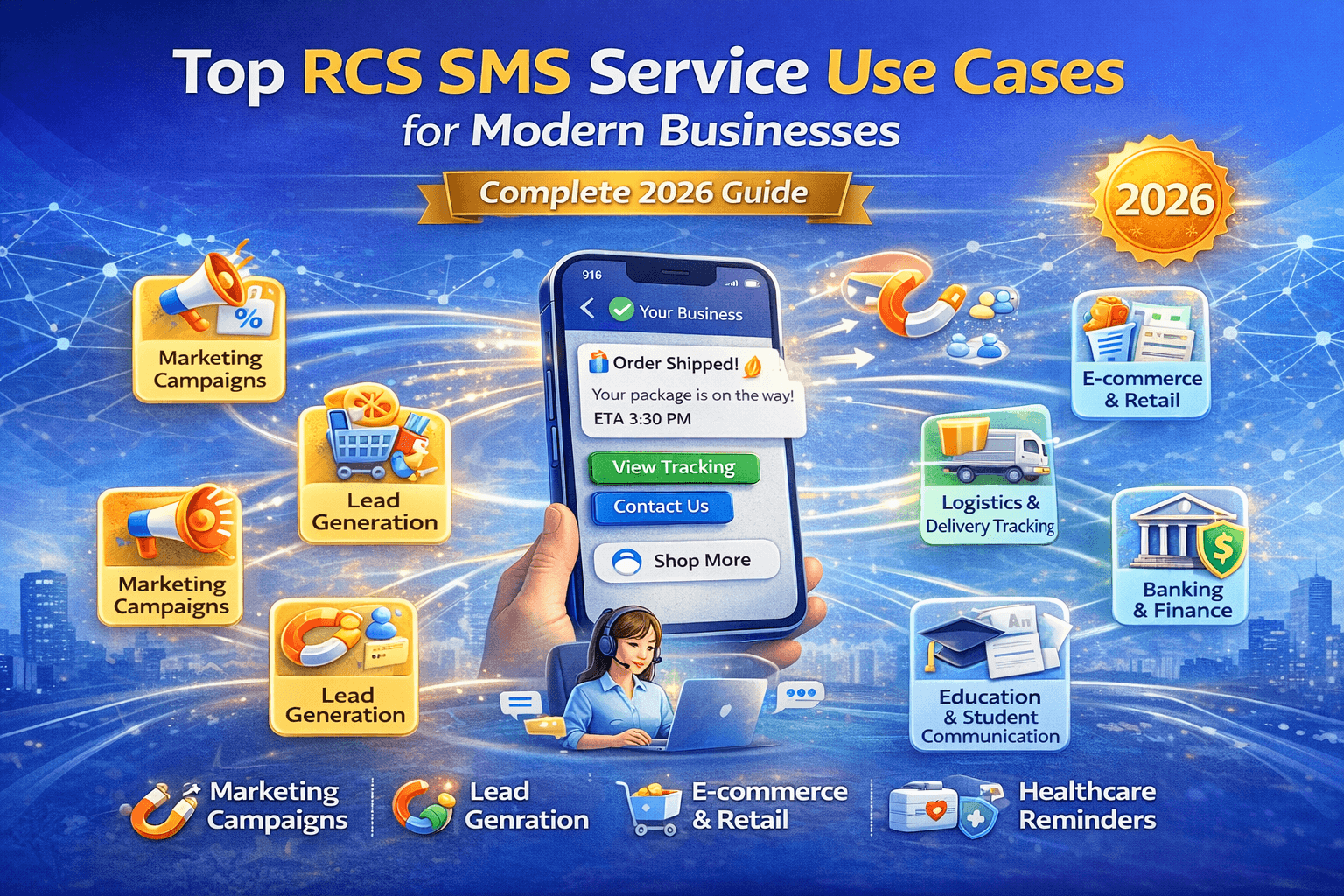
Top RCS SMS Service Use Cases for Modern Businesses - Complete 2026 Guide
Explore the top RCS SMS service use cases for modern businesses in 2026. Learn how RCS messaging improves marketing, automation, lead generation, customer support, and engagement.
Rich
Communication Services (RCS) is the carrier-grade upgrade to SMS that
transforms plain text business messages into branded, interactive, data-rich
conversations. Where SMS delivers 160 characters from an unrecognised short
code, RCS delivers a verified brand name with logo, full-resolution images and
video, interactive reply and action buttons, real-time read receipts, and
campaign analytics - all inside the recipient's native Messages app, with no
app download required.
In 2026, with over 6.5 billion RCS-capable devices globally, near-universal Android coverage in India, and Apple's full RCS support in iOS 18, the question for most businesses is no longer whether to adopt RCS - it is which use cases to prioritise first. This guide covers the twelve most commercially important RCS SMS service use cases across modern business categories - with real message templates, performance benchmarks, and India-specific context for each.
|
6.5B RCS-Capable Devices Globally - End of
2025 |
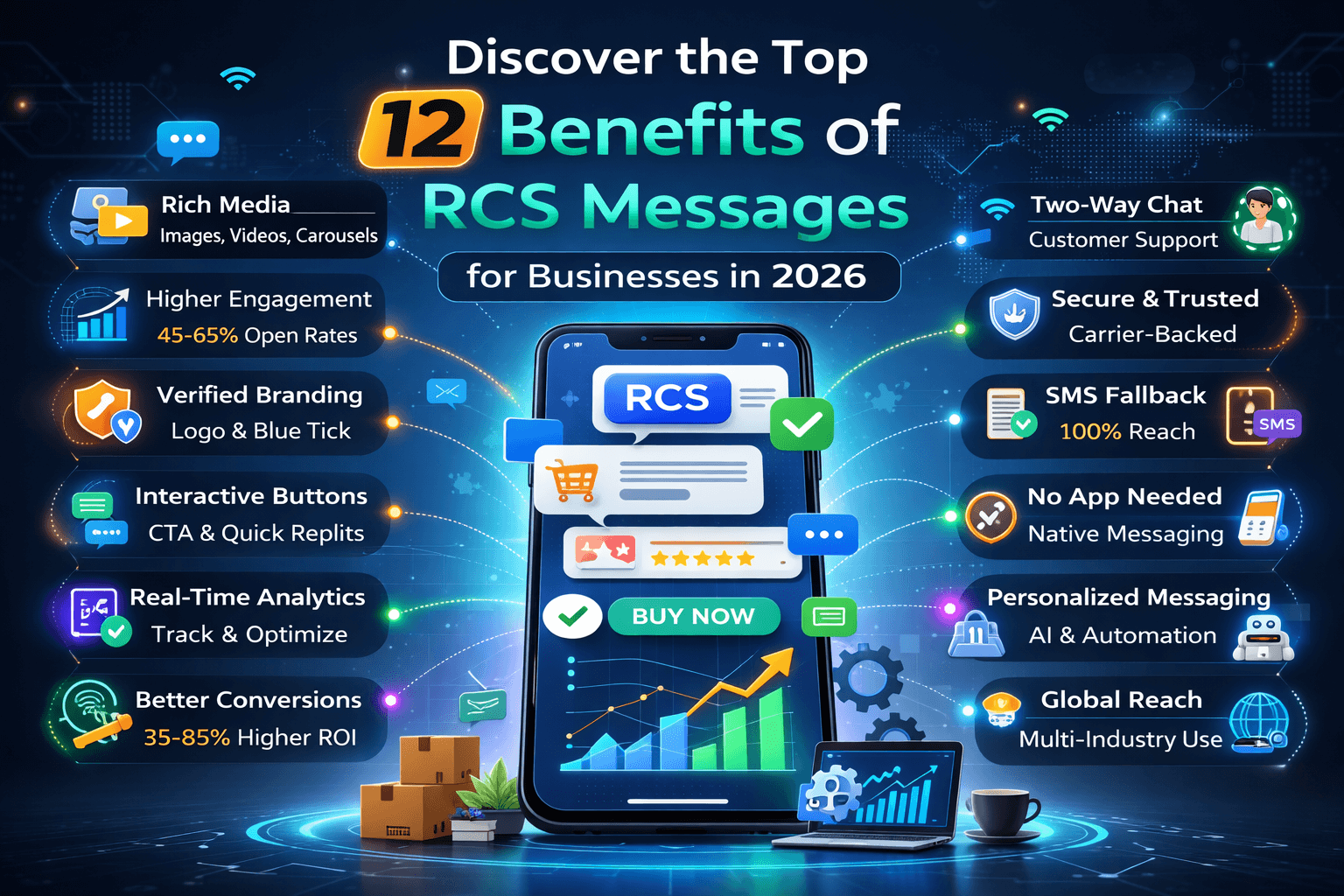
45-65% RCS Open Rate vs 20-30% for Plain SMS |
3-5x Higher Click-Through Rate - RCS vs SMS
Links |
|
35% Average Higher Engagement Rate vs Plain
SMS |
60+ Countries With Active RCS Business
Messaging |
Rs.0.01-0.05 Per-Message Cost - RCS Business
Messaging India |
RCS SMS service
- formally called RCS Business Messaging (RBM) - is the commercial use of RCS
infrastructure for business-to-consumer communication. It uses a separate,
registered, verified business sender pathway requiring brand identity
registration, carrier verification, and regulatory template approval before any
commercial messages can be sent.
The result of this verification process is the defining feature from the customer's perspective: every message arrives with the business's verified name, logo, and an official verification badge - not an unrecognised short code. A verified sender is trusted. A trusted sender is opened. An opened, interactive message is acted upon. This is the chain of value that separates RCS SMS service from plain SMS in every industry context.
|
Capability |
Plain SMS |
RCS SMS Service |
|
Sender
identity |
Short code / unknown number |
Verified brand name + logo + badge |
|
Message
format |
Plain text, 160 chars max |
Rich text, no character limit |
|
Images and
video |
None |
Full-resolution, native display |
|
Product
carousels |
Not possible |
Horizontal scrollable card sets |
|
Interactive
buttons |
None |
Reply, action, deep-link buttons |
|
Read
receipts |
Delivery only |
Delivered + read + clicked |
|
Campaign
analytics |
Delivery rate only |
Open + click + conversion data |
|
Open rate
benchmark |
20-30% |
45-65% - up to 3x higher |
|
SMS
fallback |
It is SMS |
Auto-fallback if device unsupported |
|
App install
required |
None |
None - native Messages app |
|
DLT
compliance India |
Required |
Required - same TRAI DLT framework |
The following twelve use cases represent the highest-ROI applications of RCS SMS service across the major business categories in India and globally in 2026. Each is presented with the specific capabilities that drive value, real performance data, and a representative message template.
|
Shopping #1 |
Retail and E-Commerce - Campaigns, Carts and Order
Journeys Turn every customer touchpoint into a visual,
interactive brand experience Retail and e-commerce businesses
deploy RCS SMS service across four high-value touchpoints. Promotional
campaigns deliver product images at full resolution, a carousel showing items
in the sale, and a Shop Now button deep-linking to the exact product page.
Abandoned cart recovery messages show the specific product left behind with
its image and price, with a Complete Purchase button linked to the
pre-populated cart. Order confirmation and tracking messages deliver a
real-time status card with a Track My Order button opening the live tracking
map. Post-purchase review requests with a star-rating button drive review
volumes significantly above plain SMS requests. Indian D2C brands using RCS for promotional campaigns report
open rates of 55-65% versus 22-28% for equivalent SMS, and click-through
rates 3-5 times higher. For abandoned cart recovery, RCS messages showing the
actual product image drive 3-4 times higher re-engagement - because the
visual reminder of purchase intent is far more compelling than a plain-text
URL. |
|
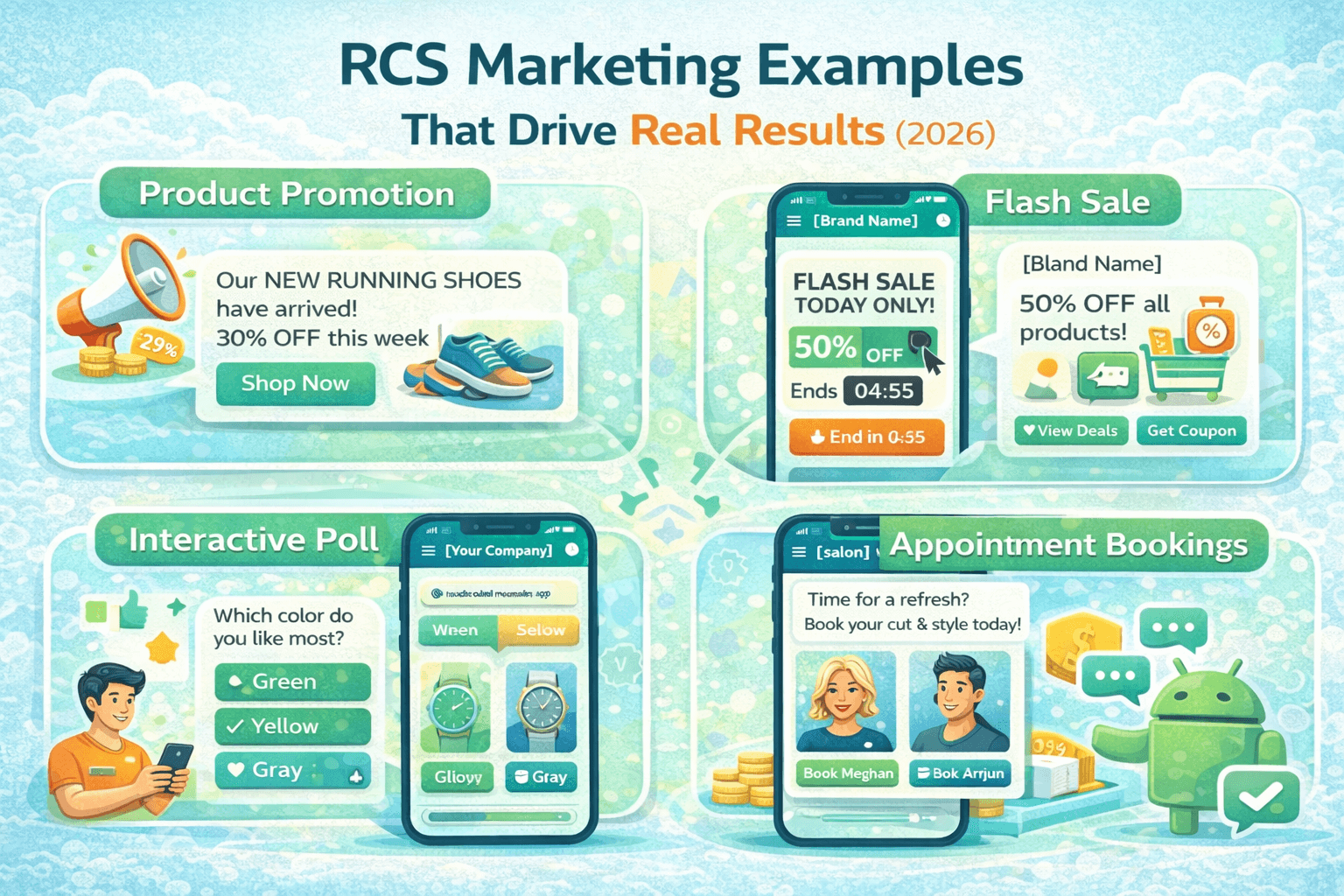
Sample RCS Flash Sale Campaign - Your Brand Name Brand Logo - Verified Badge - Brand Name Flash Sale - Ends Tonight at Midnight! Up to 60% off on Premium Footwear - Today Only Product Carousel: Running Shoes Rs.2499 - Sneakers Rs.1899 -
Formals Rs.3299 [ Shop the Sale Now ] [ View All Offers ] [ Get My Exclusive Member Discount ] |
|
Bank #2 |
Banking and Financial Services - Trusted, Verified
Financial Communication Replace fraud-vulnerable SMS with verified, interactive
financial messaging at scale Banks, NBFCs, insurance companies, and
fintech platforms deploy RCS for high-stakes financial communication where
verified sender identity delivers disproportionate value. Transaction alerts
arrive with verified bank identity, eliminating the is-this-real-or-phishing
question that plagues SMS-based financial alerts. Loan offer campaigns with a
personalised eligibility card, EMI details, and an Apply Now button drive
significantly higher application rates than SMS links. Pre-approved offer
campaigns with personalised limit amounts and one-tap application buttons
achieve conversion rates 3-5 times higher than equivalent SMS campaigns. The verified sender identity is the most commercially
impactful RCS capability for banking in India, where SMS-based financial
fraud is pervasive. An RCS message with a verified bank logo and official
badge is trusted in a way that a plain SMS from an unrecognised short code
never can be. This trust differential translates directly into higher open
rates, higher interaction rates, and higher conversion for every financial
product communicated through RCS. |
|
Health #3 |
Healthcare and Pharma - Compliant, Trusted Patient
Communication Reduce no-shows, improve medication adherence and
support patients through verified RCS Healthcare providers and diagnostic
chains deploy RCS across five high-impact use cases. Appointment reminders
with a Confirm button and a Reschedule button reduce no-show rates by 40-60%
compared to plain SMS - because verified clinic identity builds trust and
one-tap confirmation captures patient intent without a phone call.
Prescription refill reminders with a Reorder Now button drive higher
medication adherence rates. Health screening invitations with a Book Your
Health Check button drive appointment booking rates 2-3 times higher than
SMS. Lab report delivery with a View Your Report button replaces
URL-and-login friction. For pharmaceutical companies, RCS enables compliant patient
support programme communications - medication adherence reminders, disease
management content, and patient-reported outcome capture through structured
response buttons - with verified pharma identity and rich educational content
cards. |
|
Package #4 |
Logistics and Delivery - Real-Time Tracking and
Exception Management Transform every delivery notification into an
interactive branded tracking experience Logistics companies and e-commerce
fulfilment operations deploy RCS across the complete delivery journey.
Dispatch notifications include a Track My Shipment button. Estimated delivery
window cards show the exact time slot. Out-for-delivery alerts include a live
map button. Delivery confirmation messages include a View Delivery Photo
button. Failed delivery exceptions include a Reschedule Delivery button and a
Change Address button that initiates a structured address update flow. Every
stage becomes an interactive, branded experience rather than a one-way text
notification. Logistics businesses migrating from SMS to RCS consistently
report 40-60% reductions in delivery-related customer service contact
volumes. The map button and structured delivery window card answer the most
common customer query - where is my delivery and when exactly will it arrive
- without any human intervention. |
|
Plane #5 |
Hospitality and Travel - Booking Journeys and Guest
Experience Build anticipation, reduce friction and elevate the
guest experience through visual RCS Hotels, airlines, and travel agencies
deploy RCS across the complete travel journey. Booking confirmations include
a visual itinerary card, Add to Calendar button, and Modify Booking button.
Pre-arrival messages feature a property image carousel, online check-in
button, and ancillary upgrade offers to drive incremental revenue. Flight
check-in reminders include a Check In Now button and a View Boarding Pass
button. Post-stay review requests sent within 24 hours of checkout capture
reviews at peak satisfaction. For travel agencies and OTAs, RCS enables personalised holiday
offer campaigns showing destination images, flight and hotel price
combinations, and a Book This Holiday button - with open and conversion rates
significantly above SMS campaigns. Visual destination imagery drives purchase
intent at its highest. |
|
Building #6 |
Real Estate - Property Discovery and Lead Nurturing Convert property inquiries into site visits and site
visits into closings through visual RCS Real estate developers and brokers
deploy RCS for new project launches with a property image carousel, RERA
registration details for trust building, and a Book a Site Visit button.
Personalised lead follow-up sequences show specific configuration cards matching
buyer preferences with a Schedule a Meeting button. Price escalation
campaigns with urgency cards, live unit availability counters, and Book Now
buttons drive last-minute purchase decisions from fence-sitting leads. The visual nature of RCS is particularly impactful for real
estate, where purchase decisions are heavily influenced by property
aesthetics that plain text can never adequately communicate. Developers using
RCS for project launches report site visit booking rates 3-4 times higher
than SMS campaigns. |
|
Car #7 |
Automotive - Sales, Service and Customer Lifecycle Drive showroom footfall, service bookings and ownership
engagement through rich automotive RCS Automobile brands and dealerships
deploy RCS across the vehicle ownership lifecycle. New model launch campaigns
with vehicle photography carousels and a Book a Test Drive button drive test
drive bookings significantly higher than SMS. Service due reminders with a
Book My Service Now button and service pricing cards drive lane bookings
above plain SMS reminders. Seasonal campaigns personalised to the customer's
specific model and registration drive both service revenue and customer
retention. For EV brands, RCS enables ownership communications: battery
health update cards, software update notifications with an Install Update
button, and charging station availability alerts with a Navigate to Station
button - new post-sale communications specific to the EV ownership
experience. |
|
Shield #8 |
Insurance - Renewal, Claims and Policy Servicing Drive renewal rates and transform claims communication
with trusted, verified RCS Insurance companies deploy RCS for
three operationally critical categories. Policy renewal campaigns sent 30,
15, and 3 days before expiry - with a personalised renewal quote card and a
Renew Now button - achieve higher renewal rates than SMS. Claims status
update messages with a structured status card dramatically reduce inbound
claim enquiry calls. Motor claim FNOL workflows - messages sent immediately
after a reported accident with Photograph Damage, Request Surveyor, and View
Workshop Network buttons - reduce processing time and improve claims data
quality. Policy issuance confirmations with a View Your Policy Document
button and a Download Policy Certificate button replace email-and-attachment
workflows with a more accessible delivery channel that achieves higher
document access rates. |
|
Signal #9 |
Telecom and Internet Services - Usage Alerts, Offers
and Upgrades Reduce churn, drive plan upgrades and cross-sell
through personalised RCS Telecom operators and ISPs deploy RCS for data usage alerts
with a structured consumption card and Buy a Data Pack button. Personalised
plan upgrade campaigns are based on the customer's actual usage patterns,
showing the specific plan they would benefit from with a monthly cost
difference clearly stated and an Upgrade My Plan button. Broadband outage
notifications with a planned maintenance window card and a Status Updates
button reduce outage-related contact volumes. Bill payment reminders with Pay
My Bill Now and Set Up Auto-Pay buttons drive higher on-time payment rates. |
|
Suit #10 |
HR and Recruitment - Candidate Engagement and Employee
Communication Transform candidate experience and internal HR
communication with branded, interactive RCS Recruitment agencies and HR teams
deploy RCS for two distinct audiences. For candidates: application
acknowledgements with reference cards, interview schedule notifications with
a Confirm Interview button and a Get Directions button, pre-interview preparation
messages with a Company Profile card, and offer letter messages with a View
Your Offer Letter button. For employees: payslip delivery notifications,
company announcements with rich formatting, training programme invitations
with a Register button, and satisfaction surveys with star-rating response
options. The verified company sender identity is particularly important
for internal HR communications in large organisations where employees are
sceptical of messages from unrecognised numbers - especially for sensitive
communications like offer letters and payslips. |
|
Food #11 |
Restaurants, Food Delivery and QSR - Orders, Loyalty
and Engagement Drive repeat orders, table bookings and loyalty
redemptions through visual food RCS Restaurants, QSR chains, and food
delivery platforms deploy RCS for reservation confirmations with a Modify
Booking button and a Get Directions button, post-meal review requests with a
Rate Your Experience star button, loyalty programme updates with points
balance cards and a Redeem My Reward button, and promotional campaigns
showing full-resolution food imagery with an Order Now button linked directly
to the item in the app. Food imagery is among the most emotionally compelling visual
content in any industry. The ability to display it in the native messaging
app - capturing purchase intent before the customer has to open a browser or
app - is a unique advantage of the RCS channel for food businesses. |
|
Building2 #12 |
Government and Public Services - Citizen Communication
at Scale Deliver trusted, accessible, action-oriented public
service communication through verified RCS Government departments, municipal
corporations, and public utilities deploy RCS for utility bill and tax due
reminders with a Pay Online Now button, appointment reminders for government
services with Confirm and Reschedule buttons, and public health communication
campaigns with Find My Nearest Centre and Book My Appointment buttons. The
verified government sender identity addresses the widespread problem of
fraudulent messages impersonating government agencies. In India, government departments already on DLT for SMS can
extend their existing entity registration to cover RCS with minimal
additional compliance burden. The TRAI DLT framework provides a
well-established compliance pathway for government entity RCS messaging. |
Industry
Quick-Reference Matrix
Use this matrix to identify the highest-priority RCS use cases for your specific industry and select your starting point for deployment.
|
Shop Retail / E-Commerce Flash sales -
Abandoned cart - Order tracking - Loyalty - Reviews |
Bank Banking and Financial Transaction
alerts - Loan offers - Pre-approved campaigns - Benefits |
|
Hosp Healthcare and Pharma Appointment
reminders - Refills - Lab reports - Health screening |
Pkg Logistics and Delivery Dispatch
alerts - Live tracking - Failed delivery - Feedback |
|
Air Hospitality and Travel Booking
confirm - Pre-arrival - Check-in - Post-stay review |
RE Real Estate Project
launch - Lead nurture - Site visit - Price escalation |
|
Test drive -
Service due - Launch campaigns - EV ownership comms |
Ins Insurance Renewal -
Claims status - FNOL workflow - Policy documents |
|
Tel Telecom and Internet Data alerts -
Plan upgrades - Bill payment - Outage notifications |
HR HR and Recruitment Interview
scheduling - Offer delivery - Payslip - Training |
|
Food Restaurants and Food Reservation -
Loyalty rewards - Promotional offers - Reviews |
Gov Government and Public Bill
reminders - Appointment booking - Health drives - Citizen alerts |
Not all RCS use cases deliver equal ROI for every business. The businesses that achieve the strongest results identify the highest-value starting point - the use case where the gap between current SMS performance and RCS potential is greatest - and build outward from there.
|
1 |
Map Your Highest-Volume SMS Campaign Types Audit your existing SMS communication - what types of messages
do you send most frequently, to the most people, at the highest stakes?
Promotional campaigns, appointment reminders, fee reminders, order
notifications, and payment reminders are typically the highest-volume
categories. Your RCS starting point should be the use case where you
currently send the most messages, because the performance improvement from
upgrading to RCS will have the greatest aggregate impact on the metric that
matters most to your business. |
|
2 |
Identify Your Current SMS Pain Points Which SMS campaigns generate the most customer service calls?
Which achieve the lowest open rates? Which require the most manual follow-up
because automated SMS did not drive sufficient action? If customers
frequently ask who sent this message, verified identity is your highest-value
RCS feature. If link click rates are low, rich media and embedded action
buttons are your highest-value feature. Pain points identify where RCS
creates the most immediate, visible improvement. |
|
3 |
Calculate the Financial Impact of Performance
Improvement Model the financial impact of RCS performance improvements for
your top candidate use cases. For fee reminders: if 40% higher payment
completion on due date, what is the cash flow impact? For appointment
reminders: if 50% no-show reduction, what is the revenue impact per recovered
appointment? For promotional campaigns: if 3x higher click-through, what is
the additional revenue from the same campaign spend? These calculations
quickly identify which use case offers the fastest return on your RCS
investment. |
|
4 |
Assess Integration Complexity and Time-to-Live Some RCS use cases require deep integration with CRM, ERP, or
payment systems. Others can be deployed as manual campaigns with minimal
integration complexity. Choose your first use case to balance high commercial
impact with manageable integration complexity, so you can reach live
deployment and generate performance data quickly. A well-executed first
campaign creates the business momentum needed to invest in deeper
integrations for subsequent use cases. |
|
5 |
Pilot in Parallel, Measure, and Scale Deploy your first RCS use case to a test segment - run RCS and
SMS in parallel to the same audience type for a direct performance
comparison. Measure open rates, button click rates, and the business outcome
metric most relevant to your use case. Document the specific performance
improvement numbers. Use this data to build the internal business case for
expanding RCS across your full portfolio. |
RCS vs Plain SMS
vs WhatsApp Business - The 2026 Channel Comparison
Understanding how the three channels complement rather than compete with each other is essential for building a coherent multi-channel strategy for 2026.
|
Metric |
Plain SMS |
RCS |
WhatsApp |
|
Cost per
message |
Rs.0.01-0.03 |
Rs.0.01-0.05 |
Rs.0.10-0.70/conv |
|
Open rate |
20-30% |
45-65% |
98% opted-in |
|
Click-through
rate |
1-3% |
5-15% |
15-40% |
|
Opt-in
required |
Not required |
Not required |
Yes - explicit |
|
App install
required |
None |
None |
Yes - WhatsApp |
|
Rich media |
No |
Yes |
Yes |
|
Verified
sender |
No |
Yes |
Yes - green tick |
|
Interactive
buttons |
No |
Yes |
Yes |
|
SMS
fallback |
It is SMS |
Automatic |
None |
|
DLT
required India |
Yes |
Yes |
No - Meta framework |
|
Best for |
Universal reach |
High-vol branded |
Conversational |
The strategic insight: RCS and WhatsApp serve fundamentally different communication objectives. RCS excels at high-volume, carrier-delivered, transactional and promotional messaging reaching every customer without opt-in. WhatsApp excels at conversational, opted-in engagement with higher rates per message but requiring explicit consent and a smaller addressable audience. SMS serves as the universal fallback. Businesses using all three channels strategically consistently outperform those relying on any single channel alone.
RCS SMS Service
in India - Market Context and DLT Compliance
Why India Is One of the World's Most Important RCS Markets
India's
smartphone market profile is uniquely favourable for RCS. With over 95% of
Indian smartphones running Android and Jio, Airtel, and Vi all supporting RCS
Business Messaging on their networks, the technical infrastructure is available
to the overwhelming majority of Indian business messaging audiences. The scale
of the Indian market - over 700 million smartphone users - makes it one of the
highest-priority markets for global RCS platform development.
TRAI DLT Compliance - The Non-Negotiable Starting Point
All commercial RCS messaging in India requires compliance with TCCCPR 2018, administered through the TRAI DLT platform. For businesses already sending commercial SMS under the DLT framework, the path to RCS compliance is an extension of existing registration. The three steps are: entity registration (confirm your Principal Entity PE ID), sender ID registration (register your RCS brand name, 3-7 business days), and template registration (register and get approval for every message template, categorised correctly as Transactional, Service, or Promotional).
Frequently Asked Questions - RCS SMS Service for Businesses
Q: What is the difference
between RCS SMS service and regular SMS for businesses?
A: RCS SMS service delivers verified brand identity, rich
media, interactive buttons, real-time read receipts, and campaign analytics -
all within the native Messages app with no app download required. Plain SMS
delivers 160 characters from an unrecognised short code with no visual content,
no interactivity, and only basic delivery confirmation. RCS achieves open rates
of 45-65% versus 20-30% for SMS, and click-through rates 3-5 times higher.
Q: Which industries get
the most value from RCS SMS service?
A: Banking and financial services benefit most from
verified sender identity, which addresses rampant SMS fraud in financial
communication. Retail and e-commerce benefit most from rich media and
interactive buttons. Healthcare and education benefit from verified identity,
interactive booking buttons, and read receipt confirmation for critical
communications. Logistics benefits most from real-time tracking integration and
exception management buttons.
Q: How much does RCS SMS
service cost compared to plain SMS in India?
A: RCS Business Messaging in India is typically priced at
Rs.0.01 to Rs.0.05 per message - comparable to or modestly above premium SMS at
Rs.0.01-Rs.0.03. The correct comparison is cost-per-outcome rather than
cost-per-message. Because RCS delivers 2-3 times more opens and 3-5 times more
clicks per message than SMS, the cost-per-outcome is typically lower for most
conversion-oriented use cases, despite the slightly higher per-message cost.
Q: Do my customers need
to do anything to receive RCS messages?
A: No. Customers do not need to download any app, create
any account, opt in to any platform, or change any settings. RCS messages are
delivered to the native Messages app on every Android smartphone and every
iPhone running iOS 18 or later. For customers whose devices or carriers do not
support RCS, messages are automatically delivered as SMS fallback - ensuring
100% reach with zero adoption barrier.
Q: How long does it take
to go live with RCS SMS service in India?
A: For businesses with existing TRAI DLT registration for
SMS, the typical timeline is 3-4 weeks: DLT sender ID registration 3-7 days,
brand profile verification 3-7 days, template registration and approval 2-5
days per batch, and technical integration with your aggregator 1-2 weeks.
Businesses without DLT registration should add 7-10 days for entity
registration.
Q: Can I use RCS SMS
service alongside WhatsApp Business API?
A: Yes - and for most businesses, using both channels is
the optimal strategy. RCS handles high-volume carrier-delivered transactional
and promotional messaging to your full customer base without opt-in
requirements. WhatsApp handles conversational opted-in engagement for customers
who are active WhatsApp users. The two channels serve different communication
objectives and reach different audience segments most effectively.
Q: What happens to
customers who cannot receive RCS messages?
A: If a recipient's device or carrier does not support RCS, the message is automatically delivered as SMS fallback - a plain text version delivered through carrier SMS infrastructure. This fallback is automatic and requires no action from the sender. Always configure clear, complete, and actionable SMS fallback content for every RCS template, as approximately 15-20% of recipients in a typical Indian database will receive the SMS version.
Conclusion -
2026 Is the Year to Go Live With RCS SMS Service
The use case
map in this guide covers twelve industries and over forty specific applications
- but the common thread is simple: RCS takes the communication investment
businesses already make in SMS and makes it work harder. Verified identity
builds trust. Visual content captures attention. Interactive buttons remove
friction. Analytics prove what works.
In India, the
infrastructure readiness, regulatory clarity, and device coverage for RCS SMS
service in 2026 is the best it has ever been. The businesses building their RCS
communication infrastructure now are not early adopters taking a risk - they
are adopting a commercially proven, carrier-backed, regulator-compliant upgrade
to the messaging channel they already use.
Start with one use case - the one where the gap between your current SMS performance and what RCS makes possible is largest. Measure the improvement. Build from there. The compounding advantage of better open rates, higher click-through, and more engaged customers starts the moment your first RCS campaign goes live.