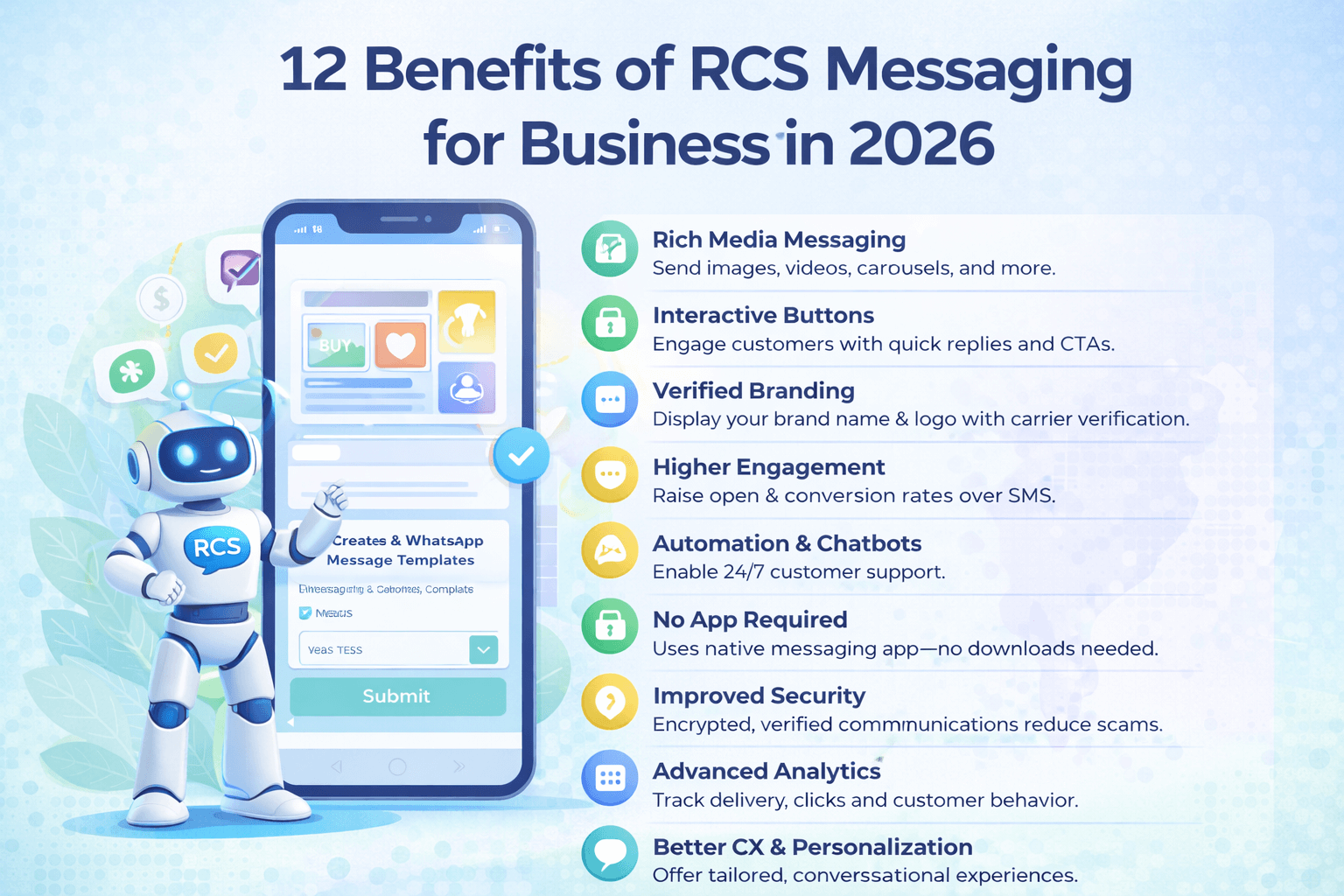
12 Benefits of RCS Messaging for Business in 2026
Discover 12 powerful benefits of RCS messaging for business in 2026 — from rich media and verified branding to higher engagement, smart automation, and real results across every industry.
SMS has been
the backbone of business messaging for over three decades. It is fast,
universal, and reliable — and for a long time, nothing came close to its reach.
But in 2026, something genuinely better has arrived at scale: Rich
Communication Services, or RCS. And for businesses that have been relying on
plain-text SMS to communicate with their customers, the upgrade is not
incremental — it is transformational.
RCS is SMS
rebuilt for the smartphone era. It delivers the same universal reach — no app
download required, works on the phone's native messaging app — but with a
feature set that rivals the richest messaging platforms available: branded
sender profiles with a verified badge, images, videos, GIF carousels,
interactive reply buttons, suggested actions, real-time read receipts, typing
indicators, and in-message analytics. Everything you have envied about
WhatsApp, Instagram DMs, or Apple Business Chat, but delivered natively to
every compatible smartphone without any friction on the customer's side.
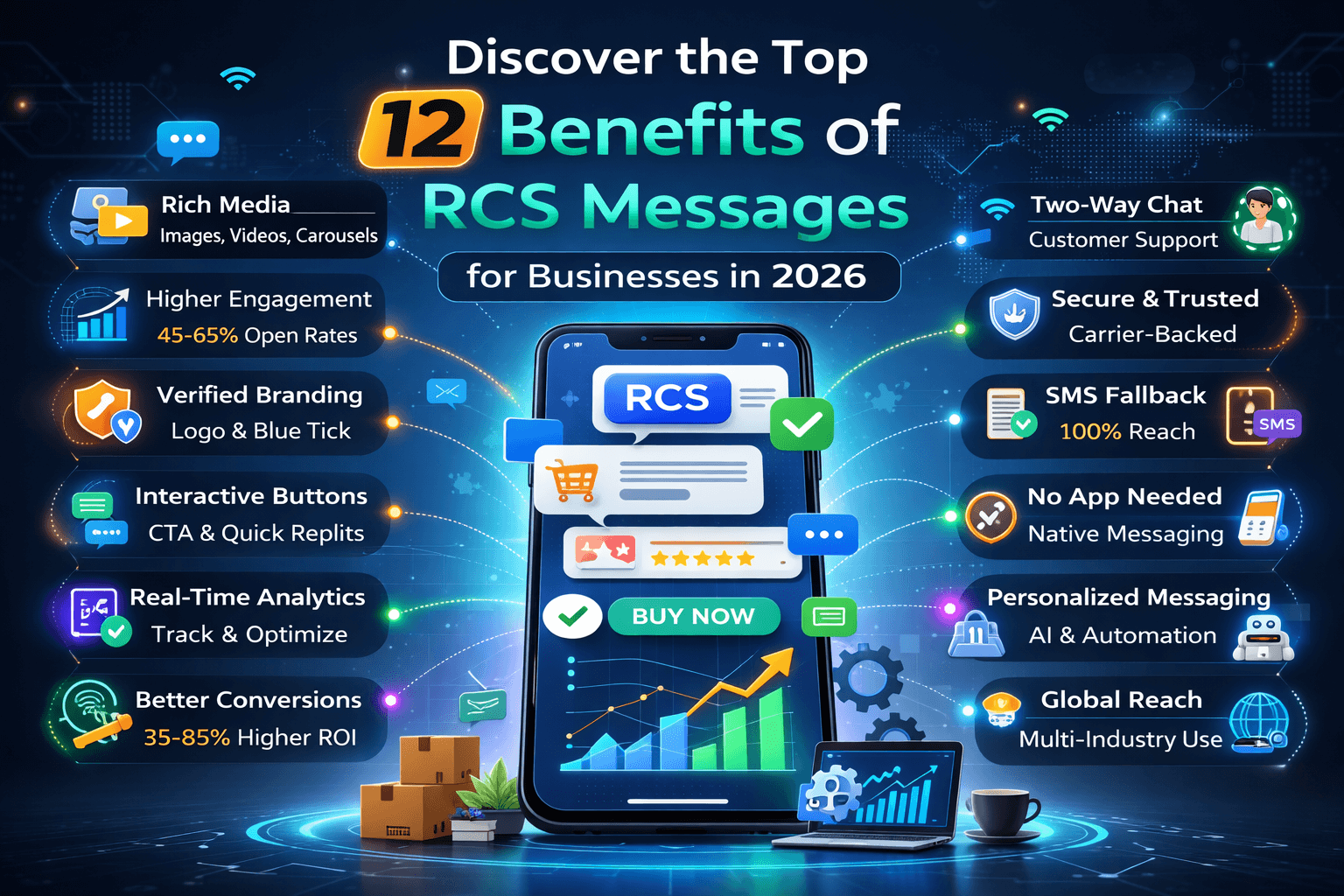
This guide covers the 12 most commercially significant benefits of RCS messaging for business — with real performance data, industry-specific examples, and the honest context of what RCS delivers today versus what is still developing. Whether you are evaluating RCS for the first time or looking to make the business case internally for upgrading from SMS, this is your complete reference.
|
35% Higher Engagement Rate for RCS vs Plain
SMS |
85% Higher Conversion Rate for RCS Rich
Cards vs SMS |
6.5B RCS-Capable Devices Globally by End of
2025 |
|
45–65% RCS Business Message Open Rate |
70% Of Customers Prefer Branded, Visual
Business Messages |
2026 Year RCS Reaches Near-Universal Reach
With iOS 18 |
Before diving into the 12 benefits, it helps to see the full gap between SMS and RCS side by side. This is what your business communication upgrades from — and to.
|
Feature |
📱 Traditional SMS |
🔵 RCS Business Messaging |
|
Message
format |
Plain text
only |
Text +
images + video + GIFs + docs + audio |
|
Character
limit |
160 characters |
Unlimited —
full rich message format |
|
Sender
identity |
Short code or
number |
Verified
brand name + logo + colour scheme |
|
Interactive
buttons |
None |
Suggested
replies + action buttons + links |
|
Read
receipts |
Not available |
Real-time
read receipts and delivery status |
|
Typing
indicators |
Not available |
Live typing
indicator visible to recipient |
|
Carousels |
Not available |
Horizontal
card carousels for products/offers |
|
Analytics |
Delivery only |
Delivery +
read + click + conversion tracking |
|
App
required |
None — native
SMS |
None —
native Google Messages / iOS Messages |
|
Branding |
No visual
branding possible |
Full brand
profile — logo, name, colour badge |
|
Fallback |
This IS the
fallback |
Auto-fallback
to SMS if RCS unavailable |
|
Open rate |
~20–30% |
45–65% — up
to 3x higher |
|
🎨 #1 |
Rich Media Messages That Stop the Scroll Move beyond plain text — send images, videos, GIFs, and
carousels that capture attention and communicate more in seconds than
paragraphs of text ever could. The most immediate and visible benefit
of RCS over SMS is the ability to send rich media content — high-resolution
images, short video clips, animated GIFs, and audio messages — all delivered
natively within the phone's messaging app. For businesses selling products,
promoting services, or communicating complex information, the difference
between a plain text message and a visually rich RCS message is the
difference between being ignored and being engaged. A fashion retailer announcing a new collection with an RCS
carousel of product images achieves dramatically higher engagement than an
SMS with a link. A restaurant sending an RCS message with a mouth-watering
photo of today's special drives more table bookings than a text description.
A property company sharing an RCS message with a short video walkthrough of a
new listing converts more enquiries than any text-based description could.
The research confirms this consistently: rich media RCS messages achieve 85%
higher conversion rates than equivalent plain text SMS messages. |
|
✅ #2 |
Verified Brand Identity — No More Impersonation Risk Your customers know exactly who they are hearing from —
verified brand name, logo, and official badge. No more number-guessing, no
more fraud risk. RCS Business Messaging requires every
business sender to be verified through the carrier registration process —
meaning your messages arrive with your official brand name, your company
logo, and a verification badge that the recipient can trust. Compare this to
SMS, where your message arrives from a random-looking short code or
international number that customers cannot easily identify, and which is
trivially easy for fraudsters to spoof. The trust impact of verified sender identity is significant
and measurable. Customers who receive a message from a verified brand name
they recognise are significantly more likely to open, read, and act on the
message. Equally importantly, the verification badge provides protection
against phishing and fraud — a significant concern for financial services,
healthcare, and e-commerce businesses whose customers are routinely targeted
by SMS-based fraud impersonating well-known brands. |
|
🔘 #3 |
Interactive Buttons and Suggested Replies Turn passive message recipients into active
conversation participants — with one-tap reply buttons, call-to-action links,
and structured interaction flows. One of the most commercially powerful
features of RCS is the ability to include interactive elements directly
within the message — suggested reply buttons (pre-written options the
recipient can tap to respond with a single touch), call-to-action buttons (links
to URLs, phone dialler triggers, or map directions), and structured response
flows that guide the recipient toward a specific action without requiring
them to type anything. For a business sending an appointment reminder, a single
'Confirm' button can capture confirmation with one tap rather than requiring
the customer to call, reply with specific text, or navigate to a booking
platform. For a customer service message asking about satisfaction, a set of
rated response buttons captures structured feedback instantly. For a
promotional message, a 'Shop Now' button with a deep link to the specific
product page eliminates the friction between message receipt and purchase
initiation. Every interactive element added to an RCS message measurably
improves response rates over an equivalent plain text SMS. |
|
📊 #4 |
Real-Time Read Receipts and Delivery Analytics Know exactly what happens after you press send — who
received it, who read it, and who acted on it. Data that SMS has never been
able to provide. SMS provides one data point: delivered
or not delivered. RCS provides a full analytics layer: message sent, message
delivered to device, message opened and read (with timestamp), and for
messages containing interactive elements — which button was tapped, which
link was clicked, and what action the recipient took next. This shift from
binary delivery confirmation to rich engagement analytics transforms business
messaging from a broadcast activity into a measurable, optimisable marketing
and communication channel. Marketing teams can A/B test RCS message variants with real
engagement data. Customer service teams can see which customers have read
their support message and which have not — enabling targeted follow-up rather
than blanket resends. Sales teams can see exactly when a prospect has read
their RCS follow-up and use that signal to time a personal call or follow-up
message at the moment of highest attention. The analytics capability of RCS
closes the attribution gap that has always limited SMS as a business communication
channel. |
|
🃏 #5 |
Product Carousels and Visual Catalogues Showcase multiple products, options, or offers in a
single horizontal carousel — the closest thing to an in-message shopping
experience available on any native messaging channel. RCS carousels allow businesses to
present multiple product cards, offer options, or content items in a single
horizontally scrollable message — each card containing an image, title,
description, and action button. For e-commerce brands, this is transformative:
instead of sending a product link that requires the customer to navigate to a
website, browse, and find the right item, the product comes to the customer —
visually, immediately, in the messaging app they are already using. Fashion brands use RCS carousels to present new collection
highlights with direct 'Shop Now' links on each card. Travel companies
present destination options with imagery and pricing. Banks present product
upgrade options with clear feature summaries. The carousel format reduces the
cognitive friction between 'seeing' and 'acting' — which is the primary
driver of its consistently higher conversion rates compared to single-image
messages or text links. |
|
📵 #6 |
No App Download Required — Reaches Everyone The biggest advantage RCS has over every OTT messaging
platform: zero friction for the recipient. It works on the phone's native
messaging app. No install, no account, no barrier. Every OTT messaging platform —
WhatsApp, Telegram, Signal, iMessage — requires the recipient to have the app
installed and an active account before they can receive business messages.
For businesses trying to reach a broad customer base, this creates an inherent
reach ceiling: you can only message the customers who happen to have the same
app you are using for outreach. RCS eliminates this barrier entirely. An RCS business message reaches every customer whose phone
supports RCS on their carrier network — which in 2026 means the vast majority
of Android users globally and, since iOS 18, a growing proportion of iPhone
users. No installation, no account creation, no permission granting beyond
the standard carrier relationship that already governs SMS delivery. The
customer's experience is simply: a message arrives in the Messages app they
already use, looking significantly more professional, visual, and interactive
than the SMS messages they have always received. |
|
🤖 #7 |
Intelligent Chatbot and Automation Integration Build structured conversation flows, automated
qualification sequences, and intelligent response handling — all delivered
through the phone's native messaging app. RCS Business Messaging supports full
chatbot integration — allowing businesses to build automated conversation
flows that respond to customer inputs, guide customers through structured
processes (booking, ordering, troubleshooting, data collection), and handle
the majority of inbound queries without human agent involvement. The
difference from a WhatsApp or website chatbot is the delivery channel: RCS
chatbot conversations happen in the native messaging app, without requiring
the customer to navigate to a website or open a third-party application. An insurance company can run a premium quotation chatbot
entirely within an RCS conversation — collecting the customer's details,
calculating a quote, presenting options with card images, and capturing the
customer's selection with a single button tap. A logistics company can handle
delivery exception management through an RCS chatbot — notifying the customer
of a delivery issue, presenting rescheduling options as interactive buttons,
and confirming the new delivery slot without any human agent involvement. The
automation capability of RCS makes it a genuinely scalable business
communication channel, not just a richer version of broadcast messaging. |
|
🔄 #8 |
Automatic SMS Fallback — Guaranteed Delivery If RCS is not available on a recipient's device or
carrier, the message automatically falls back to SMS. You get the richest
possible experience for every recipient who can receive it — and guaranteed
delivery for everyone else. One of the practical advantages that
gives RCS a significant deployment advantage over OTT messaging platforms is
the automatic fallback mechanism. When a business sends an RCS message to a
contact whose device or carrier does not support RCS, the message is
automatically delivered as an SMS — ensuring the communication reaches the
recipient regardless of their technology setup. No message is lost, no
recipient is excluded, and no special handling is required on the business
side. This fallback guarantee is particularly valuable for
businesses operating across diverse customer bases — where some customers
have the latest smartphones with full RCS capability, while others are on
older devices or networks where RCS has not yet been deployed. The business
sends a single message; the platform delivers it as RCS to every recipient
who can receive it, and as SMS to everyone else. As RCS adoption grows, an
increasing proportion of messages are delivered in their rich format — while
the SMS fallback ensures no coverage gaps during the transition period. |
|
🏢 #9 |
Enhanced Brand Experience and Professionalism Every RCS message is an on-brand experience —
consistent visual identity, professional presentation, and the trust signals
that separate credible businesses from the noise. RCS Business Messaging allows
businesses to configure a complete brand profile that is displayed with every
message they send — company name, logo, brand colour, and a verified badge.
This persistent brand identity means customers always know who is communicating
with them, builds recognition and trust over time, and elevates the perceived
quality of the business in every interaction. Compare this to SMS, where the
sender is displayed as a numerical short code or phone number with no visual
branding whatsoever. For businesses that have invested in building strong brand
recognition — and particularly for financial services, healthcare, and
e-commerce businesses where trust is a prerequisite for customer action — the
brand visibility and verification of RCS is commercially significant. Studies
consistently show that customers are more likely to engage with messages from
recognisable, professional-looking senders, and that brand consistency across
touchpoints improves customer lifetime value over time. |
|
💳 #10 |
Frictionless Payments and Deep Link Actions Trigger payments, app deep links, phone calls, calendar
additions, and map directions directly from a message — turning a passive
notification into an active transaction. RCS action buttons can trigger a wide
range of device-level actions directly from the message — opening a payment
flow, deep-linking to a specific page within a mobile app, placing a phone
call, launching a map for directions to a physical location, or adding an
event to the phone's calendar. These deep action capabilities transform RCS
messages from passive information delivery into active transaction initiation
tools. A utility company can include a 'Pay Now' button in a billing
RCS message that opens the payment app directly. A restaurant chain can
include a 'Get Directions' button in a promotional message that launches
Google Maps with the nearest location pre-selected. An e-commerce brand can
include an 'Open in App' button that deep-links to the specific product being
promoted. A healthcare provider can include a 'Book Appointment' button that
opens the booking system directly. Each of these actions reduces the steps
between message receipt and desired customer action — and every reduction in
steps increases conversion rates measurably. |
|
📈 #11 |
Higher Open Rates and Conversion Rates Than SMS The engagement data is consistent: RCS messages
outperform SMS across every key metric — open rates, click rates, response
rates, and conversion rates. The performance advantage of RCS over
SMS is not marginal — it is substantial and consistent across every market,
industry, and use case where comparative data has been collected. RCS
business messages achieve open rates of 45 to 65% compared to 20 to 30% for
SMS. Click-through rates on RCS messages with interactive buttons are 3 to 5
times higher than click rates on SMS messages with URLs. Conversion rates for
RCS campaigns — measured as the percentage of recipients who complete the
desired action — are 35 to 85% higher than for equivalent SMS campaigns,
depending on the richness of the message format and the quality of the
interactive elements. The reasons for this performance advantage are structural: RCS
messages are more visually engaging than plain text, more credible because of
verified sender identity, more actionable because of interactive buttons, and
more contextually rich because of the ability to include images, videos, and
product information that make the message immediately understandable without
requiring a click to an external page. Each of these factors individually
would produce a modest performance improvement; together, they produce an
engagement advantage that makes RCS the highest-performing native messaging
channel available to businesses in 2026. |
|
🌍 #12 |
Global Reach With Local Relevance RCS is a global standard — available across 60+
countries and growing. Send consistent, rich business communications at
global scale with local carrier delivery. RCS Business Messaging is available in
over 60 countries in 2026 — supported by the major carriers in the US, UK,
Europe, India, Latin America, Southeast Asia, and beyond. For businesses
operating across multiple markets, RCS provides a single messaging channel
that delivers the same rich, branded experience to customers in every
supported country — without the need to manage country-specific OTT messaging
platform accounts, comply with different app-based messaging regulations in
each market, or deal with the fragmentation of customer communication across
multiple platforms. The global standard nature of RCS also means that businesses
investing in RCS messaging infrastructure — templates, chatbot flows,
creative assets, analytics setups — can deploy that investment across every
market where RCS is available, with carrier-level localisation handling the
delivery mechanics. As more carriers activate RCS globally, the ROI on that
infrastructure investment compounds automatically — reaching more customers
in more markets without additional platform development or compliance overhead. |
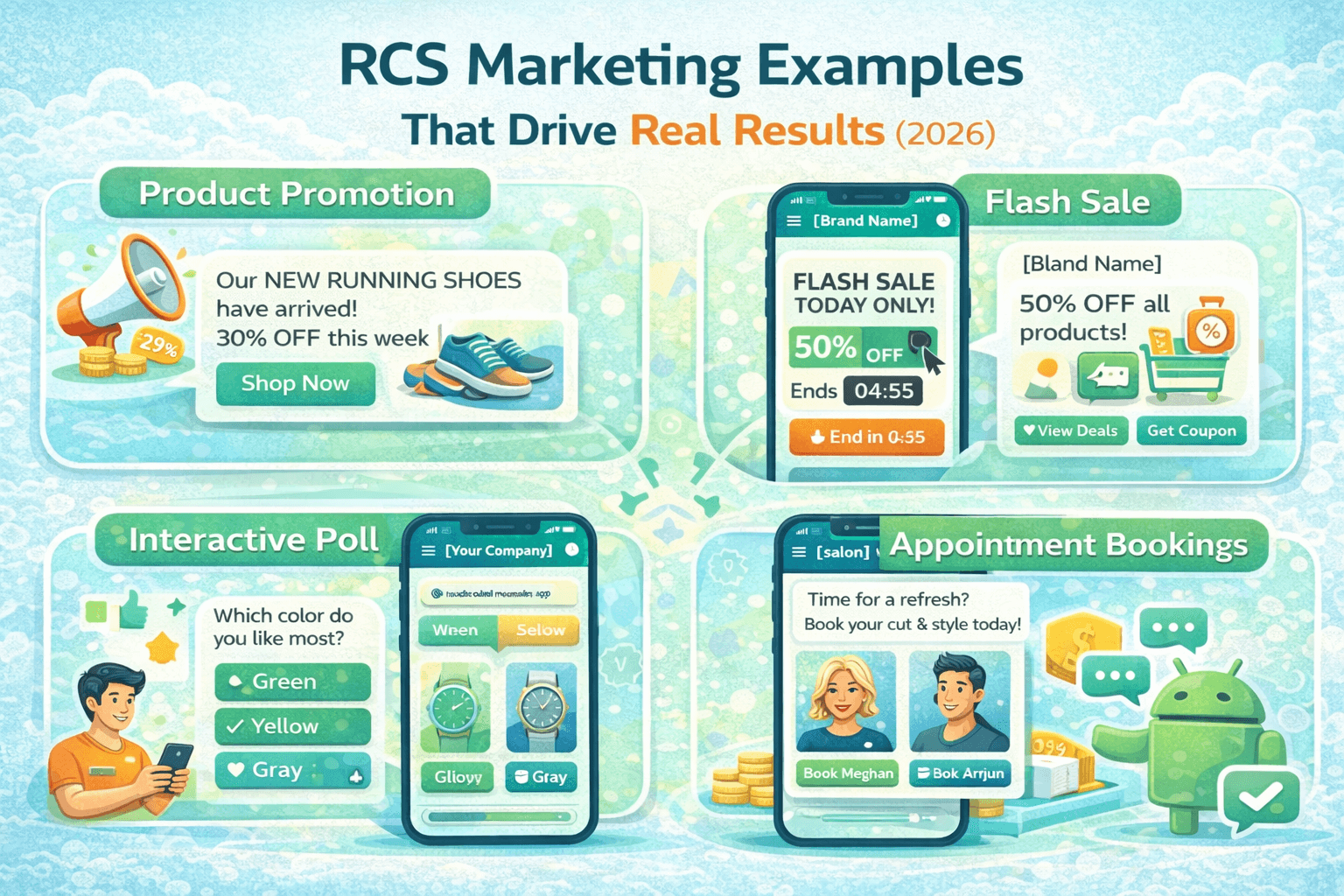
RCS delivers its benefits differently depending on the industry. Here is how the most commercially significant sectors are deploying RCS to drive real outcomes.
|
🏦 BANKING / FINTECH |
Use Cases: Loan offer carousels, EMI payment reminders with Pay Now
button, fraud alert confirmation with verified sender, account statement
delivery with branded card, credit card spend notifications Result: 30–40% higher payment completion rates
on RCS payment reminder campaigns vs SMS. Significant fraud reduction through
verified sender eliminating spoofed SMS impersonation. |
|
🛍️ E-COMMERCE / D2C |
Use Cases: Abandoned cart recovery with product image + Buy Now button,
flash sale announcements with product carousel, order tracking with branded
notification, review request with star rating buttons Result: 85% higher conversion on cart recovery
campaigns vs SMS. 3x higher click-through rate on promotional campaigns. 40%
reduction in customer service contacts through rich order tracking
notifications. |
|
🏥 HEALTHCARE |
Use Cases: Appointment reminders with Confirm/Reschedule buttons,
medication refill reminders with pharmacy deep link, lab results notification
with view report button, health screening invitations with booking flow Result: 55% reduction in appointment no-show
rates. 70% higher patient engagement with health communications. Branded
sender identity builds trust for health-critical communications. |
|
🚚 LOGISTICS / DELIVERY |
Use Cases: Delivery notifications with live tracking map button, delivery
exception management with rescheduling options, pickup reminder with location
map action, proof of delivery confirmation with image Result: 60% reduction in customer service calls
about delivery status. 45% higher rescheduling completion rate vs SMS for
delivery exceptions. |
|
🏫 EDUCATION / EDTECH |
Use Cases: Course enrollment confirmation with branded card, assignment
reminder with submit button, live class reminder with join link button, fee
payment reminder with Pay Now action, result notification with progress card Result: 50% higher fee payment completion on
RCS reminders vs SMS. 65% higher click-through on course enrollment
campaigns. Students engage more with visual branded communications. |
|
🏨 HOSPITALITY / TRAVEL |
Use Cases: Booking confirmation with hotel imagery and map directions,
check-in reminder with digital key or check-in link button, restaurant
recommendation carousel, loyalty points update with redeem button, post-stay
review request with rating buttons Result: 35% higher upsell conversion on in-stay
RCS campaigns. 70% higher review completion rate vs email follow-up. Branded
visual communications reinforce premium brand perception. |
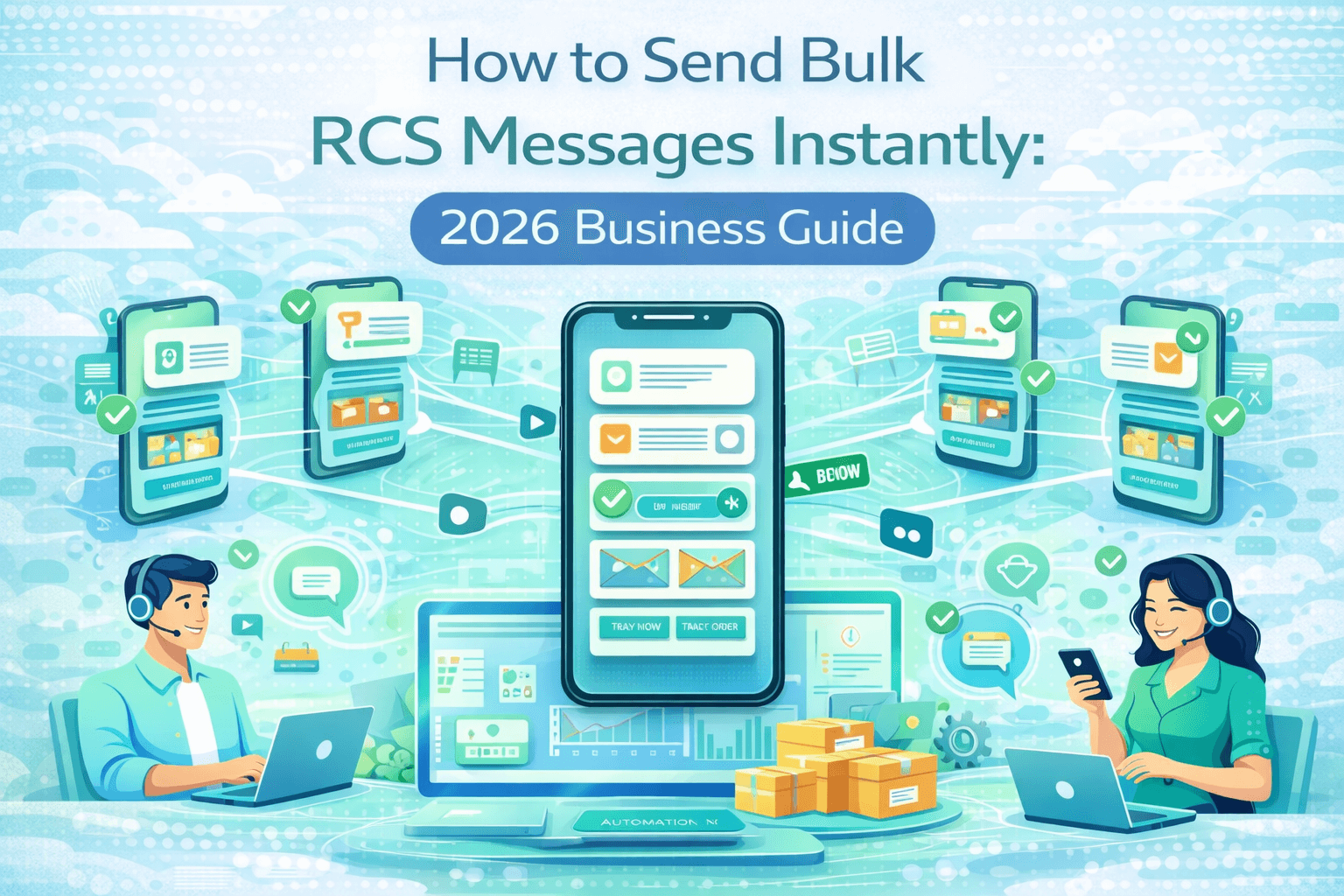
Step 1 — Register Your Business
RCS Business
Messaging requires business registration and verification through a
carrier-approved aggregator or directly with Google's RCS Business Messaging
platform. In India, this means registering on the TRAI DLT system — the same
platform governing commercial SMS. Your business entity, sender ID (the brand
name that will appear with your messages), and message templates all need to be
registered before sending. Work with a TRAI-registered aggregator or RCS
Business Messaging provider to manage the registration process.
Step 2 — Choose Your RCS Business Messaging Platform
Select an RCS
Business Messaging platform or aggregator that supports the features your use
cases require. Key evaluation criteria are: the richness of the message builder
(does it support carousels, all button types, and media formats), the quality
of analytics reporting, the chatbot and automation capability, CRM and API
integration options, the carrier network coverage in your target markets, and
the fallback SMS handling quality. Leading RCS aggregators for the Indian
market include Jio's enterprise messaging platform, Airtel Business, and global
aggregators with India carrier relationships.
Step 3 — Build Your First Campaign
Start with the
highest-impact, lowest-complexity RCS campaign your business can run —
typically a transactional notification upgrade (appointment reminder, order
confirmation, or delivery notification) where the addition of brand identity,
read receipts, and a single action button provides immediate measurable
improvement over the plain SMS equivalent. Measure the performance improvement
versus your SMS baseline, document the results, and use them to build the
business case for broader RCS deployment.
Step 4 — Expand to Promotional and Conversational Use Cases
Once your transactional RCS infrastructure is operational and you have baseline performance data, expand to promotional campaigns (product carousels, flash sale announcements, personalised offers) and conversational use cases (chatbot-driven qualification flows, customer feedback collection, interactive customer service). Each use case builds on the capability of the platform and deepens the engagement advantage of RCS over your previous SMS communications.
Frequently Asked Questions — Benefits of RCS Messaging
Q: What are the main
benefits of RCS messaging over SMS?
A: RCS delivers 12 key advantages over SMS: rich media
support (images, video, GIFs, carousels), verified brand identity with logo and
badge, interactive reply and action buttons, real-time read receipts and click
analytics, product carousels for visual showcasing, no app download required
for recipients, chatbot and automation integration, automatic SMS fallback for
unsupported devices, enhanced brand experience, deep-link payment and action
capabilities, significantly higher open and conversion rates (45–65% open rate
vs 20–30% for SMS), and global reach across 60+ countries. Each benefit
compounds the others — a verified branded sender with rich media and
interactive buttons achieves dramatically better results than any single
feature in isolation.
Q: Is RCS better than SMS
for business messaging?
A: Yes, across every performance metric that matters
commercially. RCS achieves open rates of 45 to 65% vs 20 to 30% for SMS,
click-through rates 3 to 5 times higher, and conversion rates 35 to 85% higher
depending on the use case and message format. The verified brand identity of
RCS also addresses one of the most serious commercial problems with SMS — fraud
and impersonation — which damages customer trust in business SMS communications
broadly. For any business currently using SMS for marketing, customer engagement,
or service notifications, upgrading to RCS delivers measurable commercial
improvement.
Q: Does RCS work on all
smartphones?
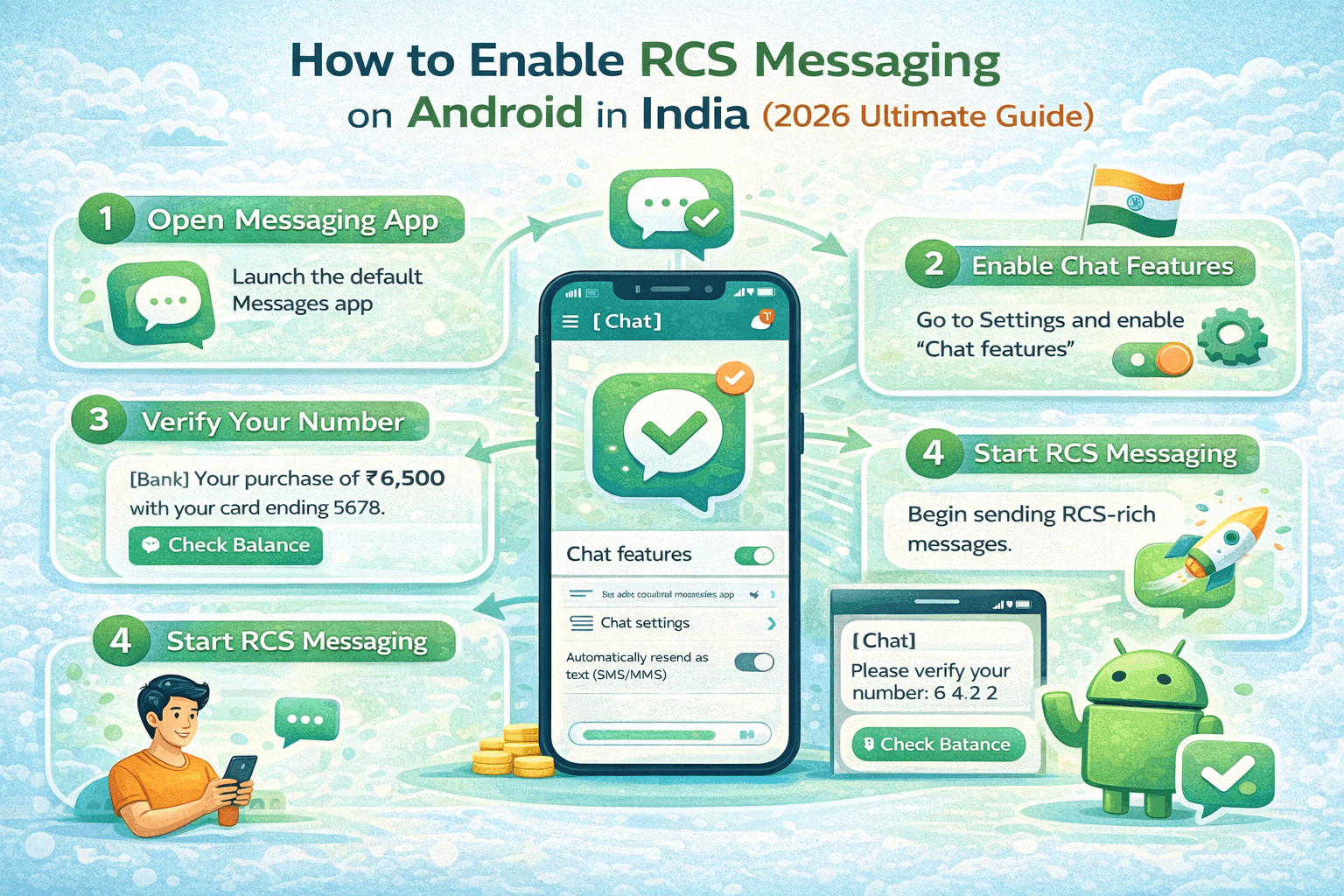
A: RCS Business Messaging works on Android smartphones
running Google Messages as the default messaging app — which covers the vast
majority of Android devices globally. Since the launch of iOS 18, iPhones also
support RCS. In markets with high Android penetration, such as India where
Android accounts for over 95% of smartphones, RCS reaches virtually the entire
smartphone user base. For recipients whose devices or carriers do not support
RCS, messages automatically fall back to SMS — ensuring 100% delivery
regardless of device capability.
Q: How does RCS compare
to WhatsApp for business?
A: RCS and WhatsApp are complementary rather than
directly competing channels for most businesses. WhatsApp has higher active
daily engagement in markets where it is dominant — particularly India, Latin
America, and the Middle East — with a 98% open rate for opted-in contacts. RCS
has broader reach because it does not require a separate app installation or
account, reaches all compatible devices natively, and does not require explicit
opt-in in the same way. For high-volume transactional messaging at scale, RCS
offers cost efficiency advantages. For conversational customer engagement,
sales, and support, WhatsApp's conversational features and payment integration
give it an advantage in WhatsApp-dominant markets. The optimal strategy for
most businesses is to use both.
Q: What industries
benefit most from RCS messaging?
A: Every industry using SMS for customer communication
benefits from upgrading to RCS — but the industries seeing the most dramatic
improvements are those where visual content, verified identity, and interactive
elements have the highest commercial impact: banking and financial services
(fraud reduction through verified senders, higher payment completion rates),
e-commerce and D2C brands (visual product promotion, cart recovery, order
tracking), healthcare (appointment management, patient engagement, trusted
health communications), logistics (delivery tracking with map integration,
exception management), education (fee collection, engagement, course
communications), and hospitality and travel (booking management, upsell, review
collection).
Q: How do I get started
with RCS Business Messaging in India?
A: In India, RCS Business Messaging requires registration
on the TRAI DLT system — the same regulatory framework governing commercial
SMS. You register your business entity, sender ID (the brand name that appears
with your messages), and message templates through a TRAI-registered aggregator
or directly with Jio or Airtel's enterprise messaging platforms. The
registration process typically takes five to ten business days. Work with an
aggregator that provides a full RCS management platform — message builder,
campaign scheduling, chatbot integration, analytics, and SMS fallback handling
— to get the most from your RCS deployment from day one.
Q: What is the ROI of
switching from SMS to RCS for business?
A: The ROI of upgrading from SMS to RCS is driven by three factors: higher engagement rates leading to more conversions from the same send volume (typically 35 to 85% more conversions per campaign), reduced customer service contact volume through richer, more informative notifications that answer customer questions before they are asked (typically 30 to 60% reduction in service contacts for logistics and e-commerce), and fraud reduction through verified sender identity (significant for financial services and healthcare). Most businesses report positive ROI within the first quarter of RCS deployment — the performance improvement is immediate and measurable from the first campaigns.
Conclusion — The Business Case for RCS Is
Clear and Compelling
RCS is not a
technology in search of a use case. It is a direct upgrade to one of the most
widely used business communication channels in the world — SMS — that delivers
measurably better results across every metric that matters commercially. Higher
open rates. Higher click rates. Higher conversion rates. Lower fraud exposure.
Better brand experience. Richer customer engagement. And unlike OTT messaging
platforms that require your customers to have a specific app installed, RCS
works natively on the device they already carry — with no friction, no
download, no account.
The businesses
that adopt RCS early — building their messaging infrastructure, template
libraries, and chatbot flows on the RCS platform now — are accumulating the
performance data, the audience familiarity, and the technical capability that
will compound into a durable competitive advantage as global RCS adoption
continues its rapid growth in 2026 and beyond.
The business case is clear. The technology is ready. The carriers are live. Your customers' devices can receive your messages. The question is not whether to upgrade from SMS to RCS — it is how quickly you can build the infrastructure to make that upgrade, and how fast you want to capture the engagement and conversion improvements that come with it.