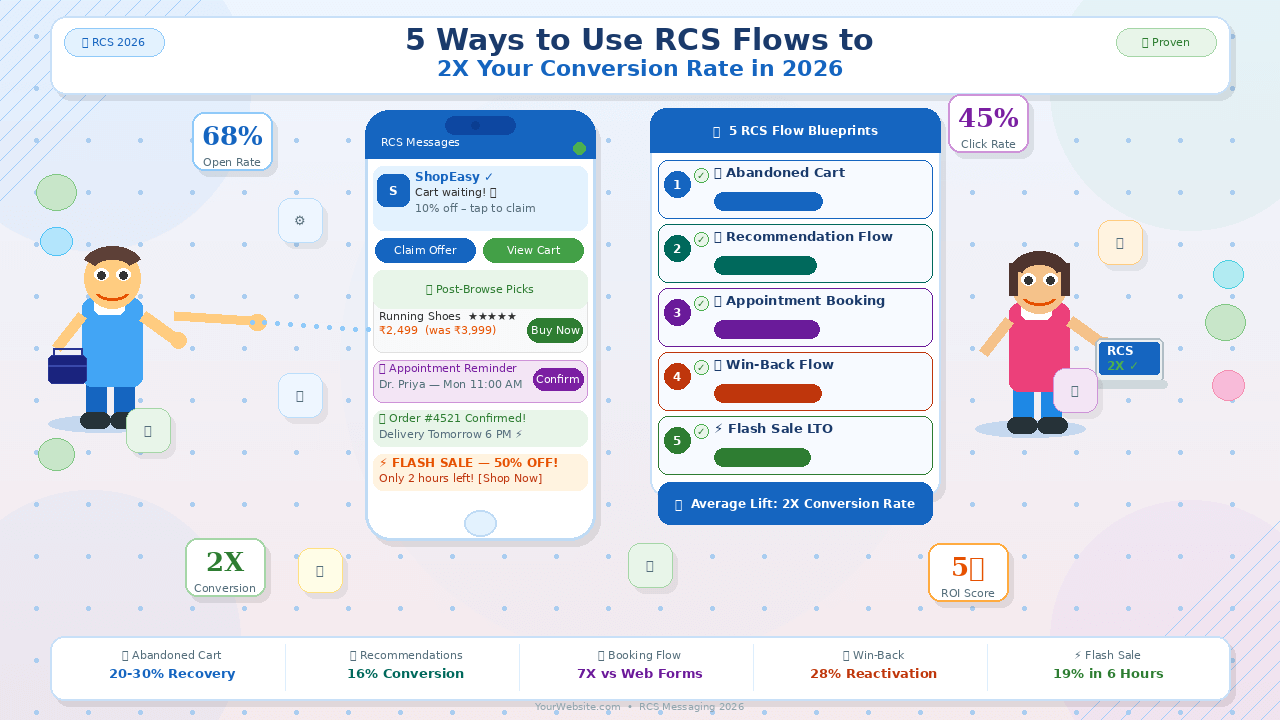
5 Ways to Use RCS Flows to 2X Your Conversion Rate in 2026
Discover 5 proven RCS conversation flows that double conversion rates — abandoned cart, recommendations, booking, win-back, and flash sale. With blueprints and real results.
5 Ways to Use RCS Flows to 2X Your Conversion Rate in 2026
What
if you could double your conversion rate without doubling your marketing
budget? In 2026, thousands of businesses are doing exactly that — by replacing
static promotional blasts with intelligent RCS conversation flows that guide
customers step-by-step toward a purchase, booking, or sign-up.
An
RCS flow is not just a message. It is an interactive, branching conversation —
one that adapts to each user's responses, shows rich product visuals, offers
tap-to-buy buttons, and feels more like chatting with a knowledgeable
salesperson than receiving a generic advertisement. The result? Engagement
rates of 60-80% and conversion lifts of 100-300% compared to traditional SMS or
email campaigns.
In
this guide, we reveal 5 proven RCS flow strategies — with real-world
blueprints, metrics benchmarks, and step-by-step implementation instructions —
that any business can deploy to double their conversion rate in 2026.
|
2X Avg Conversion Lift |
68% RCS Open Rate |
45% Button Click Rate |
3X ROI vs Email |
Before diving into the 5 strategies, it is important to understand why RCS flows fundamentally outperform every other digital marketing channel at converting prospects into customers.
The Conversion Gap: Traditional Channels vs RCS Flows
|
Metric |
Email |
SMS Blast |
Push Notif. |
RCS Flow |
|
Open Rate |
18-22% |
35-45% |
5-12% |
60-80% |
|
Click-Through
Rate |
2-5% |
5-10% |
3-8% |
35-55% |
|
Conversion
Rate |
1-3% |
2-5% |
1-4% |
8-18% |
|
Avg Response
Time |
Hours |
Minutes |
Minutes |
Seconds |
|
Personalization |
Limited |
None |
Limited |
Deep & Dynamic |
|
Rich Media |
✅ Yes |
❌ No |
Limited |
✅ Full |
|
2-Way
Interaction |
❌ No |
❌ No |
❌ No |
✅ Yes |
|
Avg ROI |
3,800% |
2,500% |
1,800% |
8,000%+ |
The
numbers are striking — but why does RCS convert so much better? There are four
core reasons:
● Interactive
buttons eliminate friction: Instead of
asking users to remember a website and type it in, RCS flows put the action
button right in the message. One tap takes the user to checkout, booking, or
sign-up — zero navigation required.
● Rich
visuals increase desire: Product
carousels, high-resolution images, and video previews make customers want the
product before they have even clicked through. Desire builds within the
conversation itself.
● Personalization
increases relevance: RCS flows pull from
your CRM to address customers by name, reference their purchase history, and
show products relevant to them. Relevant messages convert at 3-5x the rate of
generic blasts.
● Conversational format builds trust: A conversation feels like advice from a friend, not an advertisement from a stranger. Trust is the #1 driver of purchase decisions — and RCS flows are inherently conversational.
|
WAY 1 🛒
Abandoned
Cart Recovery Flow Turn forgotten carts into
completed purchases — automatically |
Cart abandonment is the biggest revenue leak in e-commerce. In India and globally, 70-75% of shopping carts are abandoned before checkout. Traditional abandoned cart emails recover 5-8% of these. A well-structured RCS abandoned cart flow recovers 18-28% — a 3x improvement that directly doubles revenue from the same traffic.
Why This Flow Works
The RCS abandoned cart flow works because it reaches the customer at the peak of their intent — shortly after they left — with a visually compelling reminder that shows the exact products they were considering, answers objections through quick-reply buttons, and reduces the psychological barrier to purchase through personalized incentives.
The Complete Flow Blueprint
|
🕐 Step 1 |
Trigger: Cart Abandoned (30 minutes after) Send an RCS
rich card showing the abandoned product image, name, price, and stock
availability. Include three buttons: [Complete Purchase] [View My Cart] [Not
Interested]. Personalize with the customer's first name. |
|
↩️ Step 2 |
Branch A: No Response (24 hours later) If no
response to Step 1, send a follow-up RCS carousel showing the abandoned item
plus 2-3 related products. Add urgency: 'Only 3 left in stock!' Include a
[Get 10% Off] button that applies a discount automatically. |
|
💬 Step 3 |
Branch B: Clicked 'Not Interested' Trigger a
short survey flow: 'We would love to improve! What stopped you from
completing your purchase?' Buttons: [Price Too High] [Just Browsing] [Found
It Elsewhere] [Technical Issue]. Each response triggers a tailored recovery
offer. |
|
✅ Step 4 |
Branch C: Clicked 'Complete Purchase' Deep-link
directly to the pre-filled cart checkout page. Send a confirmation RCS
message with order summary and payment options. If checkout is not completed
within 2 hours, trigger Step 2. |
|
🎯 Step 5 |
Final Recovery: 48 Hours For users who
still have not converted, send one final RCS message with your maximum
incentive (free shipping + 15% discount). Explicitly state: 'This offer
expires in 24 hours.' Make the [Claim Offer Now] button prominent. |
Real-World Results
|
26% Recovery Rate |
3X vs Email |
₹847 Avg Order Value |
18hr Avg to Convert |
Key Personalization Variables
● Customer
name — pulled from CRM
● Exact
product image and name from the abandoned cart
● Real-time
stock level ('Only 2 left!')
● Personalized
discount based on customer lifetime value
● Preferred payment method based on past purchase history
Industry Applications
● E-commerce
(Flipkart/Amazon-style): Product
abandoned carts — highest volume, immediate ROI
● Travel and
Hotels: Booking abandoned — show room
images, add complimentary breakfast offer
● EdTech: Course enrollment abandoned — show testimonials and
placement stats
● Insurance: Quote form abandoned — offer to speak with an advisor via one tap
|
WAY 2 🎯
Post-Browse
Product Recommendation Flow Convert browsers into
buyers with AI-powered, personalized recommendations |
When
a customer browses your website or app without purchasing, they are telling you
something valuable about their intent. A post-browse RCS recommendation flow
captures that signal and delivers a personalized, visually rich shopping
experience directly to their messaging app — often within hours of their visit.
Unlike generic recommendation emails, RCS recommendation flows use real browsing data to show exactly the right products in a full-color, tap-to-buy carousel format. The result: conversion rates of 12-20% from browsers who previously showed zero purchase intent.
The Complete Flow Blueprint
|
👁️ Step 1 |
Trigger: Product Category Browsed (2 hours after) Identify
which product category the user browsed most (minimum 3 product views). Send
an RCS message: 'Hi [Name], we noticed you were exploring [Category]. Here
are our top picks just for you!' followed by a product carousel of 5
personalized recommendations. |
|
🛍️ Step 2 |
Carousel Interaction Each carousel
card shows: product image, name, rating (stars), price, and [Buy Now] + [Save
for Later] buttons. Track which cards the user swipes to and which buttons
they tap — this data improves future recommendations. |
|
💎 Step 3 |
Branch: Saved But Did Not Buy If user taps
[Save for Later] but does not purchase, send a wishlist reminder 48 hours
later: 'Your saved items are waiting! [Product Name] has been viewed 47 times
today.' Add a subtle urgency signal and a [Complete Purchase] button. |
|
🤖 Step 4 |
AI Price Drop Alert If any
browsed product drops in price, trigger an immediate RCS alert: 'Price Drop
Alert! [Product Name] you viewed is now [X]% cheaper. Limited time — grab it
before the price goes back up!' Timing-based urgency dramatically increases
click rates. |
|
⭐ Step 5 |
Social Proof Boost For
high-consideration products (electronics, furniture, high-value fashion),
send an RCS rich card showing recent customer reviews with star ratings and
verified purchase badges. Social proof is the #1 conversion driver for
considered purchases. |
AI-Powered Personalization Engine
The
most effective post-browse flows in 2026 use an AI engine that scores each
product's likelihood to convert for each specific user based on:
● Browsing
depth (how many seconds spent on each product page)
● Category
affinity (what they have bought before in similar categories)
● Price
sensitivity (past purchase price points)
● Time-of-day
preferences (when they typically shop)
● Device type and behavior patterns
Real-World Results
|
16% Conversion Rate |
140% Lift vs Email |
4.2X ROAS |
2hr Avg Response |
|
WAY 3 📅
Appointment
Booking and Lead Qualification Flow Convert curious prospects
into booked appointments — without a sales team |
For service businesses — healthcare, real estate, financial advisors, salons, coaching, B2B sales — the biggest conversion challenge is getting prospects from 'interested' to 'booked.' Traditional lead forms convert at 2-5%. A conversational RCS booking flow converts at 18-35% — because it feels like talking to a receptionist, not filling out a form.
The Complete Flow Blueprint
|
👋 Step 1 |
Entry: Lead Magnet or Ad Click After a
prospect clicks your RCS ad or scans a QR code, they receive: 'Hi [Name]!
Thanks for your interest in [Service]. What brings you to us today?' Quick
reply buttons: [I Want to Book a Consultation] [I Have Questions First] [Just
Exploring]. |
|
🔍 Step 2 |
Branch: Lead Qualification Questions For [Book a
Consultation] — ask 2-3 qualifying questions via quick-reply buttons to
understand their need, timeline, and budget. This qualifies the lead before
any sales rep time is spent. Example: 'What is your timeline?' → [This Month]
[Next 1-3 Months] [Just Researching]. |
|
📆 Step 3 |
Live Availability Calendar Send an RCS
message showing available appointment slots for the next 3 days as
quick-reply buttons: [Monday 10 AM] [Monday 3 PM] [Tuesday 11 AM] [See More
Times]. One tap books the appointment — no redirects, no form filling. |
|
✅ Step 4 |
Instant Confirmation + Preparation Upon booking,
send a rich confirmation card with: appointment details, advisor photo and
name, office address with map link, preparation checklist, and calendar add
button. This reduces no-show rates by 40-60%. |
|
🔔 Step 5 |
Smart Reminder Sequence 24 hours
before: 'Your appointment is tomorrow at [Time]. Reply CONFIRM or
RESCHEDULE.' 2 hours before: 'Starting soon! [Advisor Name] is ready for you.
Click for directions: [Map Link].' Post-appointment: NPS survey flow. |
Lead Qualification Flow for B2B
For
B2B businesses, the qualification flow is more sophisticated — designed to
identify decision-makers, budget authority, and urgency before routing to a
sales rep:
1. What
is your company size? [1-10 employees] [11-50] [51-200] [200+]
2. What
is your biggest messaging challenge? [Delivery Rates] [Cost] [Features]
[Compliance]
3. When
are you looking to implement? [Immediately] [This Quarter] [This Year]
4. What
is your monthly message volume? [Under 10K] [10K-100K] [100K-1M] [1M+]
Based on responses, the flow routes: high-value prospects to enterprise sales, mid-market to inside sales, and small businesses to self-serve with a free trial link.
Real-World Results
|
31% Booking Rate |
58% No-Show Reduction |
7X vs Web Form |
4min Avg to Book |
|
WAY 4 🔄
Re-Engagement
and Win-Back Flow Reactivate dormant
customers and turn churned users into repeat buyers |
Your existing customer list is your most valuable asset — and your most underutilized one. Industry data shows that re-engaging a dormant customer costs 5x less than acquiring a new one. Yet most businesses send generic 'We Miss You' emails that are ignored. A personalized RCS win-back flow with rich media and targeted incentives reactivates 20-35% of dormant customers.
Defining Your Win-Back Segments
Effective
win-back flows segment dormant customers by their last purchase behavior, not
just time since last purchase:
● Segment A
— Recently Dormant (60-90 days): Mild
reactivation with new arrivals or 'what you might have missed' showcase.
Highest reactivation rate (40-50%).
● Segment B
— Moderately Dormant (90-180 days): Stronger
incentive needed — personalized offer based on their purchase history category.
Reactivation rate 25-35%.
● Segment C
— Highly Dormant (180+ days): Maximum
incentive + emotional reconnection. 'We have improved significantly since you
last visited.' Reactivation rate 15-20%.
● Segment D — High-Value Dormant (any period): VIP treatment regardless of dormancy period. Personal message style, exclusive offer, direct line to account manager. Reactivation rate 35-50%.
The Complete Flow Blueprint
|
💌 Step 1 |
Entry: Personalized Re-Introduction 'Hi [Name],
we have missed you! A lot has changed since your last [purchase/visit] on
[date].' Show a rich card highlighting what is new since they last engaged —
new products, features, or improvements relevant to their history. |
|
🎁 Step 2 |
Personalized Win-Back Offer Based on
their segment and purchase history, present a tailored offer as a rich card:
product image, their loyalty points balance, and a personalized discount.
Buttons: [Claim My Offer] [Browse New Arrivals] [Not Interested]. |
|
🔍 Step 3 |
[Not Interested] — Exit Survey If they tap
[Not Interested], trigger a 2-question exit survey: 'We understand! Could you
tell us why?' Buttons: [Price] [Found a Better Option] [No Longer Need It]
[Other]. This data is invaluable for product and pricing decisions. |
|
⏰ Step 4 |
Urgency Reminder (48 hours) If the
win-back offer was not redeemed, send a timer-based reminder: 'Your exclusive
offer expires in 48 hours. [Name], this is reserved specifically for you.'
Countdown urgency consistently adds 15-25% more redemptions. |
|
🌟 Step 5 |
Post-Purchase Re-Onboarding Once the
win-back customer makes a purchase, immediately trigger a re-onboarding flow:
welcome back message, loyalty program update, personalized 'you might also
like' recommendations based on their new purchase. Lock in the second
purchase while intent is high. |
Real-World Results
|
28% Reactivation Rate |
5X ROI vs Acquisition |
2.3X LTV Increase |
48hr Avg to Convert |
Win-Back Flow for Different Industries
● E-commerce:
Show products related to their last 3
purchases with 'New from your favorite brands' messaging
● SaaS /
Apps: Highlight new features added since
they stopped using the product — 'We built this based on feedback like yours'
● Fitness /
Wellness: 'Your streak was impressive!
Start fresh with 30 days free' — emotional re-engagement with a free trial
● Banking / Finance: Personalized financial health check offer — 'You have ₹[X] in savings. See how to grow it faster'
|
WAY 5 ⚡ Flash Sale and Limited-Time
Offer Flow Create urgency-driven
micro-moments that spike conversions in hours |
A
flash sale or limited-time offer (LTO) is one of the most powerful conversion
triggers in marketing — but only when the urgency is real, the offer is
compelling, and the path to purchase is frictionless. RCS flash sale flows
combine all three elements in a way that no other channel can match: rich
visuals that create desire, real-time countdown urgency, and one-tap purchase
capability.
The average RCS flash sale flow converts at 14-22% — compared to 3-5% for equivalent email campaigns. The reason is simple: RCS messages are read within minutes (68% opened within 4 minutes), while email flash sales are often discovered hours later when the best deals are already gone.
The Complete Flow Blueprint
|
🚨 Step 1 |
Launch: Flash Sale Announcement Send a
high-impact opening RCS message with: bold sale graphic, headline (e.g., '50%
OFF — Next 6 Hours Only!'), top 3 deal items in a carousel, and [Shop Now]
button. Send to your full opted-in list simultaneously. Use countdown
language in the message body. |
|
🎯 Step 2 |
Personalization Layer Within the
same campaign, customize the carousel for each recipient based on their
purchase history. Customer A who bought electronics sees electronics deals.
Customer B who bought fashion sees fashion deals. Same sale, personalized
product mix — 2x higher relevance, 2x higher click rate. |
|
⏳ Step 3 |
Mid-Sale Urgency Pulse (Halfway Point) At the
halfway point of the sale, send a 'Sale is half over!' message to users who
opened but did not purchase. Show the top 3 remaining deals with updated
availability counts: 'Only 47 units left at this price!' Real stock numbers
beat fake urgency every time. |
|
🏆 Step 4 |
VIP Early Access Flow For your top
20% of customers by LTV, send the flash sale announcement 2 hours before the
general public. The message: 'You are a VIP — exclusive early access to our
sale starts NOW, 2 hours before everyone else.' VIP early access consistently
achieves 35-50% higher conversion than general audience announcements. |
|
⌚ Step 5 |
Closing Countdown (1 Hour Before End) Send a final
'Last chance!' RCS message to all non-converters. Include a real-time
countdown: '58 minutes remaining.' Show only 2-3 highest-demand items still
available. One clear button: [Shop Before It Ends]. Closing messages
typically convert 30-40% of total campaign conversions. |
Flash Sale Flow Calendar — Monthly Planning
The most successful businesses run structured flash sale flows on a planned calendar — not ad-hoc. Here is a proven monthly flash sale calendar:
|
Week |
Sale Type |
Target
Segment |
Typical
Conversion |
|
Week 1 |
New Arrival
Flash |
All customers
— first look |
12-16% |
|
Week 2 |
Loyalty
Member Sale |
Top 30% by
LTV — VIP |
22-30% |
|
Week 3 |
Category
Flash |
Category-specific
browsers |
15-20% |
|
Week 4 |
End-of-Month
Push |
Non-purchasers
this month |
10-15% |
Real-World Results
|
19% Avg Conversion |
4 min Avg Open Time |
6hr Optimal Duration |
280% Lift vs Email |
How to Build and Launch RCS Flows — Complete
Implementation Guide
Now that you understand the 5 conversion flows, here is how to build and launch them step by step:
Phase 1: Foundation Setup (Week 1)
1. Choose
your RCS platform: Select from Gupshup, Sinch, Twilio, or Kaleyra based on your
business size and technical capability. Ensure the platform supports flow
builder, CRM integration, and analytics.
2. Complete
business verification: Submit your business details for Google RCS Business
Messaging verification. Plan for 3-7 business days.
3. Integrate
your CRM: Connect your customer database to your RCS platform so flows can
access customer names, purchase history, and segmentation data for
personalization.
4. Design your brand profile: Set up your RCS agent profile with your logo, brand colors, verified sender name, and contact information.
Phase 2: Flow Design and Approval (Week 2)
1. Map
your conversion journeys: For each of the 5 flows, draw the complete decision
tree — every branch, every response option, every possible path from trigger to
conversion.
2. Create
your message templates: Write all message variants for each branch. Remember:
each unique message requires template approval before it can be sent.
3. Design
your rich media: Create product images (16:9, min 1440x810px), carousel cards,
and CTA buttons for each flow. Ensure brand consistency.
4. Submit for template approval: Submit all templates simultaneously — 24-72 hours for approval. Plan your launch date accordingly.
Phase 3: Testing and Launch (Week 3)
1. Internal
testing: Send all flows to internal team phones. Check: rendering on Google
Messages and Samsung Messages, button functionality, branch logic, CRM data
population, and fallback to SMS.
2. Soft
launch (5% audience): Send to a 5% test segment before full rollout. Monitor
delivery rates, open rates, and conversion in real time.
3. Full
launch: Roll out to your complete audience segments. Monitor your analytics
dashboard actively for the first 2 hours.
4. A/B test continuously: Test one variable at a time — message timing, button labels, offer amounts, image choices. Optimize every 2 weeks.
Key Metrics to Track for Each RCS Flow
Measuring the right metrics for each flow is critical to understanding performance and identifying optimization opportunities:
|
RCS Flow |
Primary
Metric |
Secondary
Metric |
Target
Benchmark |
|
Abandoned
Cart |
Cart Recovery
Rate |
Revenue
Recovered per Flow |
20-30%
recovery |
|
Post-Browse
Rec. |
Carousel CTR |
Browse-to-Purchase
Rate |
12-20%
conversion |
|
Appointment
Booking |
Booking
Completion Rate |
No-Show Rate |
25-35%
booking |
|
Win-Back Flow |
Reactivation
Rate |
Second
Purchase Rate |
20-30%
reactivation |
|
Flash Sale
Flow |
Campaign
Conversion Rate |
Revenue per
Message Sent |
14-22%
conversion |
Beyond flow-specific metrics, track these universal RCS metrics across all campaigns: delivery rate (target 90%+), open rate (target 60%+), button click-through rate (target 35%+), conversion rate (target 10%+), revenue per message sent (track trend weekly), and opt-out rate (keep below 1%).
Frequently Asked Questions (FAQs)
Common questions businesses ask about using RCS flows to increase conversions:
|
Q1: How much does it cost
to run RCS conversion flows? |
|
RCS message
costs vary by provider and volume — typically ₹0.30–₹0.70 per message in
India or $0.005–$0.015 internationally. For a business sending 10,000
messages per flow at ₹0.50 each, that is ₹5,000 per campaign. Compare this to
the revenue generated: a 20% conversion rate on ₹1,500 average order value =
₹30 lakh in revenue from ₹5,000 spent. The ROI typically exceeds 500%. |
|
Q2: Do I need coding skills
to build RCS flows? |
|
No. All major
RCS platforms (Gupshup, Sinch, MessageBird, Kaleyra) have visual flow
builders with drag-and-drop interfaces. You can build all 5 flows described
in this guide without writing a single line of code. For more advanced
personalization (dynamic CRM data, AI-powered recommendations), some JSON
configuration or API work may be required — but most no-code platforms handle
this through native CRM integrations. |
|
Q3: How long does it take
to see conversion improvements? |
|
Most
businesses see measurable conversion improvements within the first 2-4 weeks
of launching their first RCS flow. Abandoned cart flows typically show
results fastest — often within the first 48 hours of launch. Full 2X
conversion improvement across all 5 flows typically takes 2-3 months as you
optimize each flow based on real performance data. |
|
Q4: Can RCS flows work for
B2B businesses? |
|
Yes — B2B
businesses benefit significantly from RCS flows, particularly the appointment
booking and lead qualification flow (Way 3). B2B use cases include: demo
scheduling, lead nurturing sequences, conference follow-up flows, contract
renewal reminders, and upsell flows for existing clients. B2B RCS flows
typically have lower message volumes but much higher value per conversion. |
|
Q5: What is the best RCS
flow to start with? |
|
Start with
the abandoned cart recovery flow (Way 1) — it has the clearest ROI, the
simplest logic, and the most immediate impact. Once that flow is optimized
and generating results, add the flash sale flow (Way 5) for campaign-based
revenue spikes. Add the remaining three flows over the following 2-3 months
as your team becomes comfortable with RCS flow management. |
|
Q6: How do RCS flows handle
users who do not have RCS enabled? |
|
When a user's
device does not support RCS, the flow automatically falls back to SMS. The
rich media elements (images, carousels, buttons) are converted to plain text
with links. While the experience is less rich, the core conversion message
still reaches the user. Most RCS platforms manage this fallback automatically
— your flow logic does not change. |
|
Q7: How many messages
should each RCS flow contain? |
|
Keep flows
focused: 3-5 messages per flow is the sweet spot. More than 5 messages per
flow risks user fatigue and opt-outs. Each message in the flow should have a
clear purpose — do not include messages just to add more touchpoints. The
abandoned cart flow (5 steps) and win-back flow (5 steps) are already at the
upper limit — shorter flows for simpler conversions. |
|
Q8: How do I prevent RCS
flows from feeling spammy? |
|
Four rules:
(1) Always obtain explicit opt-in before sending RCS marketing flows. (2)
Always include a clear and easy opt-out button in every message. (3) Respect
time — do not send messages before 9 AM or after 9 PM in the recipient's time
zone. (4) Limit frequency — no more than 2-3 RCS marketing messages per week
per customer. Following these rules keeps opt-out rates below 1% and
maintains customer trust. |
|
Q9: Can I run A/B tests
within RCS flows? |
|
Yes — A/B
testing is essential for optimizing RCS flows. Most RCS platforms support
splitting your audience and sending different message variants. Test one
variable at a time: message timing (30 min vs 1 hour after trigger), offer
amount (10% vs 15% discount), button labels ([Buy Now] vs [Claim My Deal]),
image style (product-only vs lifestyle). Run each test for at least 7 days
and a minimum of 500 recipients per variant for statistical significance. |
|
Q10: What industries see
the highest conversion lift from RCS flows? |
|
The highest
conversion lifts from RCS flows are seen in: E-commerce and D2C (150-300%
lift over email), Travel and Hospitality (120-200% lift), Financial Services
like insurance and lending (100-180% lift), EdTech and Online Courses
(80-150% lift), and Healthcare and Wellness (70-120% lift). Industries with
high-consideration purchases and complex decision journeys benefit most,
since RCS flows can provide the information and reassurance needed to move
customers through a longer decision process. |
Conclusion: Start With One Flow, Scale to
Five
The
businesses doubling their conversion rates in 2026 are not doing something
magical — they are replacing one-way broadcast messages with intelligent,
interactive RCS flows that meet customers where they are, show them what they
want, and make it effortless to say yes.
The 5 flows in this guide are your complete conversion toolkit:
● Way 1 —
Abandoned Cart Flow: Recover 20-30% of
abandoned carts with personalized rich card reminders and smart incentives.
● Way 2 —
Post-Browse Recommendation Flow: Convert
browsers into buyers with AI-powered, visually rich product carousels.
● Way 3 —
Appointment Booking Flow: Fill your
calendar without a sales team using conversational, frictionless scheduling.
● Way 4 —
Win-Back Flow: Reactivate dormant
customers at 5x lower cost than new customer acquisition.
● Way 5 — Flash Sale Flow: Spike conversions in hours with urgency-driven micro-moments that email simply cannot match.
You
do not need to build all five at once. Start with Way 1 — it has the highest
immediate ROI and the simplest logic. Get it live, optimize it for 4 weeks,
measure the conversion lift, and then add the next flow. Within 90 days, you
will have a fully operational RCS conversion machine running in the background
— generating revenue around the clock.