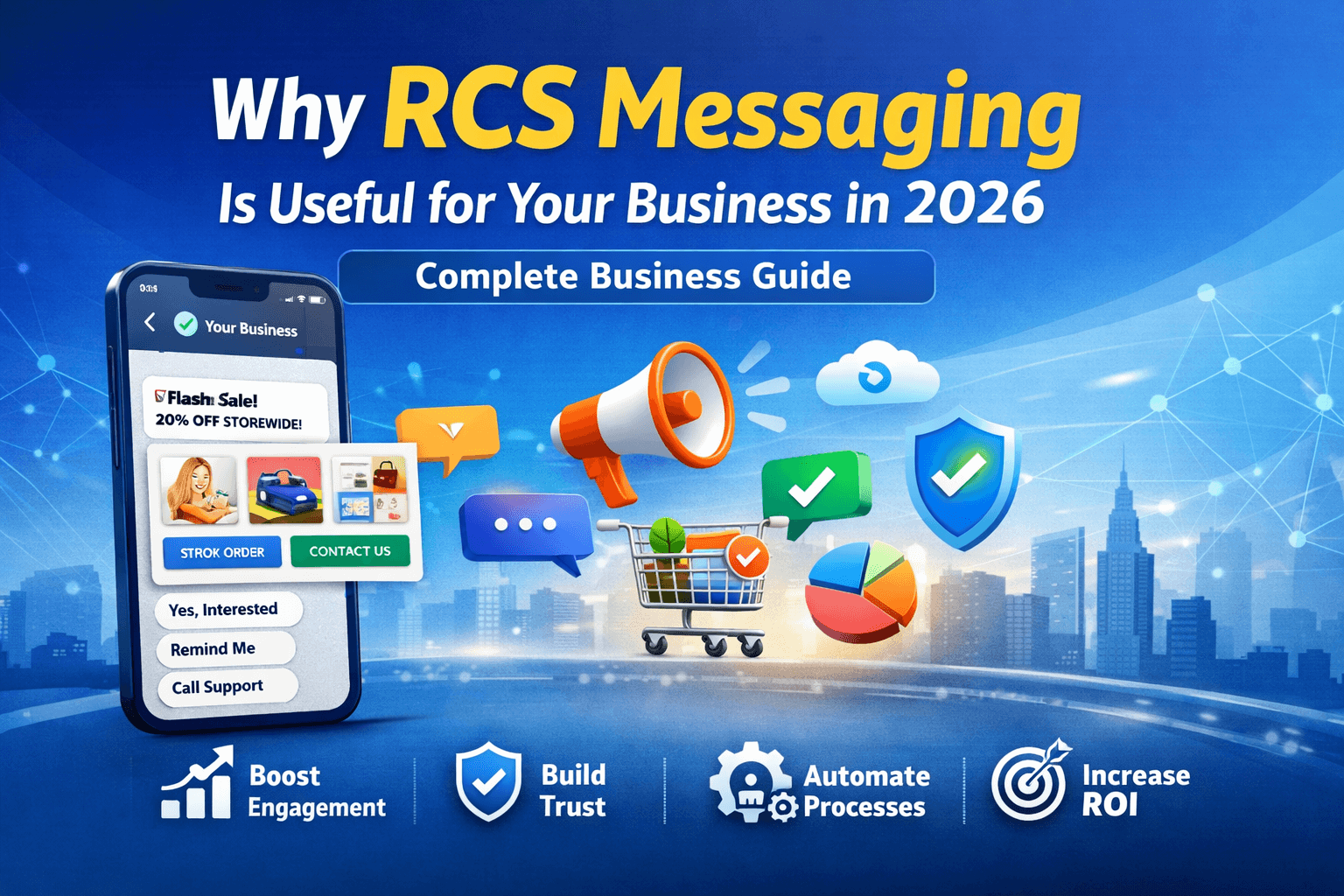
Why RCS Messaging Is Useful for Your Business in 2026 | Complete Business Guide
Discover why RCS messaging is transforming business communication in 2026. Learn how Rich Communication Services improves engagement, branding, automation, marketing ROI, and customer experience.
The Messaging Revolution Is Here
For more than three decades, SMS has been the workhorse of business-to-customer communication. Dependable, universal, and cheap — it powered billions of appointment reminders, delivery alerts, and promotional campaigns. But in 2026, SMS alone is no longer enough.
Customers now live inside rich, interactive digital environments. They browse Instagram stories, swipe through app carousels, and tap single-button actions without a second thought. When a business sends them a plain-text SMS in that context, it feels like receiving a fax. The channel mismatch creates friction — and friction kills conversions.
Rich Communication Services, or RCS, changes everything. It is the native successor to SMS, built directly into the default messaging apps on Android and iOS — no additional download, no sign-up, no barrier. It brings the interactivity of a branded app into the inbox that customers already open dozens of times each day.
This guide is written for business owners, marketing leaders, and customer experience teams who want to understand RCS at a strategic level and begin using it to drive measurable growth. We will cover what RCS is, why it outperforms SMS, how businesses across industries are deploying it right now, and how you can launch your first RCS campaign.85% Average RCS open rate | 3x Higher CTR vs. SMS | 5B+ Users now reachable | 40% Lower cost-per-action |
1. What Is RCS? A Plain-English Explanation
RCS stands for Rich Communication Services. It is a
communication protocol developed by the GSMA (the global mobile industry body)
and championed by Google and, crucially, Apple — who added native RCS support
in iOS in late 2024. It is designed to replace SMS and MMS as the universal
standard for mobile messaging.
Think of it as iMessage or WhatsApp — but for every phone, on
every carrier, without requiring a separate app. When a business sends an RCS
message, the recipient sees it inside their standard messages app, with full
branding, media, and interactivity intact.
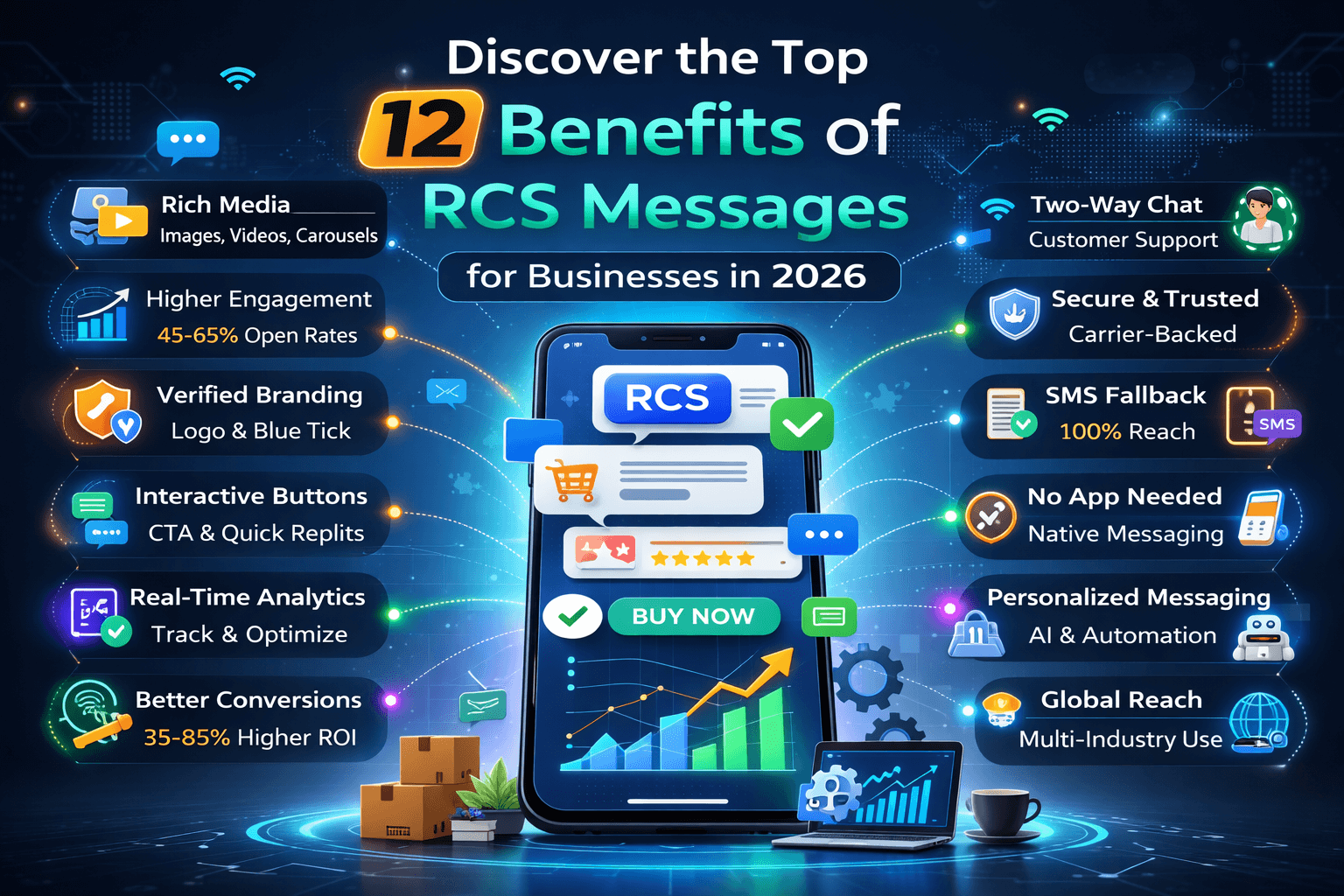
What RCS Can Do That SMS Cannot
•
Send high-resolution images, video clips, GIFs, and audio files
•
Display branded sender profiles with your company logo, name,
and a verified checkmark
•
Include interactive buttons — single CTA, suggested replies, or
full action carousels
•
Show read receipts and live typing indicators
•
Enable in-message payments via Google Pay and Apple Pay
•
Share documents, PDFs, and location pins directly in the thread
•
Provide real-time two-way conversations with AI chatbot support
• Deliver rich analytics: opens, reads, button clicks, conversions
None of this requires your customer to download anything. It works because their phone's operating system — Android or iOS — already supports the RCS standard at a system level. The experience simply appears, seamlessly, in the app they use every day.
The table below illustrates the key differences between traditional SMS and RCS. For any business that currently relies on SMS campaigns, this comparison makes clear exactly what is being left on the table.
|
Feature |
SMS |
RCS |
|
Character
Limit |
160
chars |
Unlimited |
|
Images
& Video |
MMS
only |
HD
media |
|
Interactive
Buttons |
None |
Yes —
carousels, CTAs |
|
Read
Receipts |
No |
Yes |
|
Verified
Sender Badge |
No |
Yes |
|
In-Chat
Payments |
No |
Yes |
|
Rich
Analytics |
Delivery
only |
Full
engagement data |
|
App
Download Required |
No |
No
(native) |
|
iOS
Support |
Yes |
Yes
(since 2024) |
|
Avg.
Open Rate |
~25% |
~85% |
The most striking figure in that comparison is the open rate. SMS messages are opened by roughly one in four recipients. RCS messages are opened by more than four in five. For a business sending tens of thousands of messages, that gap translates directly into revenue.
The difference is not simply that RCS is newer. It is that RCS messages look trustworthy, feel premium, and make action easy. When customers see your verified logo, a clear headline image, and a single tap-to-buy button, the psychological barrier to engagement drops dramatically.
Dramatically Higher Engagement
The data is consistent across markets: RCS outperforms SMS on
every engagement metric. Open rates average 70–90%. Click-through rates on
interactive buttons regularly reach 30–45%, compared to 2–5% for SMS links.
Conversion rates from RCS promotional campaigns are typically two to four times
higher than equivalent SMS campaigns — meaning the same marketing spend
produces measurably better business outcomes.
Verified Identity Builds Customer Trust
Trust is in short supply in mobile messaging. Phishing scams and
SMS spoofing have made consumers wary of unknown numbers. RCS solves this with
a mandatory carrier and platform verification process. Before a business can
send RCS messages, its identity is verified by the network. Customers see your
company name, logo, and a blue verified badge — the same visual shorthand they
associate with authenticity on social media. This verification alone has been
shown to reduce opt-out rates by 20–35% compared to unbranded SMS.
Interactive Experiences Without an App
One of the largest costs in modern digital marketing is driving
customers out of one context into another — clicking a link, loading a browser,
completing a form, then hopefully returning to buy. Every step in that journey
loses people. RCS collapses the journey. A customer can browse a product
carousel, select their size, confirm their address, pay with a saved card, and
receive a confirmation number — all without leaving the messages thread. This
frictionless experience drives dramatically higher completion rates for
transactions, bookings, and form submissions.
Rich Analytics and Attribution
SMS gave marketers almost nothing to work with beyond delivery
receipts. RCS provides a complete picture: which recipients opened the message,
when they read it, which button they tapped, whether they completed the desired
action, and how long after receiving the message they engaged. This data
enables real A/B testing of message formats, precise send-time optimisation,
and accurate ROI attribution that satisfies CFOs and justifies increased
investment in the channel.
Apple + Android = Total Coverage
The single biggest barrier to enterprise RCS adoption prior to
2024 was Apple. With iOS support now live, RCS can reach every modern
smartphone user — across both major operating systems — through a single
campaign workflow. Businesses no longer need to maintain separate flows for
Android RCS and iOS fallbacks. The addressable audience for a single RCS
campaign is effectively the entire mobile-phone-using population in any market
where carriers support the standard.
Cost-Efficiency at Scale
Higher engagement from fewer messages creates an immediate cost advantage. Businesses running RCS in 2025 reported sending 20–30% fewer messages to achieve the same campaign objectives as SMS — because the interactive design captures attention immediately rather than requiring multiple follow-up sends. Add in the reduced load on call centres (customers self-serve via in-message buttons) and the lower cost-per-acquisition from higher conversion rates, and RCS delivers a compelling ROI case even before factoring in the brand premium of a polished, verified messaging experience.
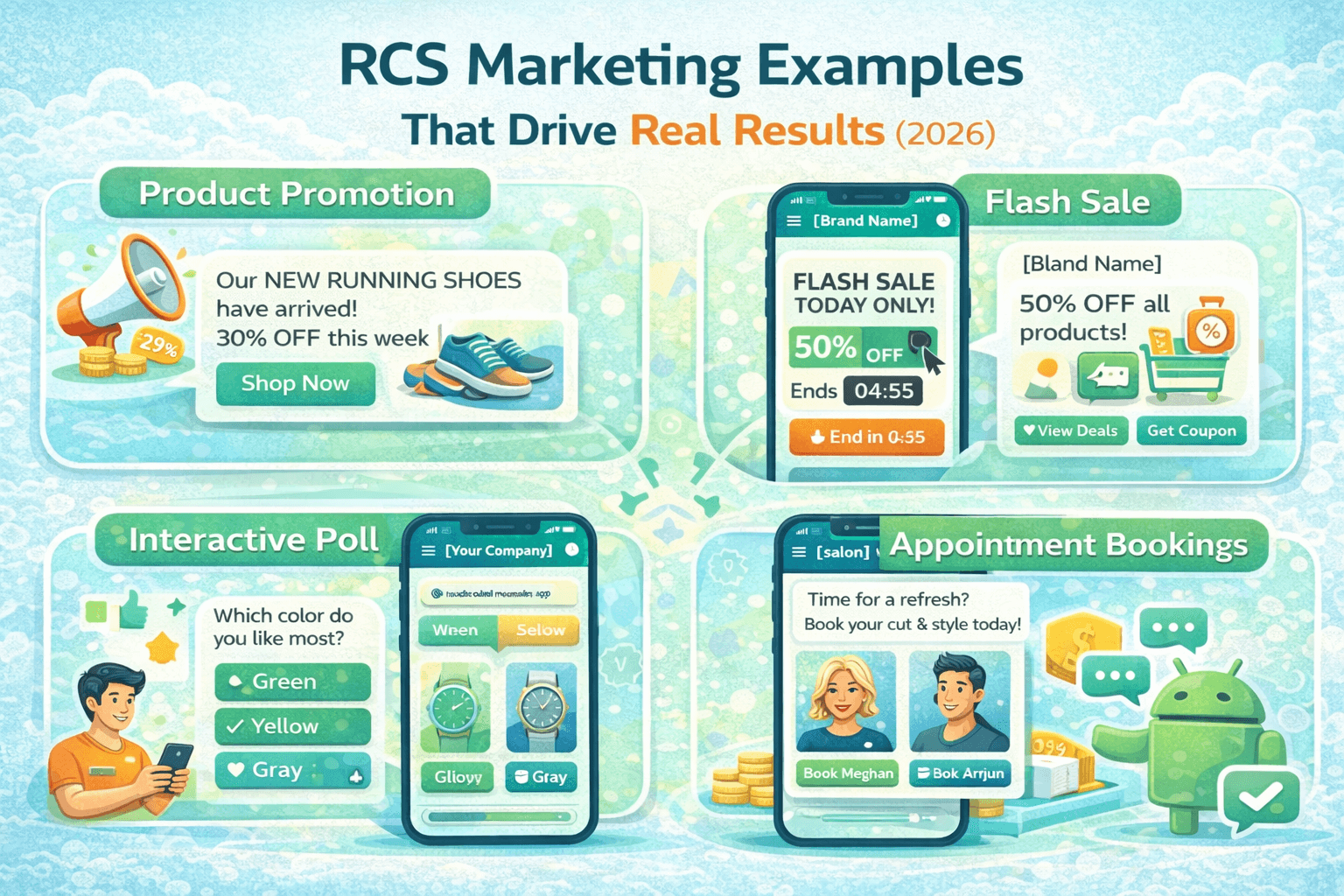
RCS is not a one-size-fits-all tool — it is a platform that adapts to the specific communication needs of any industry. Here is how leading businesses are deploying it right now.
|
🛍️ Retail &
E-Commerce •
Abandoned cart recovery with product image,
price, and one-tap checkout button •
Flash sale alerts with countdown timer and
swipeable product carousel •
Order shipped and delivered notifications
with live tracking map link •
Post-purchase review requests with
star-rating buttons embedded in the message •
Loyalty programme updates with personalised
points balance and reward options |
|
🏦 Financial
Services & Banking •
Fraud alerts with instant Approve / Deny
action buttons — stopping fraud in real time •
Monthly account summaries with visual
spending breakdown and quick-action shortcuts •
Loan and credit offer campaigns with
in-message eligibility check and application start •
Card activation flows completed entirely
within the message thread •
Regulatory notices and statement delivery
with instant digital acknowledgement |
|
🏥 Healthcare •
Appointment reminders with Confirm,
Reschedule, or Cancel buttons — reducing no-shows by up to 40% •
Post-visit follow-up with symptom check and
care instruction videos •
Prescription refill reminders linked
directly to pharmacy portal with one-tap reorder •
Preventive screening campaigns with
eligibility check and instant booking •
Test result delivery with secure
verification and next-step guidance |
|
✈️ Travel &
Hospitality •
Booking confirmations with digital boarding
pass, hotel key, and local weather •
Real-time gate change and delay
notifications with rebooking options •
Upsell campaigns for seat upgrades, room
upgrades, and excursion packages •
Day-of check-in reminders with one-tap
check-in and baggage tracking •
Post-stay review requests with star rating
and image upload support |
|
🔧 Telecoms &
SaaS •
Data usage warnings with instant Add-On
purchase button •
Bill delivery with itemised breakdown and
Pay Now integration •
Plan upgrade offers triggered by usage
behaviour, with in-message switching •
Technical support workflows with guided
troubleshooting and escalation to live agent •
Contract renewal campaigns with
personalised offer and one-tap acceptance |
Getting started with RCS in 2026 is more accessible than ever. The ecosystem has matured significantly — verification is faster, platform support is broader, and most enterprise CPaaS providers offer RCS as a first-class channel. Here is the practical path from zero to live campaign.
Step 1: Choose a CPaaS Provider with RCS Support
CPaaS stands for Communications Platform as a Service — the
middleware that connects your business to carrier networks and device
ecosystems. Look for a provider that offers native RCS Business Messaging (RBM)
integration, automatic SMS fallback for users on carriers or devices not yet
supporting RCS, a template builder for message flows, and an analytics
dashboard with real-time reporting. Major providers with proven RCS
capabilities include Sinch, Infobip, Twilio, MessageBird, and Vonage.
Step 2: Complete Business Verification
Before sending a single RCS message, your business must be
verified through the provider's process, which involves carrier and platform
vetting. You will need to submit your company registration documents, describe
your messaging use cases, provide sample message templates, and confirm your
opt-in consent mechanisms. Verification typically takes 5 to 15 business days
in established markets. This process is what earns your verified badge and
protects the ecosystem — so take it seriously and submit clean, complete
documentation.
Step 3: Design Your Sender Profile and Message Templates
Your RCS sender profile is your brand identity in the channel —
logo, company name, description, website URL, and support contact. Make it
match your broader brand standards. Then build templates for your key use case
categories: transactional messages (order confirmations, appointment
reminders), promotional messages (offers, launches, seasonal campaigns), and
conversational messages (customer service workflows, two-way dialogues). Keep
each template focused on one clear action per message.
Step 4: Connect Your Data and Personalise at Scale
RCS without personalisation is just a prettier SMS. The real ROI
comes from connecting your CRM, CDP, or e-commerce platform to your RCS
provider, enabling dynamic content that adapts to each recipient — their name,
recent purchase, account status, local store, or behaviour trigger.
Personalised RCS campaigns consistently achieve 50 to 200 percent higher
engagement than generic broadcast messages. This integration step is worth the
effort.
Step 5: Build Opt-In Flows and Manage Consent
Opt-in compliance is non-negotiable. RCS marketing messages
require the same explicit consent as SMS under regulations including TCPA (US),
GDPR (EU), TRAI (India), and equivalent frameworks in other jurisdictions.
Build clear opt-in moments into your customer journey — at checkout, during
account setup, or via a dedicated sign-up page. Always provide a clear opt-out
mechanism in every message, and honour opt-outs immediately. Store consent
records with timestamps.
Step 6: Launch a Pilot, Measure, and Scale
Do not start by mailing your entire list. Select a representative segment of 5,000 to 20,000 customers and run your first campaign. Monitor open rates, click rates, conversion rates, and opt-out rates closely. Compare results against your SMS benchmarks. Use the analytics to identify which message formats, CTA placements, and send times perform best. After two to three campaign cycles you will have enough data to optimise confidently — then scale to your full audience.
RCS operates within the same legal framework as SMS. Businesses
must follow applicable consumer protection and data privacy regulations in
every market where they send messages. The core principles are straightforward:
•
Always obtain explicit, verifiable opt-in consent before sending
marketing messages via RCS
•
Include a clear and prominent opt-out option in every
promotional message
•
Honour opt-out requests immediately — do not send any further
messages after a user unsubscribes
•
Maintain timestamped consent records for audit purposes
•
Keep message frequency reasonable — over-messaging is the
fastest way to generate opt-outs
•
Never use RCS for unsolicited cold outreach — this will get your
sender ID banned
• Ensure your CPaaS provider complies with local data residency requirements
The good news is that the RCS verification system itself is a powerful compliance ally. Because businesses must be verified before sending, the ecosystem is far less vulnerable to spoofing and spam than open SMS. A verified sender badge signals trustworthiness not just aesthetically but structurally — customers know that the business messaging them has been vetted.
AI-Powered Conversational Agents
The next wave of RCS deployment pairs the channel's rich
interface with large language model intelligence. In 2026, leading brands are
already deploying AI agents that operate entirely within RCS threads —
answering product questions, processing orders, resolving complaints, and
escalating to human agents only when necessary. The customer never leaves their
messages app, and the brand handles hundreds of simultaneous conversations
without proportional staffing cost.
RCS Commerce: End-to-End In-Message Shopping
Google Pay and Apple Pay integration means the full purchase
journey — browse, select, pay, confirm — can happen within a single RCS thread.
In 2026 this is live for select verticals; by 2027 it is expected to be a
standard feature across most CPaaS platforms. For retail businesses, the
implications are significant: lower abandonment rates, faster checkout, and a
shopping experience that meets customers exactly where they are.
Expanded Global Carrier Coverage
RCS carrier coverage has grown dramatically in recent years, but
some markets — particularly parts of Southeast Asia, Africa, and Latin America
— are still in rollout phases. By 2027, industry analysts project global RCS
coverage exceeding 90% of active smartphone users. Businesses that build RCS
capabilities today will be perfectly positioned as those markets open up.
Cross-Channel Orchestration
The most sophisticated marketing platforms are treating RCS as a first-class channel in automated customer journeys alongside email, push notifications, WhatsApp, and paid media. Expect AI-driven orchestration that automatically routes each message to the optimal channel for each individual user — based on device capability, past engagement behaviour, time of day, and message type — with RCS as the preferred default for high-value interactions.
Conclusion: RCS Is Not the Future — It Is
Now
In 2026, RCS has completed its transition from emerging
technology to essential business infrastructure. Universal device support,
carrier verification, AI integration, and a proven track record of
outperforming SMS on every meaningful metric have made the case conclusively.
The question facing businesses today is not whether to adopt RCS. It is how quickly to move, and how boldly to invest, before the competitive advantage narrows. The brands that adopted email marketing early, or social media early, or personalised push notifications early — they captured the first-mover premium. RCS represents that same kind of moment, right now.
Start with a verified sender profile and one carefully designed
use case. Measure the results with rigour. Let the data build the business case
for expansion. The infrastructure investment is modest. The upside — in
engagement, conversion, customer satisfaction, and reduced operational cost —
is substantial.